Should an Adult Child Keep Mom’s California Home?
In California, inheriting a parent’s home can be a huge financial blessing — but only if the numbers work. The biggest issues are usually:
property taxes, mortgage balance, income, maintenance, and whether the child will actually live in the home.
This page uses a common San Pedro example: a parent bought a home decades ago at a much lower price, the home may now be worth several times more, and the adult child may have limited income. In that situation, keeping the home can sometimes be far cheaper than selling and trying to buy something smaller.
| Quick Answer | Run the Numbers | Prop 19 Warning | Questions to Ask |
Quick Answer
If the inherited home is paid off or has only a small loan, and the child can live there as their primary residence, keeping the home may be dramatically cheaper than selling and buying a condo or small replacement home in today’s market.
But if there is a large mortgage, home equity loan, reverse mortgage, or the child cannot live in the home, the decision changes quickly.
The Prop 13 / Prop 19 Issue
Many families assume the child automatically gets the parent’s low property tax basis. That is no longer always true. Under California Proposition 19, the parent-child exclusion is generally limited to a family home that was the parent’s principal residence and becomes the child’s principal residence. The child usually must move in within one year and file for the homeowners’ exemption.
Practical meaning: if the child keeps the home but does not live there, the property tax may be reassessed based on current market value.
Simple Keep-or-Sell Calculator
Use this simple worksheet to compare the real monthly cost of keeping the family home versus selling and buying something else.
Scenario A: Keep the inherited home
- Property tax: $________ / month
- Mortgage, HELOC, or reverse mortgage payoff: $________ / month
- Insurance: $________ / month
- Maintenance reserve: $________ / month
- Utilities: $________ / month
Total monthly cost to keep home: $________
Scenario B: Sell and buy something smaller
- New mortgage payment: $________ / month
- New property tax: $________ / month
- HOA dues, if condo: $________ / month
- Insurance: $________ / month
- Maintenance reserve: $________ / month
Total monthly cost to buy replacement home: $________
Example: Why Keeping the Home Can Be Powerful
A paid-off inherited home might cost roughly $1,000 to $1,500 per month after property tax, insurance, utilities, and maintenance. A modest replacement condo or small home could easily cost several thousand dollars per month once mortgage, property tax, HOA dues, and insurance are included.
For someone with income around $30,000 per year, that difference can be the difference between stability and being priced out.
What If the Child Rents Out One Room?
Renting out one room may be very different from renting out the entire house. The key question is whether the inherited home remains the child’s true primary residence. If the child lives there and rents a room, the Prop 19 issue may be less dangerous than if the child lives elsewhere and treats the property as a rental.
Because this is a property-tax rule, do not rely on guesses. Confirm with the county assessor or a qualified California estate/property-tax attorney before making a final decision.
Questions to Ask Before Deciding
- Is there a mortgage, HELOC, reverse mortgage, or lien?
- What is the current property tax bill?
- Will the child actually live there as their primary residence?
- Can the child afford repairs, insurance, utilities, and maintenance?
- Are there siblings or other heirs who must be bought out?
- Would selling create enough cash to safely replace the housing?
- Would renting one room make the home affordable?
Bottom Line
If the home is paid off or nearly paid off, and the child can live there, keeping the inherited home may be the best financial move. Selling can create cash, but it may also force the child into today’s expensive housing market, where the monthly cost of a “smaller” home may be much higher than simply staying put.
| Email Steve | Ask a Question | More Consumer Guides |
This is general educational information, not legal, tax, real estate, or financial advice. Prop 19, estate planning, reverse mortgages, Medi-Cal recovery, and capital gains issues should be reviewed with the appropriate licensed professional.
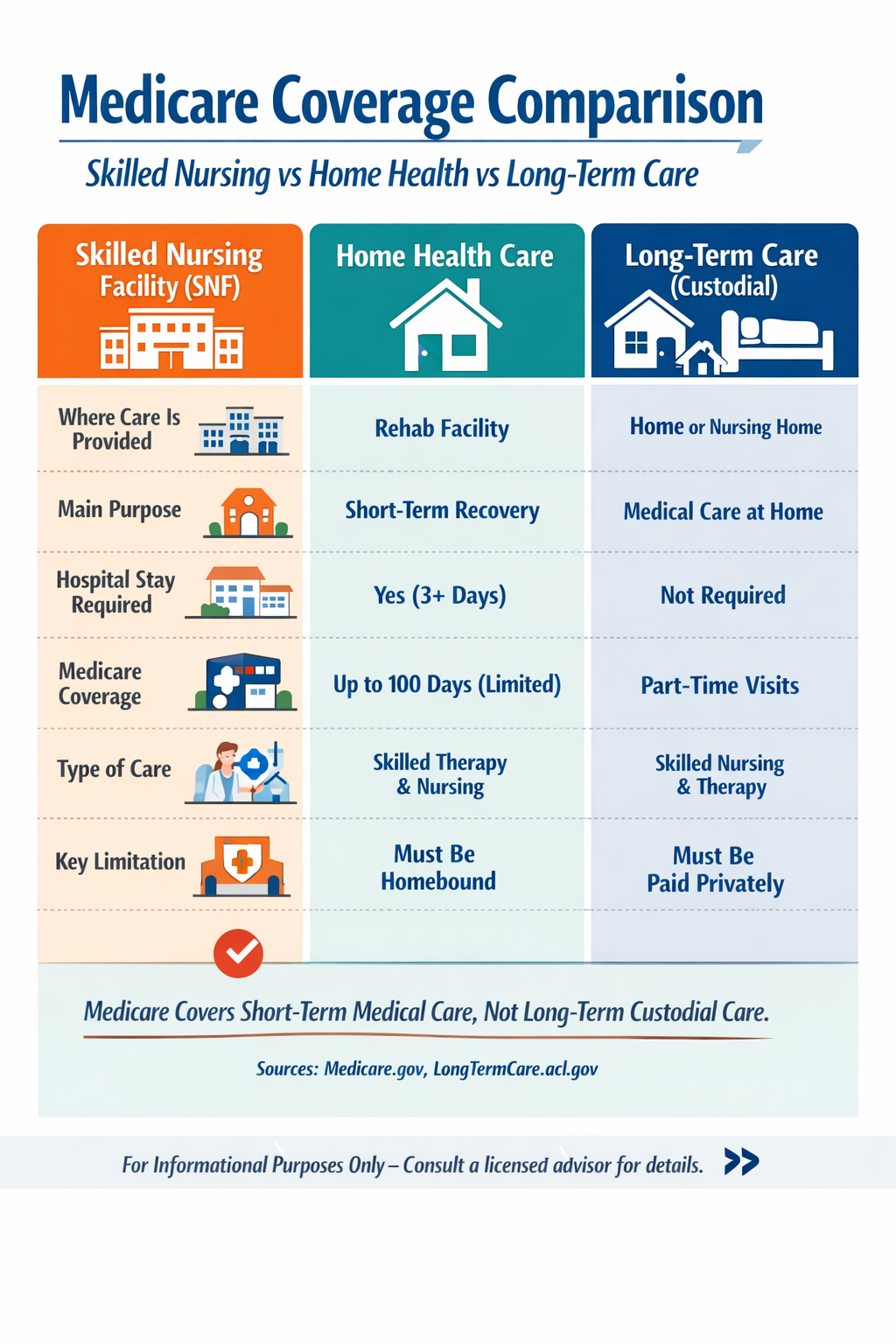
Medicare Coverage Comparison: Skilled Nursing vs Home Health vs Long-Term Care
| Type of Care | Skilled Nursing Facility (SNF) | Home Health Care | Long-Term Care (Custodial) |
|---|---|---|---|
| Where Care is Provided | Nursing facility / rehab center | Your home | Home, assisted living, or nursing home |
| Main Purpose | Short-term recovery after hospital stay | Medical care at home (nurse or therapy) | Help with daily living over time |
| Requires Hospital Stay? | Yes (typically 3+ inpatient days) | No (in many cases) | No |
| Type of Care | Skilled (therapy, IV meds, wound care) | Skilled (nurse visits, therapy) | Custodial (bathing, dressing, eating) |
| Medicare Coverage | Days 1–20: 100% Days 21–100: Copay After 100: Not covered |
Usually covered if medically necessary and homebound | Not covered by Medicare |
| Length of Coverage | Up to 100 days per benefit period | Intermittent / part-time visits | Ongoing / long-term |
| Key Limitation | Stops when skilled care is no longer needed | Must meet “homebound” and medical criteria | Must be paid out-of-pocket or insured |
| Common Misunderstanding | People think it covers long-term stays | People think it includes full-time caregivers | People think Medicare will pay — it won’t |
Bottom line: Medicare is designed for short-term medical care, not long-term living assistance.
Not sure which type of care applies to your situation?
✔ Get help understanding Medicare coverage
✔ Review long-term care planning options
✔ Compare Medicare Supplement plans