Lanterman-Petris-Short (#LPS)
Conservatorships
LPS conservatorships are used to care for adults with serious mental health illnesses who need special care.
These conservatorships are used for people who usually need very restrictive living arrangements (like living in locked facilities) and require extensive mental health treatment (like very powerful drugs to control behavior). Welfare & Institutions Code 5000-et seq
Conservatees in LPS conservatorships cannot or will not agree to the special living arrangements or treatment on their own. LPS conservatorships must be started by a local government agency. courts.ca.gov
The Act in effect ended all hospital commitments by the judiciary system, except in the case of criminal sentencing, e.g., convicted sexual offenders, and those who were “gravely disabled“, defined as unable to obtain food, clothing, or housing CA Jury Instruction 2002 * psycheteria.org * [Conservatorship of Susan T.]. It did not, however, impede the right of voluntary commitments. It expanded the evaluative power of psychiatrists and created provisions and criteria for holds. Wiki Pedia
#Gravely Disabled
What exactly is it?
Definition? Criteria?
The statutory definition of commitment for grave disability is:
- “a condition in which a person, as a result of a mental disorder, is unable to provide for his basic personal needs, for food, clothing, or shelter.’ CAL. WELl. & INST. CODE § 5008(h) 5250
- “a finding of imminent danger as evidenced by a recent overt act, attempt or threat,” CA Civil Jury Instructions 4002 * Capacity Declaration GC 335 * Grave Disability Includes Financial & Health Issues
Be sure to check out our main page on Conservatorship for an introduction
Grave disability
The LPS Lanterman Petris Short act, defines grave disability is defined with three seemingly simple reasons – criteria:
- Inability to provide for
- Cannot distinguish between food and non food
- Endangers health by gross negligence in needed diet and nutrition
- Begging or stealing food
- Eating out of refuse or garbage cans
- Ordering meals at restaurants without having funds
- Demonstrates excessive and consistent food preferences or aversions which endanger health (except for genuine religious reasons)
- Having spoiled food in refrigerator or no food for a lengthy period of time in the house
- Engaging in public nudity or “unthinking” exhibitionism
- Engaging in bizarre style of dressing that does would be apt to lead to social difficulties (if not used by social group or personal preferences)
- Wearing filthy or soiled clothes with lack of recognition of personal hygiene problem
- Wearing disheveled clothes for prolonged period of time
- Leading a nomadic existence with an inability to establish stable community living, including living in the streets or other public places
- Unable to locate housing and make the appropriate arrangements with an inability to ask for or accept assistance in doing so
- Unable to manage his or her household in such a way as to avoid clear dangers to health
- Presence in household of filthy conditions) fire hazards that the person cannot correct, vermin infestations, and lack of bathing and toilet facilities
- Resists leaving residence even if evicted or the residence is sold
- Hoarding nonsensical items while misplacing necessary items
Financial incompetence
- Unable to earn an income and unable to avail himself of financial assistance from public or private agencies
- Completely dependent on family or friends to provide financial assistance for basic personal needs
- Has funds but no longer knows or understands the location and/or extent of them
- Refusing to expend funds to the extent of endangering personal health and/or safety
- Has no funds and does not see this as a problem
- Grossly and inappropriately expends funds needed for basic personal needs
- Has untrue beliefs as to having extensive money or property
- Mismanages funds so that rent and utility bills remain unpaid
- Unable to accept inability or loss of ability to understand complex financial matters leaving him vulnerable to manipulation by unscrupulous individuals
Incompetence in regard to health
- Unable or unwilling to follow medical instruction regarding treatment and self care which are essential to health
- Loss of weight or other evidence of malnutrition due to not eating or lack of proper food
- Wanders away from residence and becomes lost frequently without recognition of the seriousness of the problem
- Failure to adjust in the community
- Involved in frequent confrontations with family members or neighbors involving abusive, threatening, or assaultive behavior
- Engages frequently in disruptive, destructive acts in the home or neighborhood, possibly leading to threatened or actual eviction
- Engages in bizarre or other behavior which may be self-endangering and/or a threat to others requiring police intervention Jewish Family Service Summary
Though these criteria may seem simple, they aren’t. For example, just because someone is mentally ill and homeless does not mean that they are gravely disabled. If they can provide a reasonable, executable plan for where they would stay or if they are stable being homeless, then they do not meet LPS criteria. If, on the other hand, they are homeless in a location in which their life or health is often in jeopardy and, as a result of mental illness, they do not comprehend this, then they likely are gravely disabled.
These issues achieve marked salience in hearings for 5250‘s in which the argument is made that someone is gravely disabled. It is often helpful to identify which underlying issues lead you to the conclusion rather than requiring the hearing officer to identify the issues. If someone is gravely disabled for an extended period of time, they can be placed on an LPS conservatorship. Note, however, that there are So, below are examples of states or conditions that have been upheld as evidence of grave disability. Note that they extend beyond a simplistic definition relating to food, clothing, and shelter. That is, there are a variety of ways one can demonstrate incompetence in these areas.
***********
the Court, in Addington v. Texas, held that the need for civil commitment must be provided by clear and convincing evidence. In the Lanterman-Petris-Short Act (LPS), the legislature opted to reduce long-term confinement of the mentally ill. “habeas corpus” meaning literally “that you have the body”)[1] is a recourse in law through which a person can report an unlawful detention or imprisonment to a court and request that the court order the custodian of the person, usually a prison official, to bring the prisoner to court, to determine whether the detention is lawful.[2]
Conservatorship of Roulet – Proof beyond a reasonable doubt
Parham (Test) v J.R. 442 US 584 1979 Gravely Disabled vs dangerous to self and others? The court in Doe I held that the grave disability term was sufficiently precise. The court found that grave disability implicitly required a finding of harm to oneself, i.e. an inability to provide for one’s basic physical needs, and therefore met the constitutional requirement of dangerousness. The right to choose and practice a particular life style is protected by the first amendment rights of association, assembly, and free expression Law.SCU.Edu Written 1.1982 *
Case Law
if nothing else, the background information is an interesting story.
- Kanuri Surgury QAWI, on Habeas Corpus Conservatorship of Carol K. Conservatorship of the Person and Estate of JESSE G HTML
- Conservatorship of Chambers
- Conservatorship of Davis (1981)
- Conservatorship of Smith (1986)
- Conservatorship of K.W.
Conservatorship Handbook
- VIDEOS
- Ventura Superior Court presents: With Heart: Understanding Conservatorship
- NAMI Zoom Meeting 1.23.2021 learn the law & process
- Resources & Links
- Reporters at inewsource are working on stories about what it’s like to manage serious mental illness in San Diego and Imperial counties. We’re going to examine mental health conservatorships, mental health courts and psychiatric holds known as 5150s and tell stories about when these processes have helped or hurt people. inews 7/2022
Consumer Guide to LPS #Lanterman Act
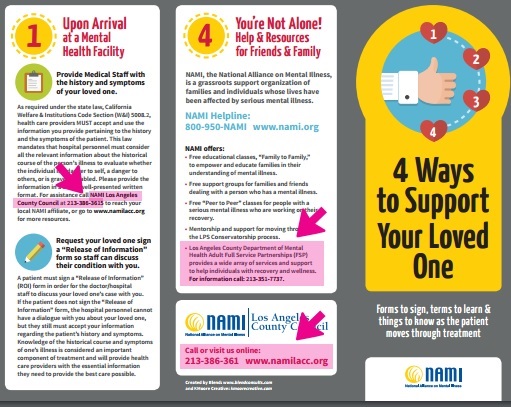
- Four Ways to support your loved one - 2 pages from NAMI
- Judges Bench Guide to LPS Proceedings
#Rights for Individuals in Mental Health Facilities
- Mental Health [email protected]
- disability rights ca.org
- Handbook to Challenge Mental Health Conservatorships -
- H E L P I N G Y O U R L O V E D O N E a family guide to conservatorship and involuntary treatment
#Power of Attorney
Bibliography, Resources & Links
- jaci law.com/power-attorney-vs-conservatorship
- Get Standard - Statutory Forms