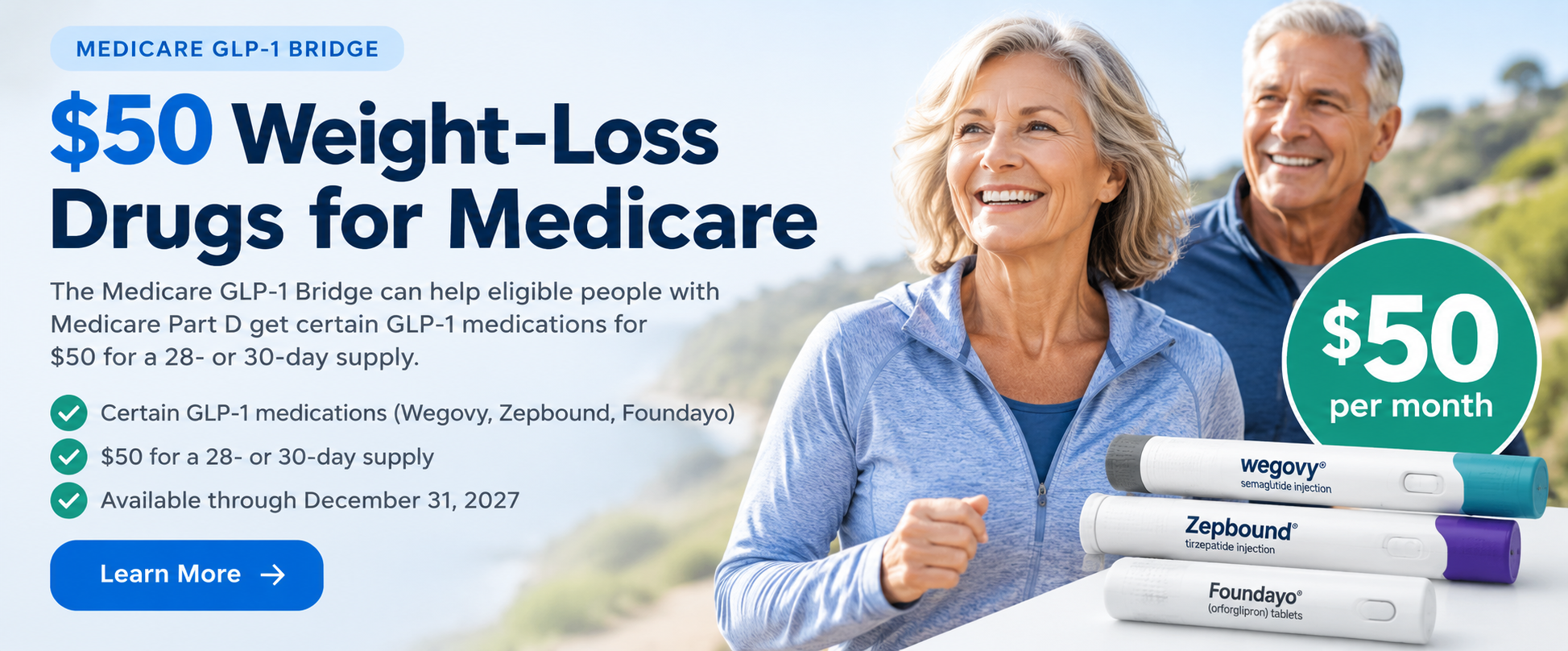
Medicare GLP-1 Bridge — $50 Weight-Loss Drugs
- Beginning July 1, 2026, Medicare started the Medicare GLP-1 Bridge program.
- Eligible Medicare beneficiaries can obtain certain GLP-1 weight-loss medications for $50 for a 28- or 30-day supply.
- The program is currently scheduled to continue through December 31, 2027.
- The GLP-1 Bridge operates outside your regular Medicare Part D prescription drug plan.
- Your Medicare Advantage or Part D insurance company does not have to opt into the Bridge.
- References
Who Can Qualify for the $50 GLP-1 Bridge?
- You must have qualifying Medicare Part D prescription drug coverage.
- You must generally be 18 or older.
- The medication must be prescribed for weight reduction or maintaining weight reduction.
- You must meet Medicare’s BMI and medical eligibility requirements.
- You generally cannot already be receiving the GLP-1 through your regular Medicare Part D benefit.
- The Bridge is not simply a discount program for anyone with an expensive Medicare drug copay.
My Medicare Plan Wants $300 or $400 — Can I Use the $50 Bridge Instead?
- Possibly — but a high copay alone does not determine Bridge eligibility.
- The important question is why the GLP-1 is being prescribed.
- If the medication is being prescribed solely for weight management, the patient may qualify for the Bridge if the other requirements are met.
- If Medicare Part D covers the GLP-1 for the patient’s medical diagnosis, the prescription may instead need to go through the patient’s regular Part D plan.
Examples of conditions that may already be covered under Medicare Part D include:
- Type 2 diabetes.
- Moderate-to-severe obstructive sleep apnea.
- Certain cases of metabolic dysfunction-associated steatohepatitis, commonly called MASH.
- Other FDA-approved indications that Medicare Part D is permitted to cover.
CMS Information for Medicare Part D Plans
What Are the Medical Requirements?
BMI of 35 or Higher
- A qualifying additional medical condition generally is not required under this category.
- nhlbi.nih.gov/calculate-your-bmi
BMI of 30 or Higher
- The patient must also have at least one qualifying condition, such as:
- Heart failure with preserved ejection fraction.
- Uncontrolled hypertension despite treatment with two blood-pressure medications.
- Chronic kidney disease, stage 3a or higher.
BMI of 27 or Higher
- The patient must also have at least one qualifying condition, such as:
- Prediabetes.
- Previous heart attack.
- Previous stroke.
- Symptomatic peripheral artery disease.
- The prescribing doctor completes the required medical certification and prior authorization.
CMS GLP-1 Bridge Information for Prescribers
Which GLP-1 Medications Does the Bridge Cover?
- Wegovy® injection and tablets.
- Zepbound® KwikPen®.
- Foundayo® tablets.
- CMS says the Zepbound single-dose pens and vials are not covered under the Bridge.
- Covered medications and program rules may change, so current CMS information should always be checked.
How Should the Doctor Write the Prescription?
- The doctor sends the prescription to the pharmacy through the normal prescription process.
- CMS recommends including an appropriate E66-family obesity diagnosis code.
- CMS also recommends putting the following notation in the electronic prescription’s note field:
SEND TO BRIDGE FOR WEIGHT MANAGEMENT
- This notation helps the pharmacy identify that the prescription should be submitted to the Medicare GLP-1 Bridge.
- An eligible patient does not necessarily have to obtain a denial from the Part D plan first.
Information Your Pharmacist May Need
- BIN: 028918
- PCN: MEDDGLP1BR
- The pharmacy also needs the beneficiary’s Medicare Beneficiary Identifier from the Medicare card.
- CMS says pharmacies do not have to separately opt into the Bridge program.
CMS Information for Pharmacies
What Happens After the Pharmacy Submits the Prescription?
- The Bridge first checks basic Medicare eligibility.
- If the patient appears eligible, a prior authorization is required.
- The doctor’s office generally receives the prior-authorization request electronically or by fax.
- The doctor submits the requested medical information.
- The patient and doctor are then notified whether the Bridge request was approved.
- If the doctor believes a denial was made in error, the request may be resubmitted for review.
- A new prior authorization generally is not required for every refill unless the patient changes to another covered GLP-1 medication.
- The Bridge covers only 28- or 30-day supplies.
Does Medicare Extra Help Reduce the $50 Bridge Copay?
- No.
- Medicare Extra Help — also called the Low-Income Subsidy or LIS — can dramatically reduce regular Medicare Part D prescription costs.
- The GLP-1 Bridge, however, operates outside the normal Medicare Part D benefit.
- Therefore, Extra Help generally does not reduce the $50 Bridge price.
- Extra Help may still substantially reduce the beneficiary’s costs for other Part D prescriptions.
Learn More About Medicare Extra Help / LIS →
Does the $50 Count Toward the Part D Out-of-Pocket Maximum?
- No.
- The Bridge operates outside Medicare Part D.
- The normal Part D deductible does not apply to a Bridge prescription.
- The $50 Bridge payment does not count toward the beneficiary’s Part D true out-of-pocket spending, commonly called TrOOP.
- Bridge spending does not move the beneficiary closer to Medicare Part D catastrophic coverage.
- Your Guide to Medicare Drug Coverage 11109
Can I Use the Medicare Prescription Payment Plan?
- No — not for the $50 Bridge prescription.
- The Medicare Prescription Payment Plan can spread certain regular Medicare Part D prescription costs over the year.
- It does not apply to prescriptions purchased through the GLP-1 Bridge.
- It can still be useful if you have other expensive medications covered under your normal Medicare Part D plan.
Learn About the Medicare Prescription Payment Plan →
Can I Use a Manufacturer Coupon With the Bridge?
- Generally, no.
- Coupons and outside discount programs cannot normally be combined with a Medicare GLP-1 Bridge claim.
- The beneficiary remains responsible for the Bridge’s $50 cost.
What If My Medicare Part D Plan Covers the Drug but It Costs Too Much?
- Check whether the prescription was processed under the correct formulary tier.
- Check whether prior authorization is required.
- Check whether step therapy applies.
- Ask whether a formulary exception may be available.
- Ask whether a tiering exception may be available.
- Ask the doctor whether another covered GLP-1 medication would be medically appropriate.
- Review whether another Medicare drug plan would cover the patient’s medications more favorably.
- Check whether the beneficiary qualifies for Medicare Extra Help.
Medicare Part D Shop & Compare Tools →
Be Careful Before Running the Prescription Through Part D
- Receiving a GLP-1 through the regular Medicare Part D plan may affect future Bridge eligibility.
- If a patient believes the prescription should qualify for the Bridge, it is worth discussing the issue with the doctor and pharmacist before the prescription is processed through Part D.
- Ask the pharmacy whether the prescription should be submitted directly to the Medicare GLP-1 Bridge.
Questions About Medicare GLP-1 Coverage?
- GLP-1 coverage can involve several different Medicare rules.
- Your diagnosis may determine whether the medication goes through regular Part D or through the GLP-1 Bridge.
- Your Medicare Advantage or Part D formulary may have its own prior-authorization and step-therapy requirements.
- Extra Help, Medi-Cal and other assistance programs may also affect your overall prescription costs.
- We can help review the Medicare coverage issues and explain your options.