
Drug Court Rehab Diversion California
shouselaw.com//drug-court-california
California drug court is an outpatient substance abuse program that allows defendants facing nonviolent drug charges to avoid jail and a criminal conviction. Treatment typically lasts nine months to three years, and meanwhile you can keep your job and go on with your life.
As long as you complete rehab, your charge gets dismissed, your record is cleared, and you can legally deny ever having had the drug charge.
 Shouse Law Group +2
- Purpose: Focuses on treating the addiction to prevent future crimes (recovery-oriented).
- Process: Often part of a plea agreement or drug court program where the sentence is suspended while the individual completes treatment.
- Eligibility: Typically available to non-violent, first or second-time offenders.
- Benefits: Potential to avoid a prison sentence, avoid a criminal conviction (if using a pre-trial diversion program), and receive treatment.
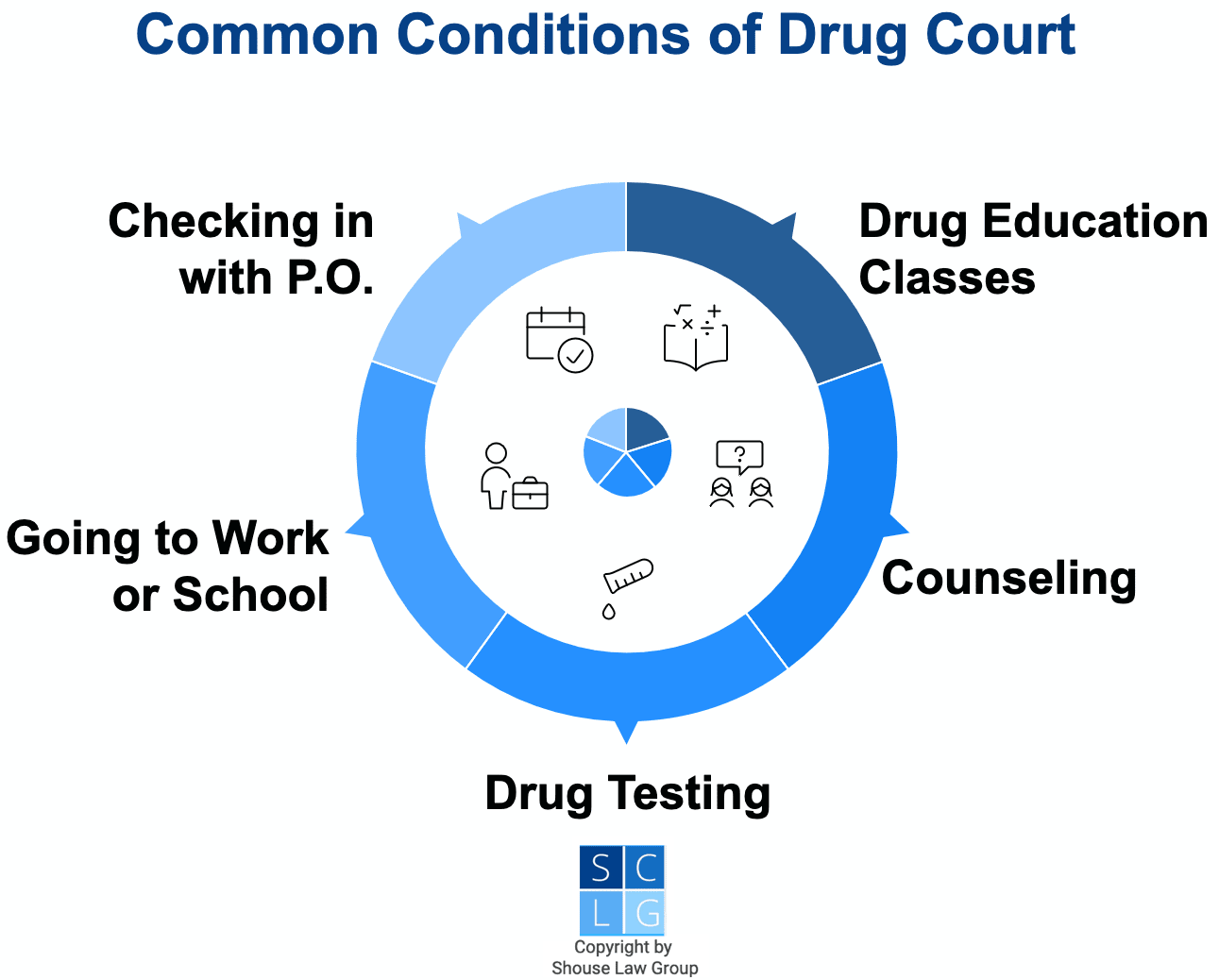
- Requirements: Strict monitoring by probation officers, regular drug tests, and progress reports to the court.
- Risk: If the participant fails to comply with the rules or quits (e.g., gets kicked out), they may be sent back to court to serve the original jail time.
Shouse Law Group +7
- Purpose: Focuses on punishment, retribution, and deterrence.
- Process: Incarceration in a county jail or state prison facility.
- Effectiveness: Studies suggest prisons are not designed to treat addiction, and incarceration alone is less effective in reducing reoffending compared to treatment.
- Impact: Offers limited access to addiction treatment services.
 Narconon +4
- Reoffending (Recidivism): Rehabilitation is often more successful than prison at reducing the rate of reoffending and helping individuals reintegrate into society.
- Cost: Drug treatment programs generally cost less than long-term incarceration.
- Time Credit: Generally, time spent in voluntary or private rehab does not count towards jail or prison time served. However, in some, but not all, cases of court-ordered, residential treatment, a judge might allow credit.
Shouse Law Group +5
 Neal Davis Law Firm +1

-
California Diversion Program – Avoid Jail & Get a Dismissal
California’s pretrial diversion allows you to avoid both jail time and a criminal record by undergoing treatment and education. If…
 Shouse Law Group
 -
California Proposition 36: How it Works – Shouse Law Group
California Proposition 36: How it Works. … Proposition 36…more commonly referred to as “Prop 36″…is a criminal sentencing initia…
 Shouse Law Group
 -
California Drug Courts – How it Works – Shouse Law Group
it frees up space in jails and prisons, rehabilitation costs the state less than incarceration, and. research indicates that drug …
 Shouse Law Group

 American Addiction Centers +3
- Referral Rates: While 25% of all admissions are court-referred, some specific, intensive programs (like drug courts) may have higher percentages of mandated participants.
- Prison Population Need: Roughly 65% of inmates have a substance use disorder, and another 20% were under the influence during their offense.
- Effectiveness: Court-mandated rehab can be highly effective; for instance, 56% of individuals in court-ordered drug treatment graduate, proving it is a viable alternative to prison.
Addiction Center +3
- Program Eligibility: Drug courts and diversion programs often prioritize non-violent offenders.
- Case-by-Case Basis: Participation is often decided on a case-by-case basis. While many programs aim to reduce recidivism in non-violent cases, some court-ordered treatment protocols can include individuals with violent histories, provided they meet specific criteria set by the judge or probation officer.
- Violations: Violating court-ordered rehab, regardless of the offender’s history, typically leads to immediate incarceration.
American Addiction Centers +4
- Drug Court Success: Individuals who complete court-ordered rehab have shown significantly higher success rates in reducing drug use compared to those who do not (56% success vs. 24% without).
- Cost Efficiency: Replacing incarceration with drug treatment for eligible offenders saves the judicial system significant costs.
American Addiction Centers +1

-
Court-Ordered Rehab – Addiction Center
Effectiveness. According to the National Institute on Drug Abuse, court-ordered rehab is effective in reducing substance misuse. T…
Addiction Center -
Court-Ordered Rehab for Addiction Treatment
Today, there are more than 3,500 drug courts in the United States, and these courts are designed to improve outcomes for offenders…
 American Addiction Centers
 -
Court-Ordered Rehab and the Consequences for Violations
Violations to court-ordered rehabilitation treatment can lead to serious consequences. The courts may determine that the person re…
 Sudduth & Associates, LLC


What Is Facebook Addiction?
A Facebook addiction is a behavioral addiction where someone compulsively engages in online interactions to the point where it interferes with their functioning at home, work, and school. The signs of Facebook addiction include:
- Obsessive thoughts about Facebook
- Use of Facebook to relieve unpleasant emotions in real life
- Inability to stop or curb Facebook use after several attempts
- Experiencing distress or withdrawal from not being able to use Facebook
- Impact on work, school, or relationships due to problematic use of Facebook
Facebook addiction is often included under the umbrella term of social media addiction, but it is important to note that different social media platforms come with their own unique symptoms and risks. When Facebook use becomes a replacement for face-to-face connection, becomes compulsive, or starts causing health issues like sleep disturbances, it may be time to evaluate if there is a social media addiction present.
What Makes Facebook Addictive?
Facebook is addictive due to its algorithms, which are a set of tech rules that decide which posts appear in a person’s feed.
In the early days, the posts with the most likes got the most attention. Over the years, advancements allowed Facebook to personalize every user’s feed based on their preferences, which they learn about by tracking internet activity.
They pay attention to the posts, videos, and advertisements each person likes, shares, or interacts with in any way. Even the amount of time someone spends looking at a photo or post is tracked. This allows Facebook to predict what someone is more likely to engage with and mark that content as more relevant for that user. Using the data they collect, the system predicts what someone wants to see and posts it to their feed. This curated content ends up making a person spend more time on the platform.
While it’s important to have an algorithm that displays relevant content, there is no regard for positive or negative feelings that someone may experience when looking at the posts. For example, using Facebook to obsessively check up on an ex romantic partner, read upsetting news articles, or constantly compare oneself to others can result in feelings of jealousy, fear, anger, and unworthiness.
As of 2024, 42 states are suing Facebook and Instagram, both owned by Meta. The lawsuits claim Facebook deliberately designed programs to hook youth and teens, deceiving the public about the harms of their platform. In a national survey on social media use among youth, researchers found the following:
- 3 out of 4 teens feel tech companies like Facebook manipulate them to spend more time online.
- 1 out of 7 teens spend more than 7 hours daily on social media.
- 1 out of 3 teens stay on social media until midnight or later.
What Causes Facebook Addiction?
Being on Facebook and other social media platforms changes how the brain functions, especially in youth and young adults whose brains are still developing. Facebook use can:
- Hijack the attention of users.
- Interfere with normal cognition.
- Decrease verbal intelligence.
- Slow maturing of gray and white matter in the brain.
Facebook also impacts behavior. For example, some students show a decline in in-person relationships and socialization, preferring to have Facebook connections instead.
Mental health and personality traits influence addiction to Facebook. Studies show females and people not in relationships tend to have more addictions to Facebook. Also, people with mental health diagnoses had higher levels of social media addiction, including those with:
Being on Facebook can trigger a release of dopamine, the feel-good chemical, giving the user a sense of pleasure and reward. The brain connects that feeling with social media and encourages the person to continue using it, seeking more pleasure, which usually happens when a person gets likes and follows.
When a person doesn’t get likes or followers, there is no dopamine release, and it can leave them feeling depressed. Instead of discontinuing their use of Facebook, they use it even more to chase the “high.” The same is true for other addictions such as gambling addiction, drug addiction, alcohol addiction, and other behavioral addictions.
Risk Factors Of Facebook Addiction
Demographics and personal traits can be risk factors for social media and Facebook addiction.
Gender
Females had higher levels of social media addiction when compared to males, possibly due to their desire to enhance communication through social activities. They took more selfies to share online than male social media users.
Impulsivity
Participants who met the criteria for having higher levels of impulsiveness were more likely to develop social media addiction. Impulsiveness to use social media may be due to a need to suppress or exacerbate other feelings, such as boredom or fluctuating attention.
Self-Esteem
People with low self-esteem use Facebook to boost their self-image. Self-esteem was a risk factor when people started seeking positive feedback online. Once they receive it, self-esteem becomes a protective factor.
Emotions
Anxiety and social anxiety are the emotions with the highest risk factor levels. Online social interactions cause much lower levels of stress for people that have trouble engaging in in-person social activity.
Attention To Negative Information
Those with social media addiction tend to display negative attention bias, an effect in which people who struggle with negative emotions seek negative information. The attention of someone experiencing depression, anxiety, or other mental health symptoms is caught easier by negative information.