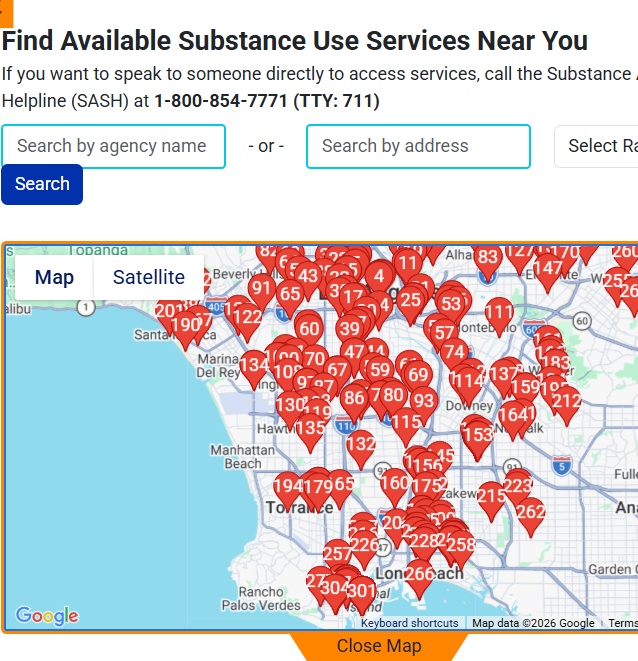
Regulation of SUD’s Substance Use Disorder and Ranking of Los Angeles Providers
In San Pedro (part of Area 8), data indicates a significant treatment gap rather than an over-concentration of facilities. While San Pedro has a visible concentration of services, these facilities are currently serving a high regional demand and do not fully meet the estimated need for the local population. [1]
## Number of People Needing Treatment in Area 8
While neighborhood-specific “need” numbers for San Pedro alone are not publicly isolated, data for the South Bay/Harbor region (Area 8) provides a clear picture of the scale:
* Total Need: Approximately 12,870 people in Area 8 are estimated to have an Opioid Use Disorder (OUD) alone.
* Treatment Gap: Between 6,692 and 9,868 of those individuals lack local access to specialized medication-assisted treatment (MAT) based on current capacity.
* Countywide Trend: Across Los Angeles, only about 10% of individuals with a substance use disorder (SUD) actually receive treatment. [2, 3, 4]
## Facility Capacity vs. Community Need
Regarding your concern that San Pedro might be “covering” for other areas, the data suggests a different dynamic:
* Regional Demand: Because San Pedro is a seaport community with unique risk factors like drug trafficking, it experiences higher-than-average local addiction rates. Existing facilities are primarily used to manage this high local and immediate regional demand.
* New Projects: A major source of local debate is the proposed Serenity Recovery Campus at 2100 Western Ave. This 122-bed facility would serve up to 1,000 outpatient clients, reflecting a massive identified shortage in the area rather than a surplus.
* Occupancy: Regional treatment facilities in California often operate at 89% to 93% utilization. If San Pedro were over-serving, you would see much lower occupancy rates or significant vacancy, which is not the case in current LA County reports. [5, 6, 7]
## Current Major Facilities in San Pedro
These are the primary centers currently operating in the San Pedro area:
* [[Providence Little Company of Mary Recovery Center](https://www.google.com/search?kgmid=/g/1260s4hgq&q=Yes+please+and+what+I%27m+looking+for+is+the+number+of+people+that+need+treatment+in+San+Pedro+area.+and+if+there+are+more+facilities+in+San+Pedro+area,+then+the+per+capita+say+number+of+people+in+San+Pedro+that+is+to+San+Pedro+have+more+facilities+than+it+needs+and+it%27s+covering+for+a+lack+of+facilities+in+other+areas)](https://www.providence.org/locations/socal/plcm-san-pedro/recovery-center): Offers medically supervised detox and residential programs.
* Fred Brown Recovery Services: A long-standing nonprofit providing inpatient and outpatient support.
* [Harbor Community Health Centers](https://www.harborchc.org/services/substance-use-disorder): Focuses on outpatient SUD treatment and integrated behavioral health.
* [Coastwise Health](https://www.coastwisehealth.com/resources/areas-we-serve/san-pedro/): Provides flexible outpatient care and therapy options tailored to local port workers and residents. [6, 8]
## Summary of the “Per Capita” Concern
While San Pedro has more facilities than some neighboring residential suburbs, this is because it functions as a service hub for the Harbor region. Data from the [California State Auditor](https://www.auditor.ca.gov/reports/2023-120/) shows that most regions in LA County still face a net shortage of beds per 10,000 residents, meaning San Pedro is likely meeting its own high demand rather than housing a surplus. [9]
Would you like more information on the specific types of treatment (like detox vs. outpatient) available at these San Pedro locations?
[Rich media excluded from paste]
[1] [https://www.latimes.com](https://www.latimes.com/california/story/2026-04-13/san-pedro-neighbors-fight-plans-to-build-addiction-recovery-center#:~:text=Advertisement.%20Tuesday%20night%27s%20meeting%20came%20after%20a,neighborhood%20feel%20less%20safe%20in%20recent%20months.)
[2] [https://www.urban.org](https://www.urban.org/sites/default/files/2018/03/20/la_spa_8.pdf)
[3] [https://www.hollywoodhillsrecovery.com](https://www.hollywoodhillsrecovery.com/reports/california-addiction-treatment-utilization-and-gaps-in-2025)
[4] [https://www.chcf.org](https://www.chcf.org/wp-content/uploads/2022/01/SubstanceUseDisorderAlmanac2022.pdf)
[5] [https://www.therecoveryvillage.com](https://www.therecoveryvillage.com/local-rehab-resources/california/san-pedro/)
[6] [https://www.latimes.com](https://www.latimes.com/california/story/2026-04-13/san-pedro-neighbors-fight-plans-to-build-addiction-recovery-center)
[7] [https://www.samhsa.gov](https://www.samhsa.gov/data/sites/default/files/quick_statistics/state_profiles/NSSATS-CA19.pdf)
[8] [https://www.coastwisehealth.com](https://www.coastwisehealth.com/resources/areas-we-serve/san-pedro/)
[9] [https://www.auditor.ca.gov](https://www.auditor.ca.gov/reports/2023-120/)
In San Pedro, substance use disorder (SUD) treatment is categorized by levels of care, ranging from high-intensity medical stabilization to flexible weekly therapy. Most residents follow a “step-down” model, starting with intensive care and gradually moving to outpatient support. [1]
## 1. Medical Detoxification (Highest Intensity) [1]
This is the first step for those with severe physical dependence. It involves 24/7 medical supervision to manage withdrawal symptoms safely. [1]
* Duration: Typically 5–10 days.
* Where to find it: [[Providence Little Company of Mary Recovery Center](https://www.google.com/search?kgmid=/g/1260s4hgq&q=Yes,+please!)](https://www.providence.org/locations/socal/plcm-san-pedro/recovery-center) is the primary local provider for acute medical detox. [2, 3, 4, 5]
## 2. Residential/Inpatient Treatment
This level provides a live-in environment where individuals receive intensive daily therapy away from the triggers of their home environment. [6, 7]
* Duration: Ranges from short-term (30 days) to long-term (90+ days).
* Where to find it:
* Fred Brown Recovery Services: Focuses on a home-like, spiritual, and 12-step centered atmosphere with residential stays designed to last about 90 days.
* [[House of Hope](https://www.google.com/search?kgmid=/g/1tf71781&q=Yes,+please!)](https://recovery.com/san-pedro/) and [SHAWL Women’s House](https://www.google.com/search?kgmid=/g/1tcx1v3_&q=Yes,+please!): Provide gender-specific residential care in the local area.
* [Beacon House](https://www.google.com/search?kgmid=/g/1tp08f1g&q=Yes,+please!): A prominent long-term residential program for men. [2, 8, 9, 10, 11]
## 3. Intensive Outpatient (IOP) & Partial Hospitalization (PHP) [12]
These programs are designed for people who need structured treatment but can live at home or in a sober living environment. [12, 13, 14]
* PHP (Partial Hospitalization): Often called “day treatment,” this usually involves 5 days a week for 6+ hours a day.
* IOP (Intensive Outpatient): Typically 3–4 days a week for about 3 hours per session, allowing for work or family commitments.
* Where to find it:
* [Coastwise Health](https://www.coastwisehealth.com/outpatient-program/): Specializes in this “middle ground” of care, offering both PHP and IOP.
* [[Harbor Community Health Centers](https://www.google.com/search?kgmid=/g/11q4bs2s1k&q=Yes,+please!)](https://www.harborchc.org/services/substance-use-disorder): Provides counseling and Medication-Assisted Treatment (MAT) such as Suboxone or Vivitrol on an outpatient basis. [1, 13, 15, 16, 17]
## 4. Standard Outpatient & Aftercare (Lowest Intensity)
Once initial stability is achieved, individuals transition to weekly or bi-weekly individual and group counseling to maintain long-term recovery. [16, 18]
* Where to find it: Most of the facilities above, including [Harbor Community Health Centers](https://www.google.com/search?kgmid=/g/11q4bs2s1k&q=Yes,+please!) and [Providence](https://www.google.com/search?kgmid=/m/02qjl_k&q=Yes,+please!), offer these ongoing support and alumni programs. [5, 15]
## Local Resource Comparison
| Facility [2, 5, 9, 13, 15, 17, 19] | Primary Level of Care | Specializations |
|—|—|—|
| Providence Little Company of Mary[](https://www.google.com/search?kgmid=/m/02qjl_k&q=Yes,+please!) | Detox & Acute Inpatient | Medical detox, Dual Diagnosis (Mental health + SUD) |
| Fred Brown Recovery Services[](https://www.google.com/search?kgmid=/g/1tfrs6_m&q=Yes,+please!) | Residential & Outpatient | Long-term 90-day residential, Vocational planning |
| Coastwise Health | PHP & IOP | High-flexibility outpatient, Trauma-informed care |
| Harbor Community Health Centers[](https://www.google.com/search?kgmid=/g/11q4bs2s1k&q=Yes,+please!) | Outpatient & MAT | Low-barrier access, Medical prescriptions for cravings |
Would you like to check if these facilities accept your specific insurance or offer sliding scale fees based on income?
[1] [https://americanaddictioncenters.org](https://americanaddictioncenters.org/rehab-guide/levels-of-care)
[2] [https://recovered.org](https://recovered.org/rehabs/providence-little-company-of-san-pedro-ca)
[3] [https://axiomcareofaz.com](https://axiomcareofaz.com/detox-vs-rehab/)
[4] [https://lakesidemilam.com](https://lakesidemilam.com/blog/detox-vs-residential-care-how-to-choose-the-right-path-to-recovery/)
[5] [https://www.providence.org](https://www.providence.org/locations/socal/plcm-san-pedro/recovery-center)
[6] [https://www.ncbi.nlm.nih.gov](https://www.ncbi.nlm.nih.gov/books/NBK64815/)
[7] [https://akuamindbody.com](https://akuamindbody.com/sober-living-vs-residential-treatment-whats-the-difference/)
[8] [https://recovered.org](https://recovered.org/rehabs/fred-brown-recovery-services-inc-san-pedro-ca)
[9] [https://fredbrown.org](https://fredbrown.org/program/)
[10] https://fredbrown.org
[11] [https://recovery.com](https://recovery.com/san-pedro/)
[12] [https://www.psychologytoday.com](https://www.psychologytoday.com/us/treatment-rehab/ca/san-pedro?category=intensive-outpatient-program#:~:text=Our%20Outpatient%20Treatment%20Programs%2C%20offering%20Partial%20Hospitalization,at%20home%20or%20in%20a%20supportive%20environment.)
[13] [https://www.coastwisehealth.com](https://www.coastwisehealth.com/outpatient-program/)
[14] [https://www.coastwisehealth.com](https://www.coastwisehealth.com/outpatient-program/iop/#:~:text=Rebuilding%20Your%20Life%20in%20Recovery.%20Our%20Intensive,return%20to%20work%2C%20and%20reconnect%20with%20family.)
[15] [https://www.harborchc.org](https://www.harborchc.org/services/substance-use-disorder)
[16] [https://higherpurposerecovery.com](https://higherpurposerecovery.com/iop-vs-op/)
[17] [https://www.coastwisehealth.com](https://www.coastwisehealth.com/resources/areas-we-serve/san-pedro/)
[18] [https://www.youtube.com](https://www.youtube.com/watch?v=kHUIhjGoMXY&t=13)
[19] [https://www.alltreatment.com](https://www.alltreatment.com/ca/san-pedro/fred-brown-recovery-services-inc-19th-street-services/)
 HHS.gov +4
- Accreditation and Licensing: Facilities must hold state licenses and, often, national accreditation from bodies such as The Joint Commission (TJC) or the Commission on Accreditation of Rehabilitation Facilities (CARF).
- ASAM Criteria Utilization: Care must align with the American Society of Addiction Medicine (ASAM) criteria, promoting a continuum of care—from medically managed detox to outpatient treatment—rather than a fixed length of stay.
- Medical and Clinical Staffing: Facilities require 24/7 supervision by qualified health professionals (nurses, physicians, counselors) to provide assessment, medication management, and withdrawal management.
- Treatment Protocols: Programs must provide evidence-based care, including medication-assisted treatment (MAT) for opioid/alcohol use disorder and cognitive behavioral therapies.
- Patient Rights and Safety: Documentation of informed consent, strict privacy standards, and individualized treatment records are required.
- Environment and Facility: Residential facilities must provide a safe, therapeutic environment that meets state residential care regulations.
HHS.gov +7
- Staff Credentials: Personnel must include licensed substance abuse counselors, social workers, and nurses. Requirements vary by state but often prioritize practical experience alongside certification.
- Training Requirements: Practitioners applying for or renewing Drug Enforcement Administration (DEA) registration must complete at least 8 hours of training on opioid and other substance use disorders.
- Integrated Care: Standards require the ability to address both substance use and co-occurring psychiatric disorders, often requiring specialized staff.
HHS.gov +4
- Mental Health Parity (MHPAEA): Facilities must comply with parity regulations, ensuring treatment limits and coverage are comparable to medical/surgical benefits.
- Documentation: Ongoing monitoring of treatment progress via written records, counseling notes, and biological testing (e.g., drug screens) is mandatory.
 U.S. Department of Labor (.gov) +2
Based on the provided search results, there is no information regarding a ranking of Substance Use Disorders (SUDs) in Los Angeles County. The available results focus on school district rankings, the largest school districts, and educational/city rankings. Therefore, a ranking of SUDs in LA County cannot be provided from this data.
 U.S. News & World Report +6

-
Best High Schools in Los Angeles, CA Area – US News
* Whitney High School. Cerritos, CA. … * Oxford Academy. Cypress, CA. … * Science Academy Stem Magnet. North Hollywood, CA. ..
U.S. News & World Report -
2026 Los Angeles Unified School District Rankings – Niche
The Los Angeles Unified School District (LAUSD) has the following rankings: * **Best School Districts in California** 203 of 466 *
 Niche
Niche -
Best School Districts in Los Angeles (2026) | reAlpha Tech Corp. (AIRE)
Top 10 School Districts in Los Angeles (2025–2026) * Redondo Beach Unified School District. … * Palos Verdes Peninsula Unified S…
reAlpha


In Los Angeles County, Alcohol Use Disorder (AUD) and Methamphetamine Use Disorder (MUD) are consistently the most prevalent substance use disorders (SUDs) as of the most recent 2024–2025 reports.
 L.A. Care Health Plan +1
These rankings reflect the primary substance reported by individuals entering publicly funded treatment programs in LA County:
 Los Angeles County Public Health (.gov)
- Alcohol: 32.5% of all admissions.
- Methamphetamine: 28.1% of all admissions.
- Prescription Drugs: 17.1% of all admissions.
- Heroin: Historically high, but now often grouped with or superseded by other opioids in newer datasets.
Los Angeles County Public Health (.gov) +1
Based on adjusted 2024 projections for the LA County population (ages 12+), an estimated 16.8% of residents (approx. 1.45 million people) meet the criteria for a substance use disorder. The estimated breakdown by disorder type includes:
Los Angeles County Public Health (.gov) +1- Alcohol Use Disorder: ~10.79%.
- Illicit Drug Use Disorder: ~6.62%.
- Pain Reliever Use Disorder: ~1.11%.
 Annandale Behavioral Health
If “ranking” is defined by the severity of health outcomes, the substances most frequently involved in accidental overdose deaths in LA County have shifted:
 COUNTY OF LOS ANGELES (.gov) +1
- Fentanyl: The leading cause of overdose deaths (involved in 52% of cases in 2024).
- Methamphetamine: The second leading cause (involved in 62% of overdose deaths in 2024, often in combination with fentanyl).
COUNTY OF LOS ANGELES (.gov) +2
- Age Groups: Young adults (ages 18–25) have the highest prevalence of both alcohol and other drug use disorders.
- Poly-drug Use: Among those discharged from treatment in FY 2024-2025, 41.1% reported poly-drug use, often combining opioids with methamphetamine.
- Homelessness: Approximately 39.2% of individuals seeking SUD treatment in LA County experience homelessness.
Los Angeles County Public Health (.gov) +3
-
Public Health Reports Most Significant Decline in Drug-Related …
This analysis, conducted by Public Health’s Bureau of Substance Abuse Prevention and Control (SAPC), is part of an annual data rep…
COUNTY OF LOS ANGELES (.gov) -
Substance Use Disorders (SUD) in Adults and Older Adults – L.A. Care Health Plan
Page 5. Where Do You Work? • Substance Use Disorder Treatment. • Mental Health Treatment. • Primary Care. • Other. Page 6. How Com…
L.A. Care Health Plan -
SAPC PREVENTION ANNUAL REPORT Fiscal Year 2023-2024
Additionally, there are recommendations for next steps in accordance with Federal and State guidelines and the Los Angeles County’
 Los Angeles County Public Health (.gov)
 -
TABLE OF CONTENTS – County of Los Angeles Public Health
… Publicly Funded Substance Use Disorder Treatment Programs in Los Angeles County, FY2024-2025. December 2025. Page 26 of 220. T…
 Los Angeles County Public Health (.gov)
 -
SAPC Data Brief – County of Los Angeles Public Health
1. Substance Abuse and Mental Health Services Administration. 2024 National Survey of Drug Use and Health: Detailed Tables. … In…
 Los Angeles County Public Health (.gov)
 -
Substance Addiction in Los Angeles: Key Statistics and Community Impact
Methamphetamine leads as the primary substance use, accounting for 30% of treatment admissions, followed closely by alcohol at 27%
 Hollywood Hills Recovery
 -
Los Angeles County Substance Abuse Statistics
Los Angeles County Substance Abuse Statistics. In Los Angeles County, substance abuse rates tend to be close to the national avera…
 Annandale Behavioral Health
 -
Drug Addiction Statistics in California: 2024 Data, Trends, and Key Insights
How Many Californians Have Substance Use Disorders? Young adults between ages 18-25 experience the highest substance use disorder …
Recovery Beach



“Truth, justice, and the American way” is a legendary, yet evolving, motto associated with Superman, symbolizing his role as a champion of idealism, hope, and humanity. While rooted in American patriotism during World War II, the catchphrase has changed over decades to reflect global perspectives and modern values.
 Smithsonian Magazine +2
- 1938–1941: Superman debuted in Action Comics #1 (1938) as a “champion of the oppressed” fighting for general “truth and justice”.
- 1942: The phrase “the American way” was added to the Adventures of Superman radio serial to signify a patriotic commitment during World War II.
- 1950s: The motto became firmly cemented in popular culture through the Adventures of Superman television show (1952–1958) starring George Reeves.
- 1978: The Christopher Reeve film Superman: The Movie solidified the phrase for a new generation.
Smithsonian Magazine +2
- Renouncing Citizenship (2011): In Action Comics #900, Superman expressed a desire to have his actions not construed as U.S. policy, stating “Truth, justice and the American way—it’s not enough anymore,” opting for a global focus.
- “A Better Tomorrow” (2021): DC Comics officially updated the motto to “Truth, Justice, and a Better Tomorrow,” announced by Chief Creative Officer Jim Lee. This move aimed to represent a global, inclusive vision for the character.
- “The Human Way” (2025): Early marketing materials for James Gunn’s Superman film indicated another shift toward “the human way,” aiming to focus on universal human kindness over nationalistic slogans, though the core of truth and justice remains.
 Variety +4
- Ideals Over Politics: Supporters often clarify that the “American way” for Superman is not about U.S. government policy, but rather the American ideals of hope, empathy, and liberty instilled in him by his upbringing in Kansas.
- The Immigrant Story: Superman represents the ultimate immigrant story—a refugee who finds a home in America and strives to make it better.
- Champion of the Oppressed: Throughout his history, he has been a defender of democracy and personal freedom.
Smithsonian Magazine +4
Despite the changes to his official slogan, “Truth, Justice, and the American Way” remains an iconic part of the character’s legacy.
 YouTube
-
Superman Changes Motto to ‘Truth, Justice and a Better Tomorrow … – Variety
Superman is officially moving on from “the American Way.” Jim Lee, chief creative officer and publisher of DC, announced on Saturd…
 Variety
 -
Here’s How Superman’s Iconic Motto of ‘Truth, Justice and the American Way …
Expanded retellings identify Smallville, Kansas, as his landing spot, where he was raised on a farm by Martha and Jonathan Kent. N…
 Smithsonian Magazine
 -
When Did Superman Get His Original “American Way” Motto? – DC Comics
* Welcome back to another edition of ASK… THE QUESTION. I’m Alex Jaffe, question-answerer in chief of our official Discord communi…
 DC Comics




https://infrastructure.buildingcalhhs.com/wp-content/uploads/2025/06/Bond_R2_RFA_FINAL_06122025_508.pdf
https://www.dhcs.ca.gov/BHCIP/Documents/RFA-Bond-R1.pdf