Rehab Centers can help make the community BETTER
- High Relapse and Drop-out Rates: Critics point out that patients often leave treatment early, leaving them stranded in the local area without resources or housing.
- Concentration of Risk Factors: Those who relapse, particularly when leaving treatment early, often have limited job skills or criminal backgrounds, increasing the potential for, or public perception of, crime.
- “Enabling” Behaviors: Some families refuse to support addicts who drop out, leading those individuals to remain in the area surrounding the treatment center.
- Public Safety Concerns: Residents may fear that increased foot traffic from clients struggling with addiction correlates with increased petty crime or loitering near residential areas, notes a and. [2, 7, 8]
- Location Choice: Studies have shown that the crime rate around treatment centers is not necessarily higher than around other commercial establishments, such as convenience stores.
- Treatment Effectiveness: Properly implemented treatment programs can decrease crime and improve public health.
- Housing First Approach: Evidence suggests that providing stable housing reduces both homelessness and substance use faster than programs that require sobriety first.
- Resource Necessity: Experts note that drug treatment centers are essential public health resources, similar to urgent care clinics. [7, 8, 9, 10]
The standard public anxiety about a Drug Treatment Center DTC attracting crime to the neighborhood is not borne out by the data.
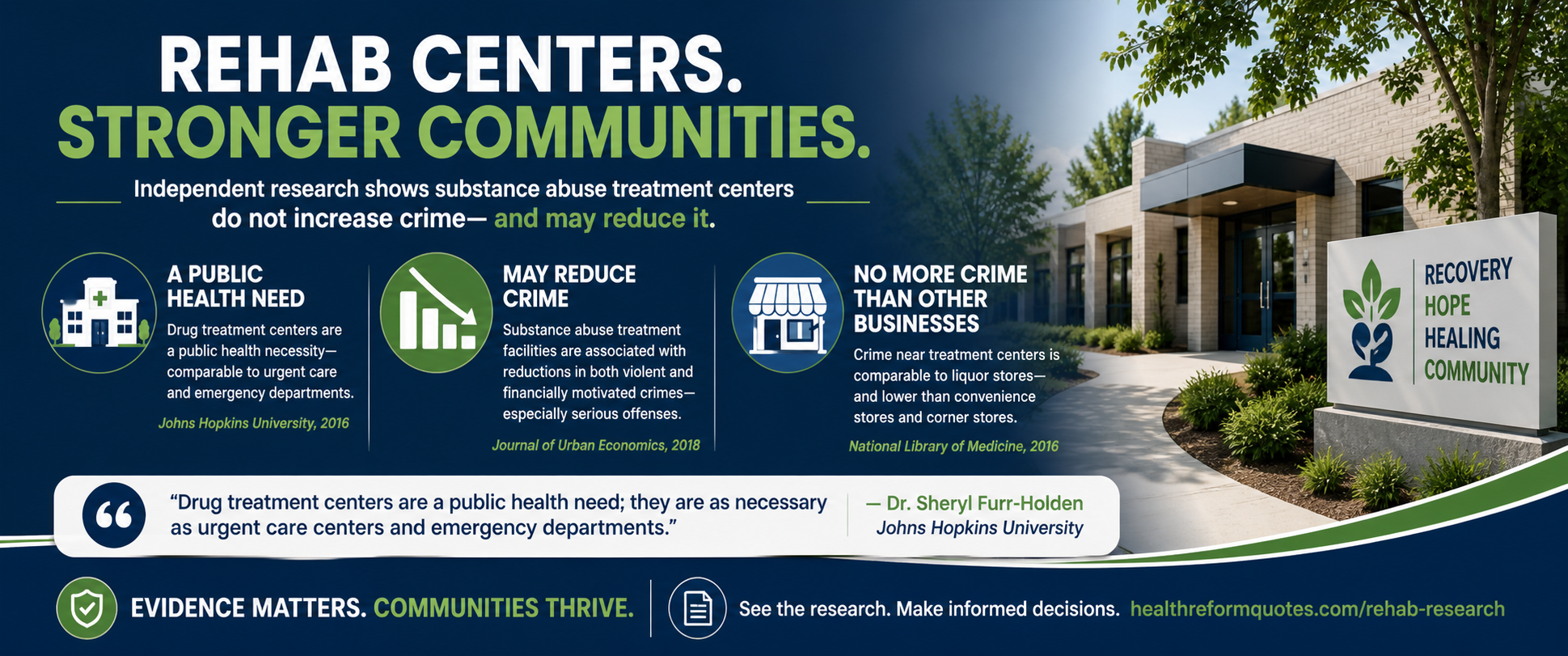
“Drug treatment centers are a public health need; they are as necessary as urgent care centers and emergency departments,” says Furr-Holden. “Our research shows that DTCs do not impact communities any more than other commercial businesses. Moving forward, communities should work with researchers, policymakers, and DTCs to have an honest dialogue regarding placement of this needed resource.” John Hopkins Magazine 2016
The results indicate that substance-abuse-treatment facilities reduce both violent and financially motivated crimes in an area, and that the effects are particularly pronounced for relatively serious crimes. Science Direct.com June 2018 *
Violent crime associated with drug treatment centers is similar to that associated with liquor stores and is less frequent than that associated with convenience stores and corner stores. National Library of Medicine January 2016
- No Significant Impact: A study of Seattle, Washington, found that the presence of a drug treatment center had no measurable impact on home values when accounting for other variables.
- No Negative Effect: Researchers from the University of New Mexico and Temple University concluded that substance-abuse disorder centers do not negatively affect property values in their immediate areas.
- Potential Increase: Some research has shown that areas with recovery residences can actually have higher median home values compared to similar areas without them.
- Contradictory Data: Some studies have suggested that specific types of treatment centers (e.g., those for opioid addiction) may be associated with a temporary or localized $8\%-17\%$ reduction in property values due to buyer perception of risk. [1, 2, 4, 5, 6, 7, 8, 9]
- Similar to Other Commercial Areas: Studies have found that neighborhoods surrounding drug treatment centers are no more dangerous than those near convenience stores.
- Safer than Alternatives: One study found that, in some cases, the areas around drug treatment centers were actually safer than those near liquor stores.
- Community Benefit: Proper addiction treatment actually reduces crime in the long run by stabilizing individuals, allowing them to lead productive lives. [2, 10, 11]
- “Not in My Backyard” (NIMBY): The resistance to rehabilitation centers is often based on stigma rather than evidence.
- Quality of Management: The impact of a rehab facility depends heavily on it being well-managed, rather than the presence of the facility itself.
- Benefits to the Community: Treatment centers are increasingly viewed as a necessary public health resource, similar to urgent care centers. [5, 12, 13, 14]
Baltimore Facebook Posts… 12/2021
Has a community successfully objected to a recovery program?
Titles are generated by AI from Meta
Need an answer to this: my community is being inundated with recovery houses, treatment programs, sober living houses, assisted livings, medication dispensing and recovery programs. Is there a community in the City who has successfully objected to and have had a program/center not come or removed? And how…? At this rate, we can’t be *that* addicted that we are saturated…
Research on Property Values
- Minimal or No Impact: A study by researchers at the University of New Mexico and Temple University, highlighted by Barron’s, found that drug treatment centers (DTCs) tend to locate in areas where property values are already slightly lower (about 2.2%), but the centers themselves do not significantly decrease values once they open.
- Variable Findings: Some data suggests a more complex picture; a study in central Virginia noted an 8% reduction in home prices near residential rehab centers, which increased to 17% for centers specifically treating opiate addiction, primarily due to buyer stigma.
- Recovery Residences: A 2026 study found no significant association between recovery residences (sober living homes) and nearby property values, even noting some areas where home values were slightly higher than in comparable tracts without them. [5, 6, 7, 8, 9, 10]
Research on Community Safety and Crime
- Comparable to Commercial Areas: Research from Johns Hopkins Bloomberg School of Public Health found that violent crime rates around publicly funded drug treatment centers were no higher than those around convenience stores and were actually lower than rates near liquor stores.
- Crime Reduction: Some evidence suggests that expanding access to substance-abuse treatment can reduce local crime by treating the underlying causes of financially motivated or violent offenses.
- Petty Crime Concerns: While violent crime is not statistically linked to these facilities, some local police departments have noted concerns regarding petty crime or public disturbances, though these are often difficult to trace statistically to a specific facility. [1, 4, 11, 12]
Related Child & Sibling Pages
- ADA & Fair Housing Act protections for Drug & Alcohol Problems
- Closed Court House – Safer? Economic?
- Court Decisions, Evidence vs Opinion
- Drug Rehab Diversion
- Extensive Research Grace Mercado Ocean View
- Fred Brown Dossier Good Bay & Ugly
- Grant Application vs. Reality
- Little Sisters of the Poor What is the Property Worth?
- Myth vs Evidence Fred Brown vs Senior Housing
- Need for Rehab and Addiction treatment in LA & San Pedro
- Recovery Housing, Crime & Community Impact Studies
- Regulation of SUD’s – Find SUD’s
- Rehab Protections for Children?
- Spencer Pratt 5 point plan to end drug abuse and homelessness
- Viable Economic Options SNF Skilled Nursing Facility or Rehab?