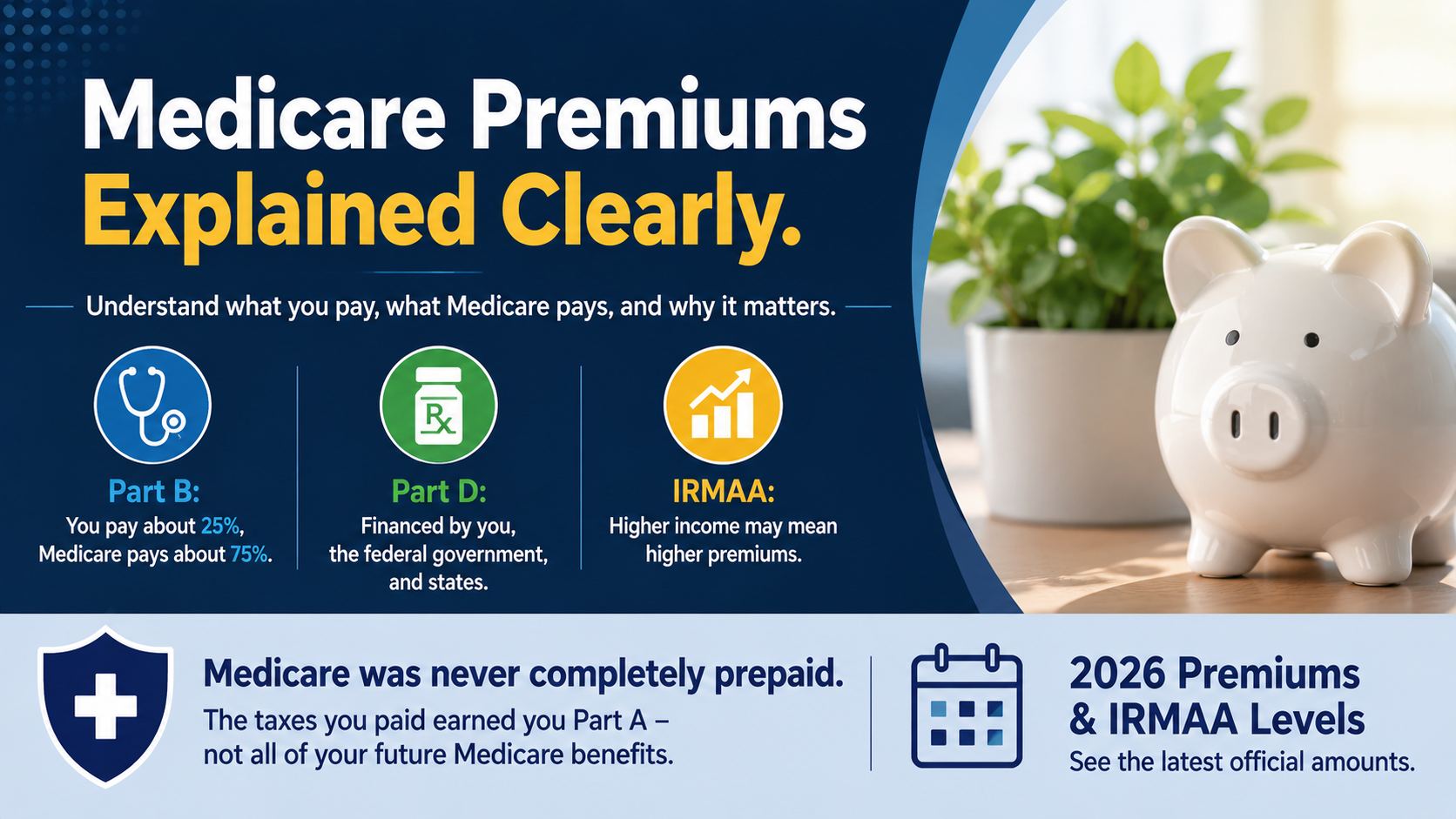
I Paid Into Medicare All My Life — Why Do I Still Have to Pay a Premium?
- This is one of the most common Medicare questions we hear.
- While you were working, the Medicare payroll taxes taken from your paycheck primarily helped finance Medicare Part A — Hospital Insurance.
- That is why most people who worked and paid Medicare taxes for at least 10 years qualify for premium-free Part A.
- Medicare Part B — doctors and outpatient services — is financed differently. Beneficiaries pay monthly premiums, but those premiums pay only part of the cost of the program.
- Medicare Part D prescription drug coverage is also financed separately through beneficiary premiums, federal government contributions and state contributions.
- In other words, paying Medicare payroll taxes while you worked did not mean that you prepaid all of your future Medicare Part B and Part D premiums.
- Learn more about Medicare Parts A, B, C and D
- Source:
How Much of Medicare Part B Are You Actually Paying?
- The standard Medicare Part B premium is generally set to cover approximately 25% of average Part B program costs.
- The federal government finances approximately the remaining 75% through general revenues.
- For 2026, the standard Part B premium is $202.90 per month.
Standard Medicare Part B Premium
So the standard Part B premium does not represent the full cost of your Part B coverage.
- The percentages above describe how the standard Part B premium is calculated based on average program costs. They do not represent an individual’s actual medical expenses or claims.
- Sources:
2026 Medicare Part B & Part D High-Income Premiums — IRMAA
- Most Medicare beneficiaries pay the standard Part B premium.
- Higher-income beneficiaries pay an additional amount called the Income-Related Monthly Adjustment Amount — IRMAA.
- For 2026, Social Security generally uses income reported on your 2024 federal income tax return.
- The higher your income, the larger the percentage of Medicare Part B program costs you are required to pay.
| 2024 MAGI Individual |
2024 MAGI Married Filing Jointly |
Approx. Share of Part B Cost |
2026 Part B Monthly Premium |
2026 Part D IRMAA* |
|---|---|---|---|---|
| $109,000 or less | $218,000 or less | 25% | $202.90 | $0 |
| Above $109,000 through $137,000 | Above $218,000 through $274,000 | 35% | $284.10 | $14.50 |
| Above $137,000 through $171,000 | Above $274,000 through $342,000 | 50% | $405.80 | $37.50 |
| Above $171,000 through $205,000 | Above $342,000 through $410,000 | 65% | $527.50 | $60.40 |
| Above $205,000 but below $500,000 | Above $410,000 but below $750,000 | 80% | $649.20 | $83.30 |
| $500,000 or more | $750,000 or more | 85% | $689.90 | $91.00 |
- *Part D IRMAA is added to whatever premium your prescription drug plan charges.
- Different IRMAA rules apply to some people who are married, lived with their spouse during the year, and file separate tax returns.
- Sources:
What About Medicare Part D Prescription Drug Coverage?
- Part D should not simply be described as “you pay 25% and the government pays 75%.”
- For 2026, Medicare actuaries estimate Part D financing comes approximately from:
- These are overall Part D program financing percentages — they do not mean every beneficiary personally pays exactly 13% of the cost of his or her drug coverage.
- Actual Part D premiums vary by plan.
- Higher-income beneficiaries may also have a separate Part D IRMAA surcharge collected by Medicare in addition to the plan’s premium.
- Resources:
What Year’s Income Does Medicare Use for IRMAA?
- For your 2026 Medicare premiums:
- Social Security generally uses the most recent federal tax return supplied by the IRS.
- Normally, that means your 2024 income tax return for determining your 2026 IRMAA.
- What income counts?
- Medicare uses Modified Adjusted Gross Income — MAGI.
- For IRMAA purposes, MAGI is generally your Adjusted Gross Income plus tax-exempt interest.
- If your income has dropped:
- You may not necessarily have to continue paying an IRMAA based on an older, higher-income year.
- Certain life-changing events may allow Social Security to use more recent income information.
- Ask Social Security to lower an IRMAA after a qualifying life-changing event
- Download Form SSA-44 — Medicare Income-Related Monthly Adjustment Amount Life-Changing Event
- Our Medicare IRMAA — High Income Part B & Part D Surcharge Information
The Bottom Line — Medicare Was Never Completely Prepaid
- The Medicare taxes you paid while working primarily financed Part A Hospital Insurance.
- Part B works differently.
- The standard beneficiary premium is intended to cover about 25% of average Part B program costs.
- Federal general revenues finance roughly the other 75%.
- Higher-income beneficiaries pay a greater share.
- Depending upon income, the Part B premium can represent approximately 35%, 50%, 65%, 80% or 85% of average program costs.
- Part D is financed differently and Part D premiums vary by the prescription drug plan you select.
- So when someone asks, “Why am I paying for Medicare when I already paid Medicare taxes my whole life?”, the important distinction is that the payroll taxes helped earn and finance Part A — they did not prepay all future Part B and Part D costs.
- Questions about Medicare premiums, IRMAA, Medicare Advantage, Medigap or Part D?
History of Medicare
on cms.gov
- cms.gov/History cms.gov/KeyMilestones
- govbooktalk.gpo.govhappy-birthday-medicare/
- Watch Video

Optional Deeper Details Below
The practical explanation is above. The section below includes supporting documents, background material, citations, examples, and technical details for readers who want more.