You Have Medicare Parts A & B — What Do You Add Next?
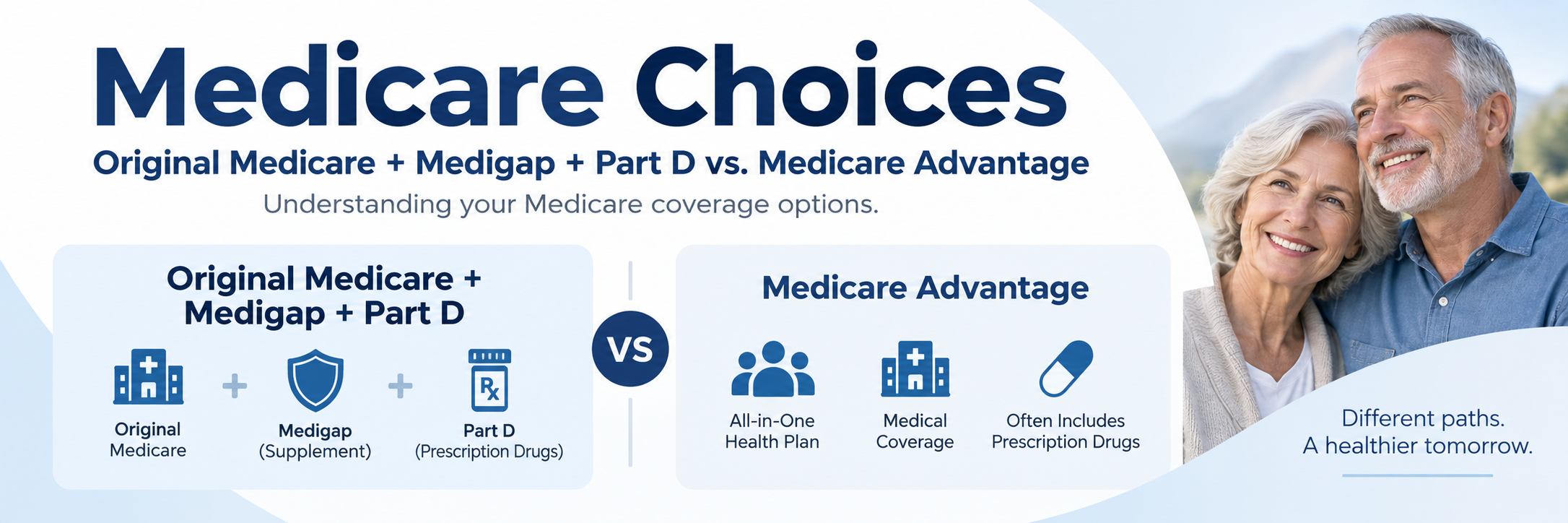
Once you have Original Medicare Parts A & B, you generally have two main ways to arrange the rest of your Medicare coverage:
- Choice 1 — Original Medicare + Medigap (Medicare Supplement) + a separate Part D prescription drug plan.
- Choice 2 — Enroll in a Medicare Advantage (Part C) plan, which provides your Part A and Part B benefits through a private Medicare-approved insurance company. Most Medicare Advantage plans also include Part D prescription drug coverage.
Important: Medicare Advantage and Part D aren’t really competing choices. Medicare Advantage is a way to receive your Medicare medical benefits. Part D is prescription drug coverage. The bigger choice is usually Original Medicare + Medigap + Part D versus Medicare Advantage, usually with Part D included.
Medicare calls these the two main ways to get your Medicare coverage.

Choice 1
Original Medicare + Medigap + Part D
- Original Medicare Parts A & B remain your primary medical coverage.
- A Medigap policy can help pay some of the deductibles, coinsurance and other out-of-pocket costs left by Original Medicare.
- You normally purchase a separate Part D prescription drug plan for your medications.
- With Original Medicare, you can generally use any doctor or hospital in the United States that accepts Medicare. See my web page — Medicare Assignment — finding doctors who accept Medicare.
- In most cases, Original Medicare does not require prior authorization before Medicare-covered services or supplies are provided.
- There is no annual out-of-pocket maximum under Original Medicare by itself. Medigap can help protect you from many of those gaps, depending on which Medigap plan you select.
- Medigap policies sold today do not include outpatient prescription drug coverage, which is why Part D is normally purchased separately.
Choice 2
Medicare Advantage — Part C
- A Medicare Advantage plan provides your Medicare Part A and Part B benefits through a private insurance company approved by Medicare.
- Most Medicare Advantage plans include Part D prescription drug coverage, often called an MAPD plan.
- Many Medicare Advantage plans use an HMO or PPO provider network. Rules differ by plan.
- You may need referrals or prior authorization for certain medical services, depending on the plan.
- Medicare Advantage plans have a yearly out-of-pocket limit for covered Medicare Part A and Part B medical services.
- Some plans have a $0 additional monthly plan premium, although you generally must continue paying your Medicare Part B premium.
- Plans may offer additional benefits such as dental, vision, hearing, fitness or other services that Original Medicare doesn’t ordinarily cover.
- Benefits, provider networks, formularies, copayments and premiums vary by plan and can change from year to year.
Medicare Advantage vs. Part D — What’s the Difference?
This is a common source of confusion because Medicare Advantage and Medicare Part D do different jobs.
- Medicare Advantage — Part C answers the question:
- “How will I receive my Medicare Part A and Part B medical benefits?”
- Medicare Part D answers the question:
- “How will I cover my prescription drugs?”
- If you stay with Original Medicare, you can enroll in a separate Part D prescription drug plan.
- If you enroll in a Medicare Advantage plan with prescription coverage — MAPD, your Part D coverage is generally included in the Medicare Advantage plan.
- In most Medicare Advantage HMO and PPO plans that include drug coverage, you should not enroll in a separate stand-alone Part D plan. Doing so can cause you to be disenrolled from your Medicare Advantage plan and returned to Original Medicare.
See my web page — Shop & Compare Medicare Part D Prescription Plans.
Official reference — Medicare.gov — Choose how you get drug coverage.
What About My Doctors and Hospitals?
- Original Medicare: You can generally see any doctor or use any hospital in the United States that accepts Medicare.
- See my web page — Medicare Assignment — Does My Doctor Accept Medicare?
- Medi gap: A standard Medi gap policy works with Original Medicare rather than replacing it. The Medigap insurer generally isn’t creating the doctor network — Medicare is still your primary coverage.
- Medicare Advantage: Many plans use HMO or PPO networks. Before enrolling, check the plan’s current directory and, when practical, confirm with the physician or medical group that they participate in the specific plan.
- Travel: If you spend significant time away from home, provider access may be particularly important.
- See my web page — Medicare Coverage Outside Your Area & Outside the Country.
Medicare’s official comparison: Original Medicare vs. Medicare Advantage.
Can I Change My Mind Later?
Yes — but changing Medicare plans and being able to purchase a Medi gap policy are two different issues.
- Medicare provides enrollment periods when you may be able to change between Original Medicare and Medicare Advantage.
- However, you should not assume that you will always be able to buy any Medi gap policy later without medical underwriting.
- Your federal Medi gap Open Enrollment Period generally lasts six months beginning with the first month you are age 65 or older and enrolled in Medicare Part B.
- After that period, an insurance company may be permitted to ask health questions or decline an application unless you qualify for a guaranteed acceptance / guaranteed issue right or another applicable protection.
- There are also certain Medicare Advantage trial rights. For example, some people who try Medicare Advantage for the first time and return to Original Medicare during the permitted trial period have special Medigap protections.
- See my web page — Guaranteed Acceptance — Medigap Supplemental Plans.
Which Medicare Choice Sounds More Like You?
There isn’t one Medicare option that is right for everybody. Your doctors, prescriptions, travel, budget and comfort with provider networks can all affect the decision.
Original Medicare + Medigap + Part D may appeal to you if:
- You place a high value on broad access to doctors and hospitals that accept Medicare.
- You travel frequently within the United States or spend part of the year away from home.
- You prefer fewer provider-network restrictions.
- You are comfortable paying separate premiums for Medigap and Part D in exchange for the benefits those policies provide.
- You want medical expenses to be more predictable based on the Medi gap plan you select.
Medicare Advantage may appeal to you if:
- Keeping your additional monthly plan premium down is particularly important.
- Your doctors, specialists, medical groups and hospitals participate in the plan you are considering.
- You like having medical and prescription coverage together in one plan.
- Additional benefits such as dental, vision, hearing or fitness are important to you.
- You are comfortable following the plan’s network, referral and prior-authorization rules.
The important question isn’t simply “Which plan costs less?”
It is “Which way of receiving Medicare fits the way I actually use health care?”
Before You Enroll — Check These Items
- Doctors and specialists: Are the physicians and medical groups you want available under the coverage you are considering?
- Hospitals: Is the hospital or health system you prefer available to you?
- Prescription drugs: Check every medication, dosage and preferred pharmacy.
- See my web page — Part D Shop & Compare Tools.
- Total cost: Look beyond the monthly premium.
- Travel: Consider where you spend time during the year and how the coverage works away from home.
- See my web page — Medicare Out-of-Area & Foreign Travel Coverage.
- Future Medi gap eligibility: Before giving up a Medigap policy or initially choosing Medicare Advantage, understand whether you would have guaranteed rights to purchase Medigap if you later change your mind.
- See my web page — Guaranteed Acceptance for Medi gap.
- Higher-income Medicare charges:
- If applicable, review IRMAA — higher-income surcharges for Medicare Part B and Part D.
- Enrollment dates: Medicare doesn’t permit every change at any time.
- See my web page — Medicare Advantage & Part D Enrollment Dates.
Still Not Sure Which Medicare Route Makes Sense?
Before choosing a plan, we can review your doctors, hospitals, prescriptions, travel and other priorities. That helps narrow the choices down to coverage that actually works for you rather than simply looking at an advertisement or a monthly premium.
- Learn more — Medigap / Medicare Supplement Plans
- Learn more — Medicare Advantage Plans
- Learn more — Medicare Part D Prescription Coverage
- Email Steve Shorr — the best way to reach me.
Sources & Resources
- My web page — What Medicare Part A & Part B Cover
- My web page — Medigap / Medicare Supplement Plans
- My web page — Medicare Advantage Plans
- My web page — Medicare Part D Prescription Drug Coverage
- My web page — Guaranteed Acceptance / Guaranteed Issue for Medigap
- Medicare.gov — Your Medicare Coverage Options
- Medicare.gov — Compare Original Medicare & Medicare Advantage
- Medicare.gov — Medigap Basics
- Medicare.gov — Medicare Part D Drug Coverage
- Medicare & You — CMS Product #10050
- California Health Advocates — Guaranteed-Issue Rights When Switching from Medicare Advantage to Medigap