

Medicare Part A
(#Hospital Insurance)
What Does Medicare Part A & Part B Cover? | Medigap Comparison
-
See full brochure I cut and pasted this from
What Should You Notice About Medicare Part A?
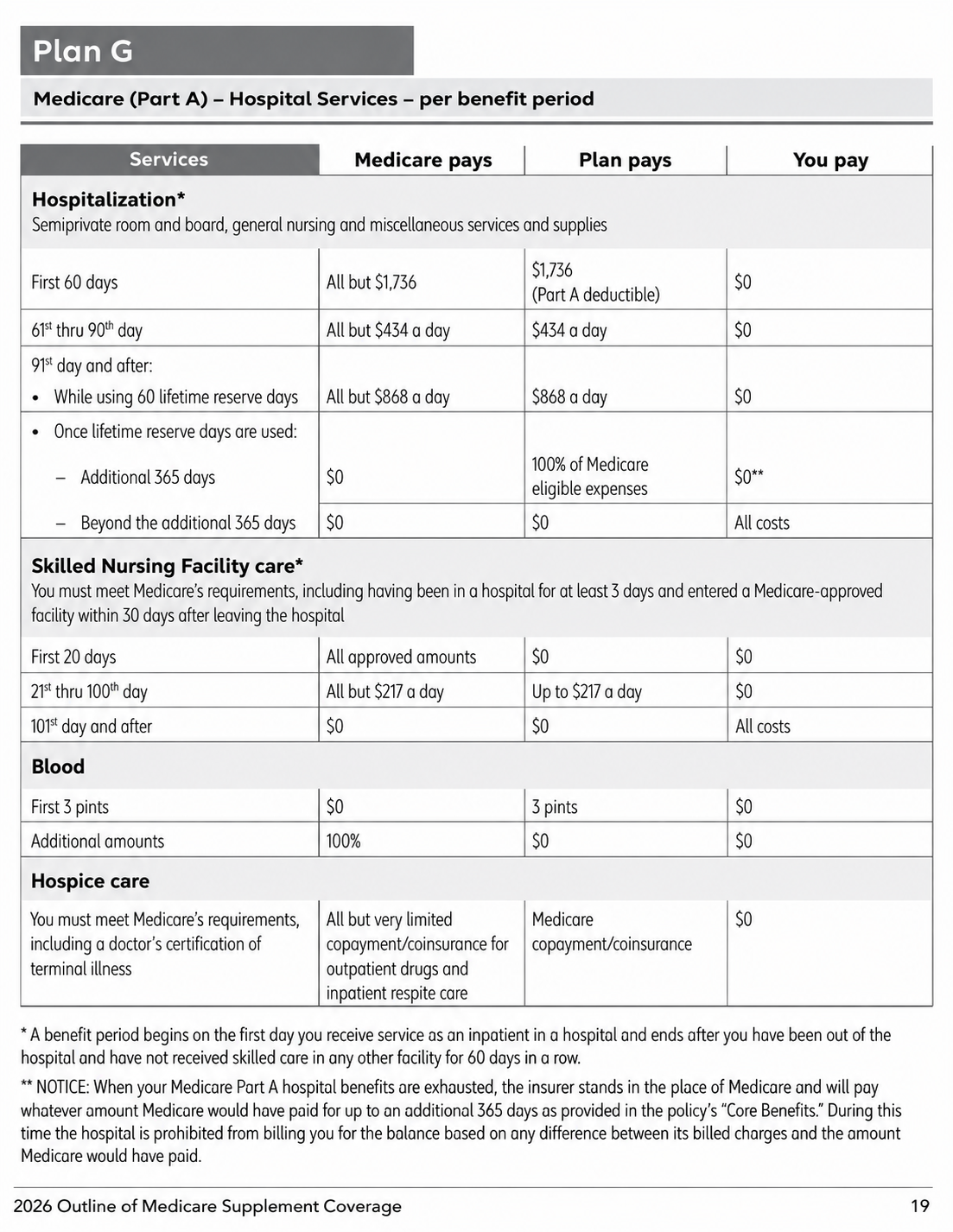
The Part A chart above shows some of the potentially large expenses that Original Medicare can leave to the beneficiary, and how Plan G can help fill those gaps.
- Hospital deductible: Original Medicare has a Part A deductible for each benefit period. Plan G pays that deductible.
- Longer hospital stays: Medicare begins charging daily hospital coinsurance after the first 60 days. Plan G pays the applicable Medicare Part A coinsurance shown in the chart.
- Skilled Nursing Facility care: Medicare can cover qualifying skilled nursing care, but Medicare’s payment changes as the stay becomes longer. The chart shows what Medicare and Plan G pay.
- Hospice: Medicare provides substantial hospice coverage, while Plan G can cover applicable Medicare coinsurance or copayments.
Learn more:
2026 Part B deductible—$283 before Original Medicare starts to pay You pay this deductible once each year CMS.gov
What Should You Notice About Medicare Part B?
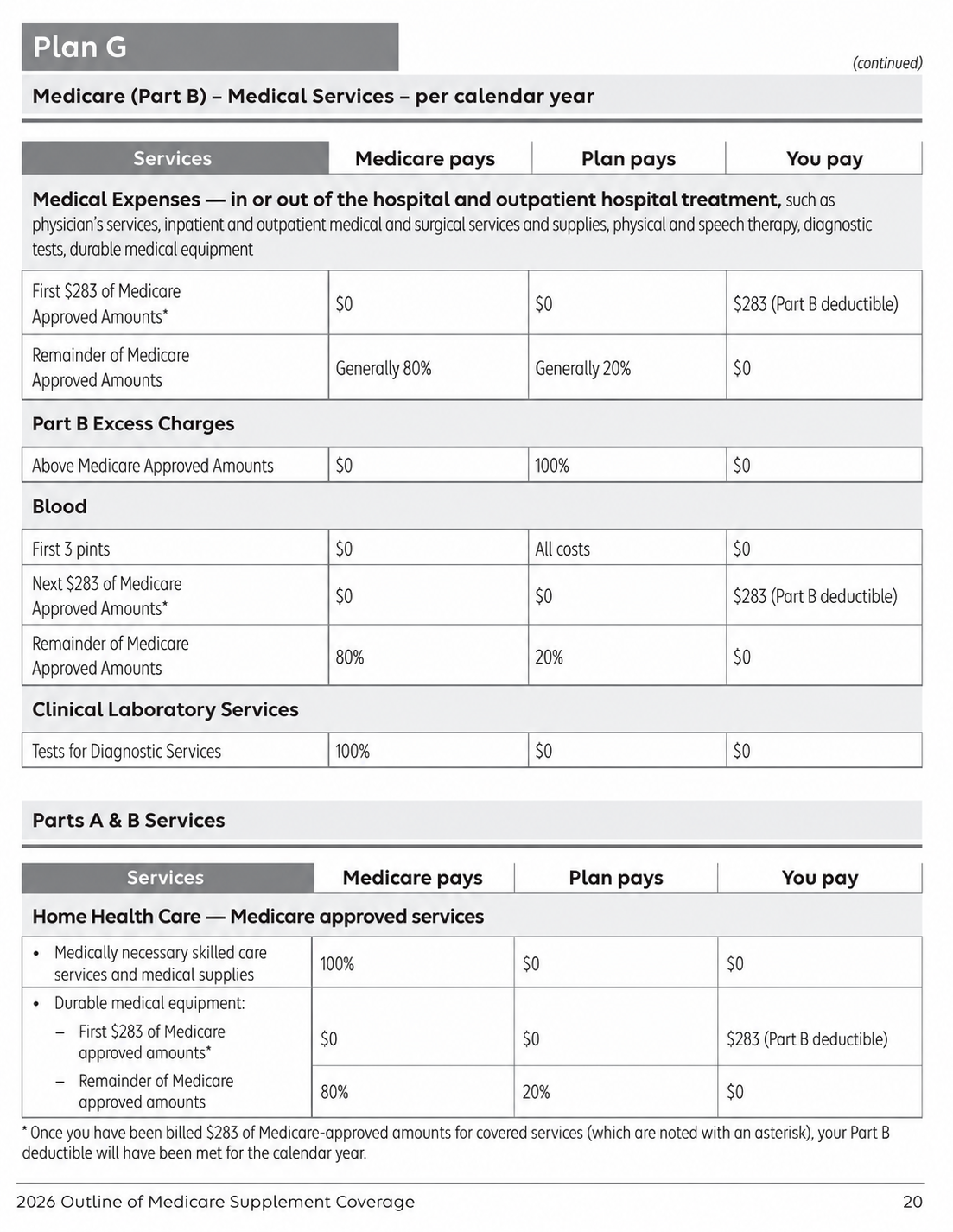
The Part B chart illustrates another important difference between Original Medicare alone and Original Medicare with Plan G.
- You pay the annual Part B deductible yourself with Plan G.
- After the Part B deductible has been met, Original Medicare generally pays 80% of the Medicare-approved amount for many Part B services.
- Plan G generally pays the remaining 20% Medicare Part B coinsurance.
- Plan G also covers Part B excess charges when they apply.
- Clinical laboratory services can be different because Medicare may pay 100% of the Medicare-approved amount for covered diagnostic laboratory tests.
This 80% / 20% split is an important reason to look beyond the Medicare premium alone. Without supplemental coverage, Original Medicare has no annual maximum limiting your total out-of-pocket expenses for covered Part A and Part B services.
Learn more:
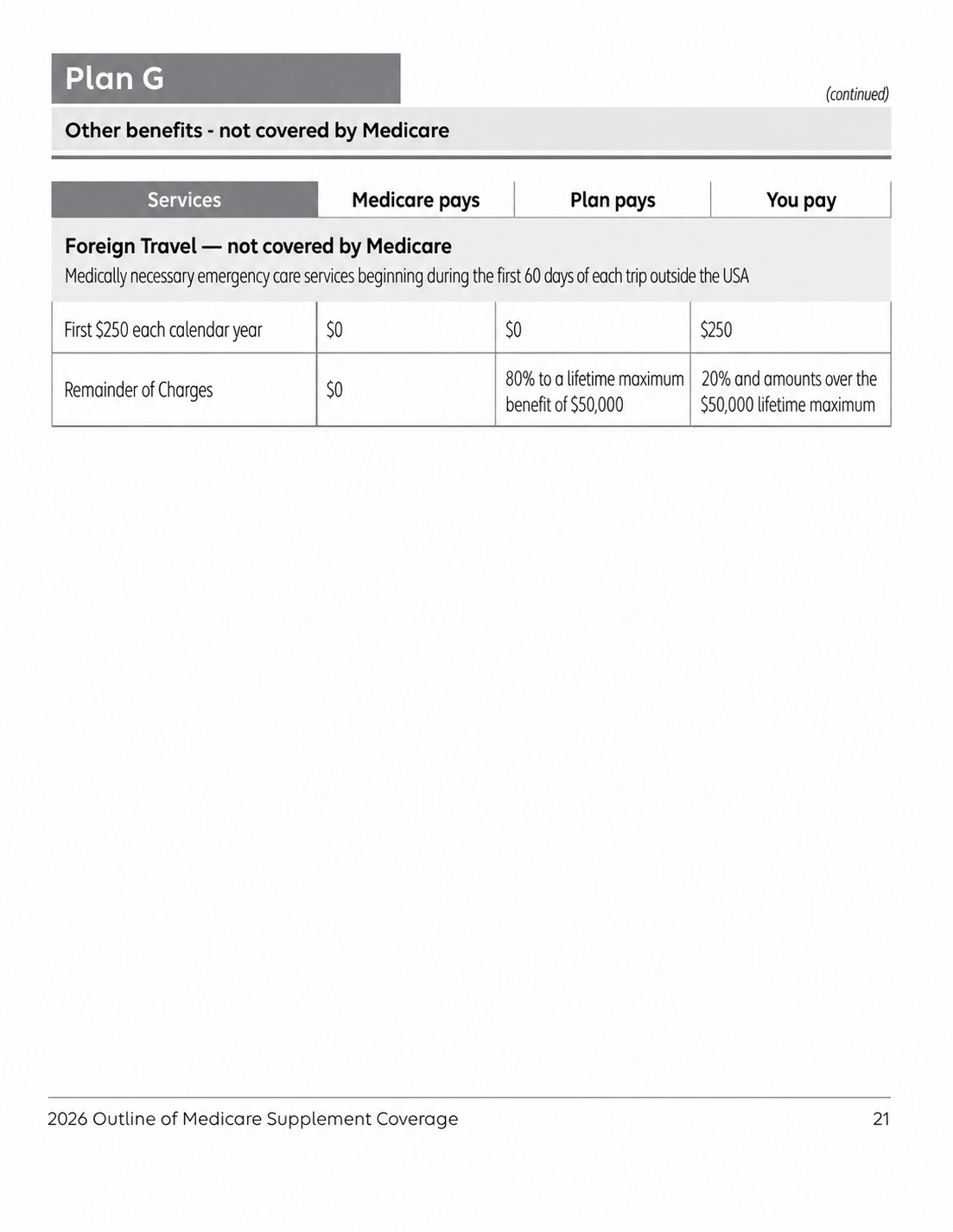
Plan G Also Has a Limited Foreign Travel Emergency Benefit
- Original Medicare generally provides very limited coverage outside the United States. As the official Plan G chart above shows, Plan G includes a limited foreign travel emergency benefit, subject to its deductible, percentage limits and lifetime maximum.
- This is not unlimited international health insurance. If you travel frequently or spend extended periods outside the United States, additional international medical coverage may be worth considering.
How Do You Compare This With Medicare Advantage?
A Medicare Advantage plan works differently from a Medicare Supplement. It does not simply pay the amounts shown in the “You pay” column above.
Instead, a Medicare Advantage plan becomes the way you receive your Medicare Part A and Part B benefits. To compare a Medicare Advantage plan with Original Medicare plus Plan G, look at the Medicare Advantage plan’s Summary of Benefits and compare the same services shown above.
- Hospital stay: What is the Medicare Advantage plan’s inpatient hospital copayment?
- Doctors and specialists: What are the office visit copays?
- Outpatient services: What are the copays or coinsurance for surgery, testing and therapy?
- Skilled Nursing Facility: What does the plan charge per day?
- Durable Medical Equipment: What percentage does the member pay?
- Ambulance: What is the copayment?
- Maximum out-of-pocket: What is the most you could pay during the year for covered Part A and Part B services?
- Doctors and hospitals: Are your providers in the plan’s network?
- Prior authorization: Which services require the plan’s approval before receiving care?
There isn’t one answer that is best for everybody. The purpose of comparing these costs is to understand what you are giving up and what you are gaining before choosing between Original Medicare with a Medicare Supplement and a Medicare Advantage plan.
Learn more:
More detail & Explanation
What Does Medicare Part A and Part B Cover?
Original Medicare is made up of Medicare Part A and Medicare Part B. A simple way to remember the difference is that Part A generally helps cover inpatient hospital and certain facility care, while Part B generally helps cover doctors, outpatient care, medical equipment and preventive services.
- Medicare Part A — Hospital Insurance
- Inpatient hospital care
- Skilled nursing facility care when Medicare’s requirements are met
- Hospice care
- Some home health care
- Medicare Part B — Medical Insurance
- Doctors and other health care providers
- Outpatient hospital services
- Lab tests, X-rays and many diagnostic services
- Physical, occupational and speech therapy when covered
- Durable medical equipment such as walkers, wheelchairs and hospital beds
- Ambulance services when Medicare requirements are met
- Mental health services
- Preventive services, screenings and vaccines
Resources:
Medicare Part A vs. Part B — At a Glance
| Medicare Part A Hospital Insurance |
Medicare Part B Medical Insurance |
|---|---|
| Inpatient hospital care | Doctors and specialists |
| Skilled Nursing Facility care | Outpatient hospital care |
| Hospice care | Lab tests and diagnostic services |
| Some home health care | Durable medical equipment |
| Inpatient mental health care | Outpatient mental health care |
| Ambulance services when covered | |
| Preventive services |
Important: These are general categories. Whether Medicare pays for a particular service can depend on where you receive the care, whether the service is medically necessary and whether Medicare’s other coverage requirements are met.
Resources:
Being in the Hospital Doesn’t Always Mean Medicare Part A
One of the most important Medicare distinctions is whether the hospital has formally admitted you as an inpatient or is treating you as an outpatient.
- You are generally an inpatient when the hospital formally admits you with an inpatient admission order.
- You can be an outpatient while receiving emergency room services, observation services, tests or even while spending the night in a hospital bed.
- Your status can affect what Medicare pays and what you pay.
- Your hospital status can also affect whether a later stay in a Skilled Nursing Facility qualifies for Medicare Part A coverage.
Ask the hospital: “Am I formally admitted as an inpatient, or am I an outpatient under observation?”
Resources:
What Do You Pay With Original Medicare in 2026?
Medicare Part A — Hospital
- Part A premium: $0 for most people who worked and paid Medicare taxes long enough.
- Part A inpatient hospital deductible: $1,736 per benefit period.
- Days 1–60: $0 daily coinsurance after the deductible.
- Days 61–90: $434 per day.
- Lifetime reserve days: $868 per day while using lifetime reserve days.
Medicare Part B — Doctors & Outpatient Care
- Standard Part B premium: $202.90 per month in 2026. Higher-income beneficiaries may pay more.
- Annual Part B deductible: $283 in 2026.
- After the deductible: For many covered services, you generally pay 20% of the Medicare-approved amount.
Important: Original Medicare does not have a yearly maximum on what you can pay out of pocket. This is one reason many beneficiaries consider Medicare Supplement / Medigap coverage or Medicare Advantage.
Resources:
What Don’t Medicare Part A and Part B Cover?
Original Medicare covers a great deal of medical care, but it does not cover everything. Some commonly misunderstood exclusions include:
- Long-term custodial care when that is the only care you need
- Most routine dental care
- Hearing aids and exams for fitting hearing aids
- Routine eye exams for prescription eyeglasses or contact lenses
- Routine physical exams — which are different from Medicare’s covered preventive and Wellness services
- Massage therapy
- Most cosmetic surgery
Skilled nursing is not the same as long-term care. Medicare Part A may cover short-term Skilled Nursing Facility care when Medicare’s requirements are met. Medicare generally does not pay for ongoing custodial care simply because someone needs help with bathing, dressing, eating or supervision.
Resources:
What About Prescription Drugs?
Medicare Part A and Part B are not a substitute for regular outpatient prescription drug coverage. Medicare Part D is primarily designed to help cover outpatient prescription drugs.
- Part A can cover drugs you receive as part of a covered inpatient stay.
- Part B covers certain medications under specific circumstances, including some medications administered by a doctor and certain drugs used with Part B-covered durable medical equipment.
- Part D generally covers outpatient prescription drugs according to the drug plan’s formulary and coverage rules.
- Many Medicare Advantage plans include Part D prescription drug coverage.
Resources:
Does Medicare Cover My Particular Test, Treatment or Equipment?
Whether Medicare covers a particular service can depend on medical necessity, where you receive the care, who provides it and Medicare’s specific coverage requirements.
Learn more about specific Medicare benefits:
- My web page — Skilled Nursing Facility Coverage
- My web page — Medicare Home Health Care
- My web page — Medicare Hospice Coverage
- My web page — Durable Medical Equipment, Ambulance, Physical Therapy & Other Medicare Benefits
- My web page — Medicare Mental Health Benefits
- My web page — Medicare Preventive Services & Annual Wellness Visit
Medicare.gov — Check Whether Medicare Covers a Test, Item or Service
Resources:
Part A and Part B Are Only the Beginning of Your Medicare Decision
After enrolling in Medicare Part A and Part B, you still need to decide how you want to receive your Medicare coverage and whether you need additional coverage.
- Original Medicare
- Includes Medicare Part A and Part B.
- You can generally use any doctor or hospital that accepts Medicare.
- You may add a separate Part D prescription drug plan.
- You may be able to purchase Medicare Supplement / Medigap coverage to help with some of the deductibles and coinsurance left by Original Medicare.
- Medicare Advantage — Part C
- An alternative way to receive your Medicare Part A and Part B benefits through a Medicare-approved private health plan.
- Most plans also include Part D prescription drug coverage.
- Plans may have provider networks, referrals, prior authorization requirements and different copayments.
- Medicare Advantage plans have an annual maximum out-of-pocket limit for covered Part A and Part B services.
Before choosing a plan, compare your doctors, hospitals, prescriptions, expected medical needs and costs.
Resources:
Medicare Part A & Part B Resources
- Medicare & You 2026 — CMS Product #10050 — Medicare’s comprehensive handbook explaining Medicare benefits, costs, coverage choices, rights and protections.
- Medicare.gov — What Part A Covers
- Medicare.gov — What Part B Covers
- Medicare.gov — What’s Not Covered by Original Medicare?
- Medicare.gov — Medicare Costs
- My web page — Medicare Guides, Forms & IRS Tax Resources
See What Medicare Pays — and What Plan G Pays
The charts below are from the 2026 Outline of Medicare Supplement Coverage for Plan G. They are especially useful because they show, side by side:
- Services — the type of Medicare-covered care you receive.
- Medicare pays — what Original Medicare pays toward that service.
- Plan pays — what Medicare Supplement Plan G pays after Medicare.
- You pay — the amount that may still be your responsibility.
This makes it much easier to see why Medicare Supplement coverage is called Medigap: it helps pay certain deductibles and coinsurance that Original Medicare leaves behind.
Look across each row from left to right: Medicare pays first, Plan G pays its portion, and the last column shows what remains for you.
- Medicare Part A Hospital coverage helps pay for care in hospitals as an inpatient,… skilled nursing facilities, hospice care, and some home health care (see publication # 10969) but not Long Term Care.
- Most people get Part A automatically when they turn age 65 at no charge, since they or a spouse paid Medicare taxes while they were working. You need to sign up close to your 65th birthday, even if you will not be retired by that time. (If you are getting Social Security benefits when you turn 65, your Medicare Hospital Benefits – Part A – start automatically.)
- Here’s a chart it’s just a illustration and is NOT official that shows what Medicare pays, the gaps in Medicare and what you may get when you add a Medi Gap Plan or Medicare Advantage to cover those gaps
- Chart Updates 2026 Fact Sheet Medicare Costs Publication 11579

- . standard Part B monthly premium amount ($202.90 in 2026)
- Steve’s VIDEO Explanation Comparing what Medicare pays and what you get extra with MAPD or Medi Gap
-
-
- “Hospital at Home” Programs Improve Outcomes, Lower Costs But Face Resistance from Providers and Payers Commonwealth Fund
- Explanation from Fortune Magazine
- Price lookup from Medicare.gov on what you pay with Original Medicare without a Medi Gap plan
-
Pays on top of Medicare Parts A & B – Any Medicare Provider
- Steve’s YouTube Video
Part B – Outpatient helps Pay For Doctors’ services, outpatient hospital care, and some other medical services that Part A does not cover, such as the services of physical and occupational therapists, and some home health care see publication 10969, but not Long Term Care. Part B helps pay for these covered services and supplies when they are medically necessary.
The chart below is a very brief summary. Check the actual Evidence of Coverage for the plan you want to enroll in, Medicare & You or actual Medicare documents.
Our Webpages with more detail:
- Coverage in Part A Hospital & B Doctor Visits? Part D Rx
- Chiropractic – Medicare A & B – MAPD
- Diabetes – Prevention & Coverage under Medicare & ACA
- Durable Medical Equipment
- End Stage Renal – Kidney Failure
- Hearing Aids
- Physical therapy – occupational speech
- Skilled Nursing SNF & Home Health What Medicare Pays
- Togetherness – Loneliness Social Determinants of Health
- Mental Health
- Blue Shield Mental Health Resource Hub >>> Visit *
- How to sign up for Medicare?
- FAQ Medical Necessity our Medical Necessity Webpage
- Original Medicare & Medi-Gap – Supplement vs Medicare Advantage MAPD
- Medicare Beneficiaries’ Out-of-Pocket Spending for Health Care