Medi Cal Long Term & Nursing Home Benefits & Qualification
but Beware:
Medi Cal can take your home and assets to pay back Nursing Home & Long Term Care Expenses
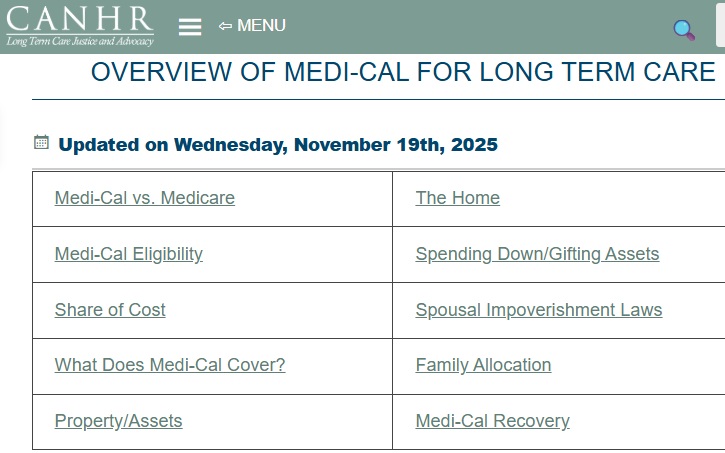
Overview of Medi Cal for Long Term Care
Canhr.org
How to qualify for Medi Cal Nursing Home Coverage
How to #qualify for
Medi-Cal to pay your Nursing Home Costs
California Advocates for Nursing Home Reform (CANHR)
- Medi-Cal Eligibility Canhr Factsheet
- Share of Cost CANHR Fact Sheet
- Our webpage on lowering Share of Cost
- What Does Medi-Cal Cover?
- Nursing home care is covered if there is prior authorization from the physician/health care provider. Residents are admitted on a doctor’s order and their stay must be “medically necessary“.
- (Clinical Guidelines from Oscar Insurance –
Explained so much better and in logical order!) Residents are allowed to keep $35 of their income as a personal needs allowance.
- (Clinical Guidelines from Oscar Insurance –
- Nursing home care is covered if there is prior authorization from the physician/health care provider. Residents are admitted on a doctor’s order and their stay must be “medically necessary“.
- Resource Limitations (Property/Assets) Assets
- Medi-Cal vs. Medicare
- FAQ’s
- Senior Care Action Network – SCAN. Independence at Home (IAH) continues that community service by connecting seniors and their caregivers to the services needed to stay out of healthcare facilities and nursing homes.
- wise and healthy aging.org/
Medi-Cal Consulting Services
- Medi Helper.com They can help you qualify – fee charged based on complexity of your case.
- CA Health Care Advocates HI CAP Medicare ONLY
#Understanding Medi-Cal Long Term Care
Archive Rev 2001
- CANHR California Advocates for Nursing Home Reform
- Our Webpage on Redetermination Requalification
- Our webpage on how to qualify for Medi Cal Nursing Home Benefits
- When will California's Medi-Cal Will Pay for a Nursing Home, Assisted Living, or Home Care Nolo.com
- Long-Term Services and Supports in Medi-Cal Fact Sheet CHCF.org
- canhr.org/overview-of-medi-cal-for-long-term-care
Understanding Long-Term Care Medi-Cal
Strategic Planning for Nursing Home Benefits
gift in contemplation of death
n. (called a gift causa mortis by lawyers showing off their Latin), a gift of personal property (not real estate) by a person expecting to die soon due to ill health or age. Federal tax law will recognize this reason for a gift if the giver dies within three years of the gift. Treating the gift as made in contemplation of death has the benefit of including the gift in the value of the estate, rather than making the gift subject to a separate federal gift tax charged the giver. If the giver gets over an apparently mortal illness, the gift is treated like any other gift for tax purposes.
See also: gift tax unified estate and gift tax law.com
Medi-Cal FAQ’s DHCS.gov – Look back only 30 month look back in CA
Resources


#Contact Us - Ask Questions - Get More Information - Schedule a Zoom Meeting
By submitting the information below , you are agreeing to be contacted by Steve Shorr a Licensed Sales Agent by email, texting or Zoom to discuss Medicare or other Insurance Plans as relevant to your inquiry. This is a solicitation for Insurance
IHSS Qualification – Our Webpage
Lower Share of Cost – Our webpage
Medi Cal Estate Recovery
Medi-Cal #Recovery Health Premiums
for Medi Cal premiums
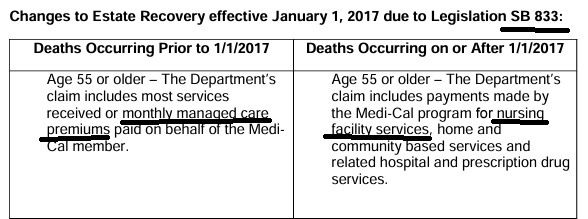
- California after January 2017 can only make claims for costs primarily related to nursing home care and “home- and community-based services,” such as adult day health care and a pilot program testing the use of assisted living as a Medi-Cal benefit. KQED News 6.16.2016 * 3.24.2015 * SB 33 * SB 833 * Simple Explanation CA HealthLine 12.23.2016 * DHCS.CA.Gov This is based on SB 833 which limits recovery to the federal minimum.
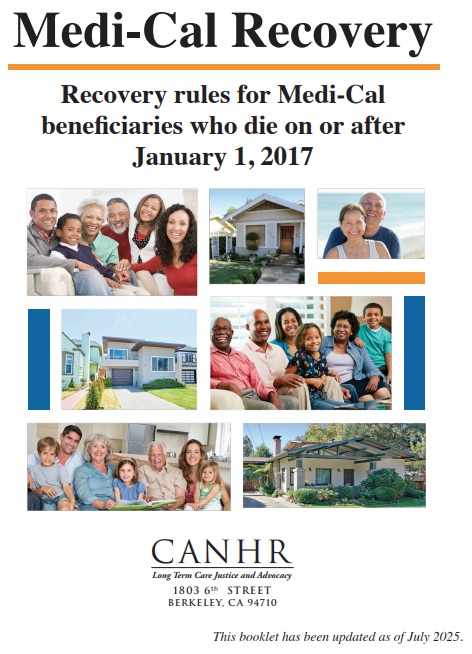
- CANHR Medi Cal Recovery after 2017 Canhr.org pdf
-
- More CANHR.org Publications
- canhr.org/fact-sheets
- CANHR Matrix Federal Law - Current CA Law -- SB 833 provisions canhr.org
- DHCS Comparison. before & after SB 833 January 2017
- Western Poverty Law - Summary new rules under SB 826 & SB 833

- MAGI Medi Cal 1095 B no longer relevant... Insure Me Kevin.com
- FYI Web Visitor that doesn't believe there is no more estate recovery for Medi Cal Health Insurance capitation
- Medi Cal still takes estate recovery during Covid (Share of Cost) i newssource 5.20.2022
- Text of SB 833
- Medi Cal updated notice for April 2022 Clean Copy without our markup
-
- Note that AFTER 2017, the notice does NOT say payments to managed care plans.
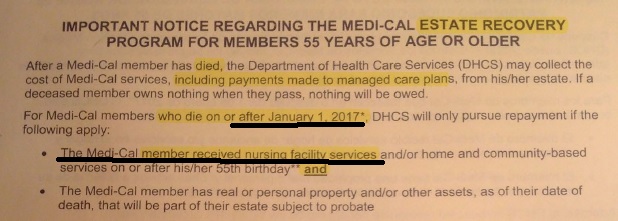
Medi Cal Nursing Home Estate Recovery
Medi Cal can take your home for nursing care! There are ways to plan for this to comply with all the new laws. Read this entire page along with our pages on Long Term Care Insurance for information or details.
MAGI Medi Cal under ACA – No longer has premium recovery for Health Insurance
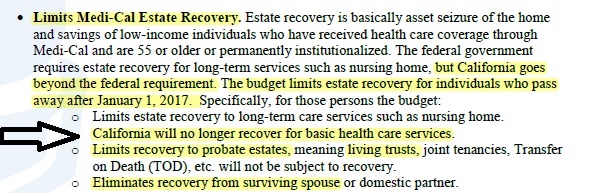
ACA Obamacare Medi-Cal no longer has asset recovery for Health Insurance Premiums – Capitation. under MAGI Medi-Cal.
CA changed the law as CA had extra $$$ pre COVID and the new budget includes $30 million to limit Medi-Cal estate recovery only to that required by federal law. Based on the definition of what “Health Care Means.” actual code SB 833 14009.5 . KQED News 6.16.2016 * 3.24.2015 * SB 33 * SB 833 * Simple Explanation CA HealthLine 12.23.2016 * DHCS.CA.Gov
- MAGI Medi Cal 1095 B no longer relevant… Insure Me Kevin.com
- California Ended Its Medicaid Long-Term Care Asset Test. What Happened?
- After People on Medicaid Die, Some States Aggressively Seek Repayment From Their Estates
- What to know about the Medicaid Estate Recovery program
- canhr.org/fact-sheets
- Understanding the Medi-Cal Look-Back Period
FAQ’s
- California’s Medi-Cal Recovery Program Frequently Asked Questions Canhr.org Fact Sheet
- Medi-Cal Recovery Recovery rules for Medi-Cal beneficiaries who die on or after January 1, 2017
- Avoiding Estate Recovery Canhr.org
- The Medi-Cal program must seek repayment from the estates of certain deceased Medi-Cal beneficiaries. Repayment only applies to benefits received by these beneficiaries on or after their 55th birthday and those who owned assets at the time of death. If a deceased beneficiary owns nothing when they die, nothing will be owed. dhcs.gov
- What you need to know and how to avoid Medi Cal Estate Recovery canhr
FAQ’s
- Question I getting a divorce and my x spouse has a chronic debilitating illness. Is my share of the equity in the family home subject to Medi Cal recovery?
- ANSWER The general rule is that there must be an “equitable distribution” of the assets and income of the couple REad More .
- agingcare.com/divorce-husband-eligible-for-medicaid
- Divorce: Allows a married couple to divide their assets equally. Thus, the at-home spouse can keep half of the property outside the reach of Medi-Cal. (This makes sense (if at all!) only for persons with substantial assets or for an at-home spouse with substantial separate property in a new marriage.) glantzlegal.com/tips
- Transferring assets to certain recipients will not trigger a period of Medicaid ineligibility even if the transfers occurred during the look-back period. These exempt recipients include the following:
- A spouse (or a transfer to anyone else as long as it is for the spouse’s benefit)
- A blind or disabled child
- A trust for the benefit of a blind or disabled child
- A trust for the sole benefit of a disabled individual under age 65 (even if the trust is for the benefit of the Medicaid applicant, under certain circumstances). elderlawanswers.com/how-does-the-medicaid-look-back-period-work

Here’s the Actual NEW CA Law
#SB 833 §14009.5. Effective 1.1.2017
Federal and State laws #require DHCS to seek recovery
from the estates of deceased Medi-Cal beneficiaries, or from any recipient of the decedent’s property by distribution or survival, for services and premiums paid on behalf of the decedent on or after age 55.
- California Code of Regulations (CCR) sections 50960-50966
- Welfare and Institutions Code (W&IC) section 14009.5
- Probate Code section 215
- Probate Code section 9202
- Probate Code section 19202
- United Stated Code (USC) section 1396
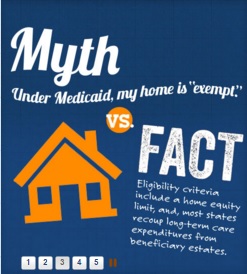
Learn More at Long Term Care.Gov
.
Find an Attorney

- Legal Match
- Findlaw.com
- American Bar Association
- Attorney Search Network
- Follow the links on this webpage. Many of them go to articles on Attorney Websites
- Also, see our appeals webpage
- Medi Cal Contact
- State Bar of California.com Attorney Referral Service
#Attorney 's --- Social Security Disability maze
- Sellers Law
- Hill & Ponton
- premier disability.com
- Cantrell & Green
-
- We don't necessarily know these attorney's...
- Editorial: Lawyers are fighting innovative proposals for more affordable legal assistance. That’s wrong LA Times 1.30.2022
Estate Planning
- We don't necessarily know these attorney's...
MISC & Historical
CA Dept of Aging – Home & Long Term Care Booklet
Please note, there are updates all the time, double check everything.
#Taking Care of Tomorrow Booklet

NAIC Shoppers Guide to Long Term Care
What is the
CA Assisted Living Waiver?
Participants in the ALW have access to the following services:
- Assisted Living Services: The following is a list of some of the services that must be provided to ALW participants. These services may be provided in an RCFE, or by a licensed Home Health Agency to residents in public housing.
- Assisting in developing and updating an individualized care plan for each resident
- Personal care and assistance with activities of daily living
- Laundry
- Housekeeping
- Maintenance of the facility
- Providing intermittent skilled nursing care
- Meals and snacks
- Providing assistance with self-administration of medications
- Providing or coordinating transportation
- Providing recreational activities
- Providing social services
- Care Coordination: These services include identifying, organizing, coordinating and monitoring services needed by participants .
- Nursing Facility Transition Care Coordination: These services help transition participants from a nursing home to the community. CA Assisted Living Waiver
Resources & Links
- DHCS.CA.Gov – CA Department of Health Care Services
- Assisted Living Waiver
- Elder Options – Private Website – DHCS subcontractor that can help people in Sacramento Area
- Nolo Press
FAQs / Ask Us a Question
Question
My 92 year old mother is on Medi-cal and Scan, but needs to go into assisted living with waiver application. They won’t accept Scan. They said she has to drop it. Does she automatically go on Medi–Medi and will her new doctor take it? The application takes 3-6 months for approval but I have to drop her from Scan insurance before I fax over the waiver form…
Answer
***I don’t have enough background to answer your question. I did learn though, my first day at my Father’s & Grand Fathers Insurance Agency, to NEVER cancel coverage till new coverage was confirmed!
Links & Resources
- Daily Kos
- CA Health Care Foundation
- Simple Explanation CA HealthLine 12.23.2016
- Insure Me Kevin.com –
- Check out Long Term Care Coverage
- DHCS.CA.Gov Explanation
- Set up an Advance Directive 5 Wishes
- Visit our Webpages
Low Income – Assets – Alternatives
Resources & Links
- Veteran’s Home Health Care
- Jewish Free Loan Assoc.
- Medicare.Gov Home Health Compare