CARE Court California Explained
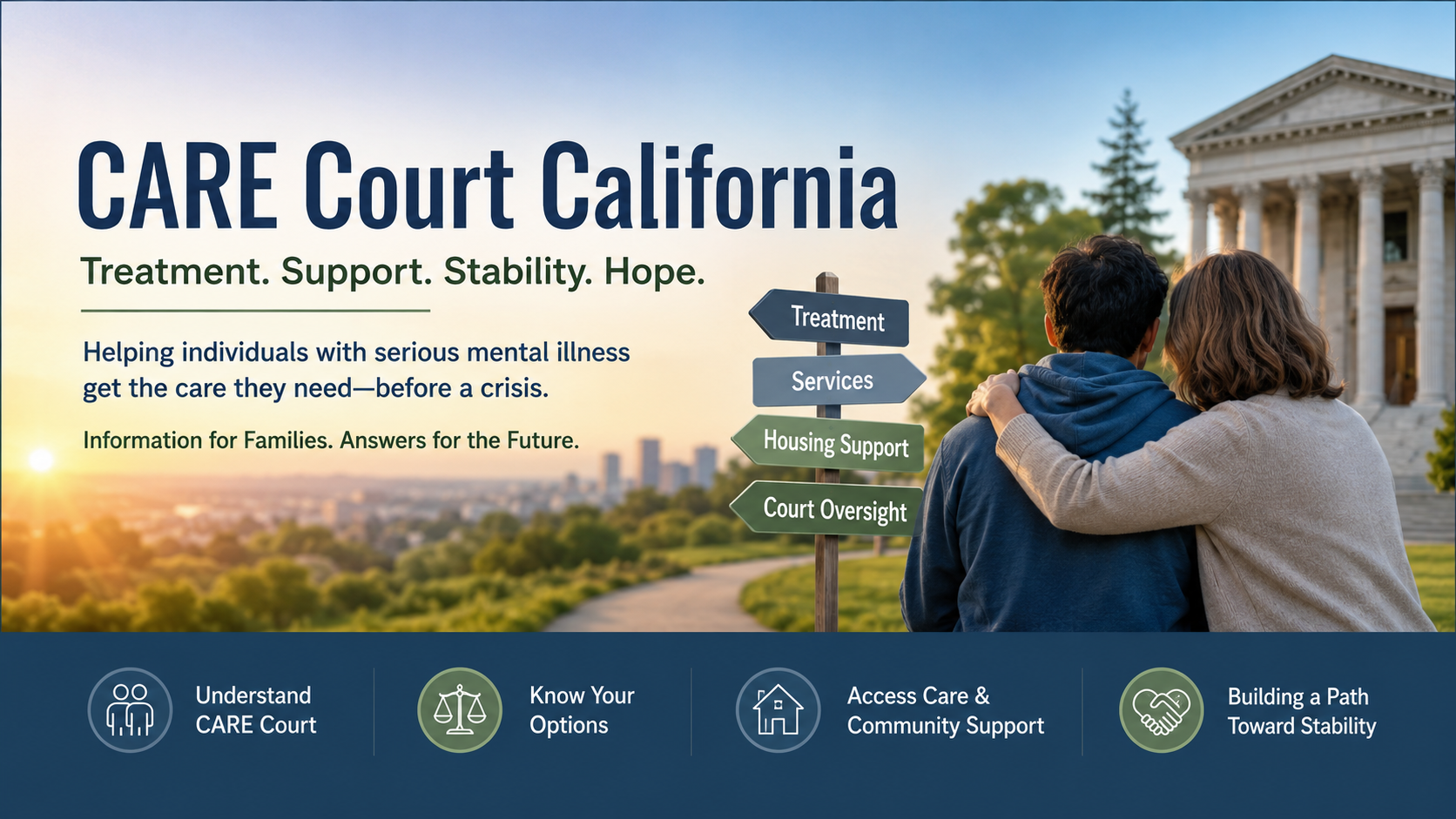
- CARE Court, officially called the Community Assistance, Recovery and Empowerment Act, is California’s civil court process for certain adults with serious untreated mental illness. It is designed to connect eligible people with treatment, services, housing support, and court oversight before the situation becomes worse.
- This page is intended as a plain-English starting point for families, caregivers, and individuals trying to understand CARE Court, mental health conservatorships, treatment rights, and related health insurance issues.
- Important: Steve Shorr is not an attorney, doctor, psychiatrist, psychologist, or tax adviser. This page is for general information only. If you need legal advice, medical advice, emergency help, or a court filing, contact the appropriate professional or agency.
Quick Summary: What Is CARE Court?
- CARE Court is not regular criminal court, and it is not the same thing as conservatorship. It is a civil court process where certain people can ask the court to review whether an adult may qualify for court-supervised mental health treatment and services.
- California courts explain that eligibility is limited and requires that the person meet specific CARE Act criteria. You can review the official California Courts eligibility information here:
- In Los Angeles County, you may also want to review the local court page here: Los Angeles County CARE Court.
- The CARE Act: A Structured Pathway to Stability CARE helps break the cycle of hospitalization, homelessness, and incarceration by coordinating treatment, housing, and accountability for people with severe untreated mental illness.
- It is a compassionate, structured path to stability and living a fuller life—focused on dignity and voluntary engagement. It is part of the continuum of California’s behavioral health system. chhs.ca.gov
- la times.com existing-statute-could-address-severe-mental-illness-addiction
Who May CARE Court Help?
- CARE Court is mainly aimed at adults with serious untreated psychotic disorders, such as schizophrenia spectrum disorders, who are not stabilized in ongoing treatment and who meet the other legal criteria. Family members, behavioral health providers, first responders, and certain other approved parties may be able to file a petition.
- If the person is already receiving appropriate treatment, or if the main issue is something outside CARE Court eligibility, another resource may be more appropriate. For broader mental health coverage issues,
- see our page on Mental Health & Substance Abuse Coverage.
CARE Court vs. Conservatorship
CARE Court is generally intended to be less restrictive than an LPS conservatorship. A mental health conservatorship may involve much greater control over a person’s treatment, placement, and decision-making. CARE Court is more focused on creating a court-supervised care plan or agreement.
| Issue | CARE Court | Conservatorship |
| Main purpose | Court-supervised treatment and services | Legal authority over a person who may be gravely disabled |
| Level of restriction | Generally less restrictive | Can be much more restrictive |
| Decision-making | The participant keeps more personal rights | A conservator may receive legal decision-making authority |
| Best starting point | LA County CARE Court | Our conservatorship page |
Who CARE Court Does NOT Help
CARE Court is not a general solution for every mental health, addiction, family, housing, or behavioral problem. This is important because many people hear “mental health court” and assume it applies to almost any difficult situation. It does not.
CARE Court may not be the right process when the main issue is:
- depression alone,
- anxiety alone,
- dementia,
- substance abuse or addiction alone,
- personality disorders alone,
- autism alone, or
- ordinary homelessness without a qualifying CARE Court mental health condition.
That does not mean these issues are not serious. It means CARE Court has limited legal eligibility rules. For health insurance and treatment coverage issues, see our pages on Essential Health Benefits, SB 855 Mental Health & Substance Abuse Treatment Coverage, and Medicare Mental Health Benefits.
Can CARE Court Force Someone Into Treatment?
- CARE Court is often misunderstood. It is court-supervised, but it is not the same as an emergency psychiatric hold, jail, locked treatment, or conservatorship. A person in CARE Court has rights, representation, and a court process.
- If someone is in immediate danger, CARE Court may not be fast enough. For emergency mental health situations, call 911, 988, your local crisis line, or go to an emergency room. CARE Court is more of a structured legal process than an instant emergency response.
Health Insurance and Treatment Access
- Even when a person qualifies for CARE Court, the practical question is often: Who will provide the treatment, where will the person go, and what will insurance cover?
- That is where health coverage rules may matter. California law, including SB 855, can be important when a health plan denies medically necessary mental health or substance abuse treatment. If treatment is denied, see our pages on Mental Health Resources and appeals-related mental health information.
- If the person has Medicare, see Medicare Mental Health Benefits. If the person has private or Covered California coverage, see Essential Health Benefits.
Related Pages on This Website
- Mental Health Conservatorships
- Mental Health Resources
- SB 855 Mental Health & Substance Abuse Treatment Coverage
- Autism and Health Insurance Coverage
- Medicare Mental Health Benefits
- Essential Health Benefits
- Contact Steve Shorr Insurance
Final Thought
- CARE Court may help some families, but it is not a magic wand. It depends on eligibility, available treatment, county resources, housing options, medical need, legal procedure, and the person’s actual situation.
- For some families, the next step may be learning about CARE Court in Los Angeles County.
- For others, the better starting point may be
CARE Court vs. Laura’s Law
- People often confuse CARE Court with Laura’s Law, also known as Assisted Outpatient Treatment (AOT). While both involve serious mental illness and court involvement, they are not the same program.
- CARE Court is California’s newer civil court process designed to connect certain adults with untreated psychotic disorders to treatment plans, services, and support before repeated hospitalization, incarceration, homelessness, or conservatorship occurs.
- Laura’s Law, also called Assisted Outpatient Treatment (AOT), is an older California law that allows counties to seek court-ordered outpatient treatment for certain individuals with severe mental illness who have a history of repeated hospitalizations, incarceration, or violence associated with untreated illness.
| Issue | CARE Court | Laura’s Law / AOT |
| Main goal | Treatment planning and support | Court-ordered outpatient treatment |
| Target population | Certain untreated psychotic disorders | Certain individuals with severe mental illness and repeated crises |
| County participation | Statewide implementation | Historically optional by county |
Both CARE Court and Laura’s Law are controversial. Supporters argue they may help some people receive treatment earlier, while critics raise concerns about civil liberties, available treatment resources, housing shortages, and whether enough community services actually exist.
Evaluations and services under the CARE Act Blue Shield covers the cost of developing an evaluation and the provision of all health care services for an enrollee when required or recommended pursuant to a CARE (Community Assistance, Recovery, and Empowerment) agreement or CARE plan approved by a court in accordance with the CARE Act.
The evaluation and services, other than prescription Drugs, are covered at no charge whether they are provided by a Participating or Non-Participating Provider.
AI Summary
- Connecting people to services: The program has connected some individuals to mental and behavioral health care, housing, and other services, though the number is lower than the initial projections.
- Establishing CARE agreements: Some individuals have agreed to voluntary CARE agreements, which is a step toward getting help.
- Addressing severe cases: The program is seen as a tool to address some of the most serious mental health crises.
- Increased petitions: Los Angeles County, in particular, has seen the most petitions filed, which is considered a sign of steady, gradual progress by some.
- Low number of court-ordered plans: Despite the initial promise, very few court-ordered treatment plans have been issued in Los Angeles, with most counties offering voluntary agreements instead.
- Slow rollout: The pace of the program is significantly slower than anticipated, with some counties initially needing to divert staff to raise awareness about the new system.
- Lack of successful completions: Los Angeles County has not yet had any “graduations,” meaning no one has successfully completed a CARE Court plan.
- Low overall engagement: The program has reached fewer people than projected, and petitioning has been difficult, leading to many dismissed petitions.
- Voluntary treatment: The program’s core is designed to be voluntary, connecting people with support and resources for mental health care, housing, and other services through a collaborative process.
- Court-ordered support: If an individual refuses voluntary treatment, a judge can order them to participate in a treatment plan, which can include medication, counseling, and housing.
- Addressing severe mental illness: The program is specifically targeted at individuals with severe mental illness who are unable to care for themselves. Get the Citations & Links Google AI
Laura’s Law
#LAURA ’s Law
Laura’s Law allows courts to order certain historically violent, dangerous, or incarcerated individuals to accept treatment as a condition of living in the community. To be eligible individuals must have a serious mental illness that causes them to be unlikely to survive safely in the community without supervision, and been in a hospital, prison or jail at least twice within the last thirty-six months; or involved in acts, attempts or threats of serious violent behavior toward self or others within the last forty-eight months.
Learn More ==>
- Report: Laura’s Law Works for Mentally Ill Los Angelenos
- Huffington Post Summary 12.16.2011
- latimes.com/
- en.wikipedia.org
- Los Angeles County Department of Mental Health – Implementation 3 pages
- Outreach & Engagement
- [email protected] or (213) 738-2440
- LAPD
- Welfare & Institutions Code §5348 et seq
- Court Services for mentally ill who get involved in Criminal Cases – Mental Health Court Linkage Program
- See CARE Proposals
- California CARE Court
- The first step is a petition to the court by a family member, behavioral health provider, first responder, or other approved party to provide care and prevent institutionalization of an individual.
- The civil court then orders a clinical assessment after a reasonable likelihood of meeting the CARE Court criteria is held. The court appoints a public defender and a CARE supporter to represent the individual to ensure their rights are being protected.
- The court reviews the clinical evaluation, and if the person meets the criteria, the development of a CARE plan is ordered, which will include therapy, medications, and housing as part of its objective Learn More Western Poverty Law 1/22/2024
- Eligibility Criteria LA Court.org
- Eligible petitioners must complete and submit the following materials to begin the CARE Court process:
- CARE-100 form AND
- CARE-101 Mental Health Declaration from a licensed behavioral health provider
OR - Attach evidence, to CARE-100 form, that the person in need of services was detained for a minimum of two periods of intensive treatment (WIC 5250 hold process) and the most recent event occurred within the past 60 days.
- Eligible petitioners must complete and submit the following materials to begin the CARE Court process:
- Community Assistance, Recovery and Empowerment (CARE) Act
- CARE Court Information and Resources DMH Department of Mental Health
- NAMI on Care Court
- 6 things to know about how Gov. Newsom’s CARE Court is working so far Cal Matters.org 9/2025
- Attorney I found on Google who can help you get your loved one help
- CA Courts What is Drug Court?
- Most adult drug courts in California are post-adjudication models in which participants are placed in drug court after entering a guilty plea.
- DHCS
- If you have questions, we are not really qualified to help you. Please contact the court, a therapist, your attorney, etc.
#Schizophrenia
- Schizophrenia Booklet NIH
- nimh.nih.gov/schizophrenia
- web md.com/schizophrenia/
- Mayo clinic on schizophrenia
- Wikipedia on schizophrenia

The comment section below is not necessarily monitored. It's not part of our Health, Life and Long Term Insurance Practice.
Hopefully, another website visitor can help you.