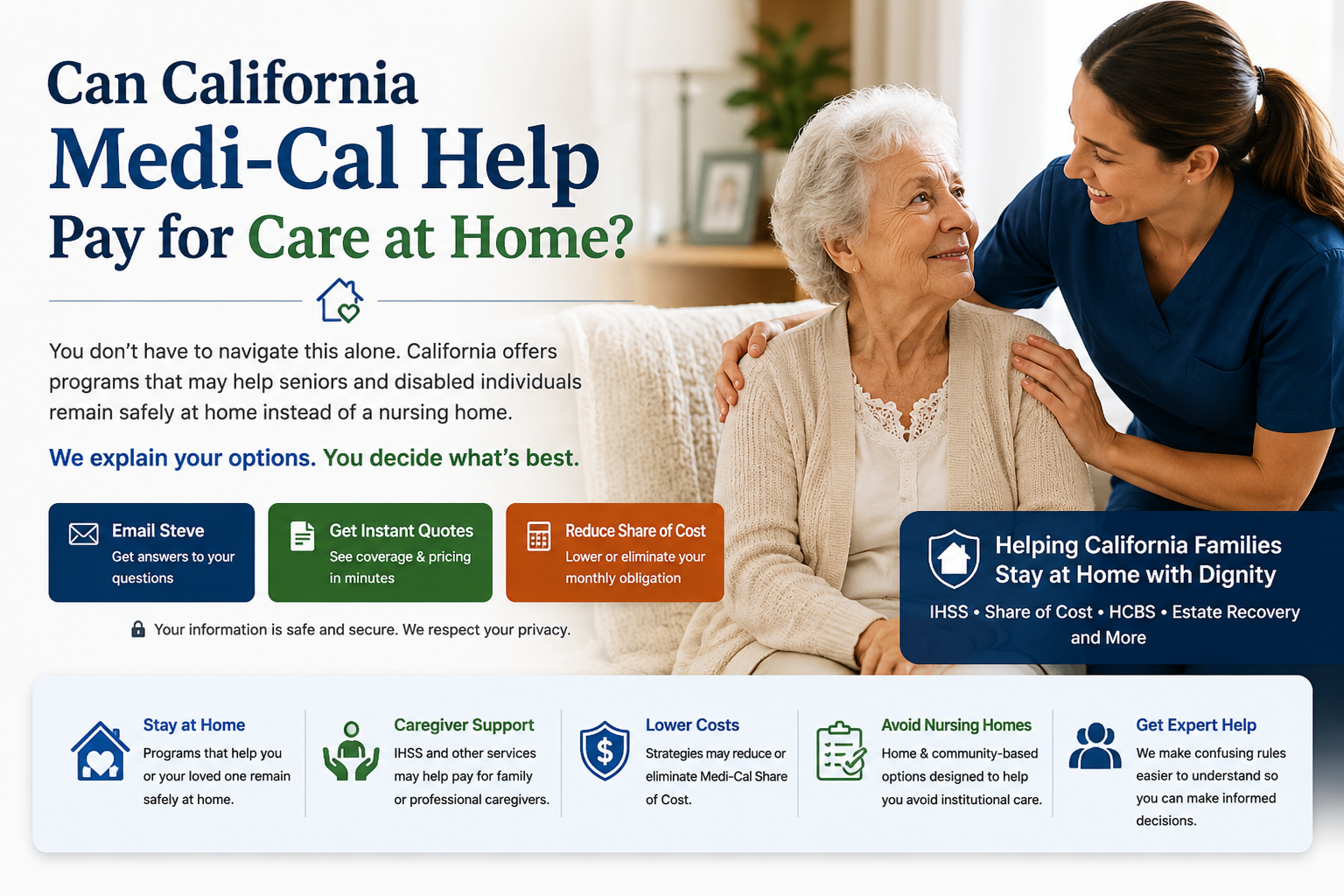
Can California Medi-Cal Help Pay for Care at Home IHSS?
- Many Californians are trying to avoid nursing homes and keep a parent, spouse, or disabled family member safely at home. Programs such as
- IHSS,
- Medi-Cal Share of Cost,
- HCBS waivers,
- disability rights ca.org/ home-and-community-based-alternatives-hcb-alternatives-waiver
- dpss.lacounty.gov/ /hcbs
- dds.ca.gov/ /hcbs/
- dhcs.ca.gov 1915c-home-and-community-based-services-waivers
- PACE, and
- other Medi-Cal services may help pay for caregivers, home support, medical care, or
- assisted living services.
- The problem is that the rules are confusing, the programs overlap, and many people are not sure where to start. This page is designed to give you a plain-English overview of some of the California programs that may help seniors and disabled individuals remain at home.
What Are You Trying To Do?
- Care for a Parent or Spouse at Home
Many families are looking for programs that may help pay for caregivers, supervision, meal preparation, transportation, or assistance with activities of daily living. Learn about California IHSS →
- Reduce Medi-Cal Share of Cost
Some individuals with high medical expenses may qualify for strategies that can reduce or eliminate monthly Medi-Cal Share of Cost obligations. Learn about Medi-Cal Share of Cost →
- Avoid a Nursing Home
California has several home and community-based care programs intended to help certain seniors and disabled individuals remain safely at home instead of entering institutional care. Learn about HCBS Waivers →
- Understand Estate Recovery Rules
Many families are concerned that Medi-Cal may “take the house.” The rules are more complicated than most people realize. Learn about Medi-Cal Estate Recovery →
- Pay for Assisted Living or Board & Care
Certain California programs may help some individuals receive services outside of a nursing home setting. Can Medi-Cal Help Pay for Assisted Living? →
What Is IHSS?
IHSS stands for In-Home Supportive Services. The program may help certain elderly, blind, or disabled California residents remain safely in their homes by providing support services such as:
- Meal preparation
- Bathing and dressing assistance
- Housekeeping
- Transportation
- Protective supervision
- Help with medications
- Personal care services
In some situations, family members may be eligible to serve as paid caregivers under IHSS rules.
However, eligibility rules, assessments, hours authorized, and interactions with Medi-Cal Share of Cost can become complicated very quickly.
Common Questions
- Can family members get paid to provide care?
Sometimes yes. California IHSS rules may allow certain relatives to serve as caregivers. - Does IHSS affect Medi-Cal Share of Cost?
Potentially. Different Medi-Cal eligibility categories and deductions can interact with Share of Cost rules. - Can IHSS help someone avoid a nursing home?
In some cases, yes. IHSS and related programs are often intended to help individuals remain safely at home. - Does Medicare pay for long-term caregiving?
Usually not in the way most people expect. Medicare generally focuses on medically necessary skilled care, not ongoing custodial care. - Can Medi-Cal help pay for assisted living?
Sometimes, through specific waiver or community-based programs, depending on eligibility and availability.
Need Help Understanding California Medi-Cal Options?
Every situation is different. Seniors, disabled individuals, caregivers, and family members often need help understanding how Medicare, Medi-Cal, Share of Cost, IHSS, and long-term care programs work together.

What are HCBS Home and Community-Based Services?
Medicaid- Medi Cal covered HCBS are services that support older adults and people with disabilities with activities of daily living in settings of their choice, including their homes, assisted living facilities, and adult day health centers. Supports include, for example, personal care assistance, care coordination, medically-tailored nutrition, transportation, medication management, home modifications, and, for individuals with high care needs, 24-hour nursing and supervision. California’s HCBS programs include:
- Assisted Living Waiver provides care and supervision in licensed board and care settings such as Residential Care Facilities for the Elderly and at a limited number of public subsidized housing sites.
- Community-Based Adult Services Program provides social, therapeutic, nutrition, and personal care services at adult day health centers.
- California Community Transitions/Money Follows the Person assists residents in skilled nursing facilities transition to community housing by identifying, adapting, and setting up housing.
- Home and Community-Based Alternative Waiver provides personal care, 24-hour nursing, and other supports to people with complex needs.
- Home and Community-Based Services for the Developmentally Disabled coordinates and purchases support services for consumers with developmental disabilities through the Department of Developmental Services’ Regional Centers.
- In-Home Supportive Services (IHSS), a consumer-directed personal care program serving over 800,000 older adults and people with disabilities, provides assistance with activities of daily living like dressing, bathing, eating, and household chores.
- Medi-Cal Waiver Program provides case management and personal care services to individuals living with HIV/AIDS as an alternative to nursing facility care.
- Multipurpose Senior Services Program includes intensive care and service coordination, social supports, home repairs, and adult day programs for older adults age 65 and over.
- Program of All-Inclusive Care for the Elderly (PACE) provides coordinated health and home and community-based services to older adults at site-based PACE centers. Source Justice in Aging *
Can Medi Cal Recover for IHSS?
- Age 55+: For individuals who received long-term care services, including IHSS, after age 55.
- Institutionalization: For anyone, regardless of age, who was permanently institutionalized.
- Services Covered: Nursing facility care, home and community-based services (like IHSS), and related hospital/prescription drug costs. [2, 5, 6, 7]
- Post-2017 Changes: For deaths on or after January 1, 2017, recovery is limited to nursing facility services and HCBS, including IHSS, but only for payments made for those specific services. dhcs.gov * dhcs.gov pdg * CANHR.org FAQ’s *
- Surviving Spouse/Minor/Disabled Child: If a surviving spouse, minor child, or disabled dependent lives in the home.
- No Probate Assets: If the estate has no assets subject to probate (e.g., held in a properly structured trust).
- Specific Service Exclusions: Costs for Medicare premiums/co-pays for certain low-income beneficiaries are exempt, and some Personal Care Services (PCS) under specific waivers might also be excluded. [1, 2, 4, 8]
- Estate Planning: Tools like irrevocable trusts can help protect assets from recovery claims.
- Notification: The state sends a notice (itemized bill) to heirs after the recipient dies.
- Professional Advice: Because rules are complex, consulting a California estate planning attorney experienced with Medi-Cal is highly recommended. [2, 7, 8, 9, 10]
FAQ’s
Can IHSS Providers – Care Workers – Get Medi Cal regardless of their income?
Here’s what the PASC-SEIU Homecare Workers website says –
As long as you are authorized work 74 hours or more per month for two consecutive months. You will continue to be eligible as long as you continue to be authorized to work at least 74 hours per month. View actual wording
On the other hand:
IHSS workers would be presumptively eligible, for 6 months – you can get temporary coverage until official eligibility is determined Law Insider * for full [Medi Cal] benefits and there would be no means test – they won’t look at your income, resources – assets or your ability to pay for health insurance. Sooner or later though, A Medi Cal application would eventually have to be completed. Investopedia * Dhcs * Report to CA Health Care Foundation by USC June 2000
On the other hand:
Here’s an optometrist making $200k that was the IHSS caretaker for his mother. He states:
i was never asked about income if i remember correctly email dated 5.9.2022
On the other hand:
I don’t do phone calls – especially when I don’t get compensated to help people with IHSS – here’s a number to call
Providers who are eligible for the plan will automatically be sent an enrollment packet that describes what the PASC- SEIU Homecare Workers Health Care Plan provides. If you are eligible for the health plan, you may contact the PASC Health Plan Call Center at 1-855-PASC-PLN, (1-855-727-2756), to request an enrollment form.
If you are already enrolled in L.A. Care plan and have additional questions about specific benefits provided by the Plan, please call L.A. Care at 1-844-854-7272, or go to their website at www.lacare.org/members/ihss.
- Visit our historical webpage on IHSS
What is the
CA Assisted Living Waiver?
- Eligibility: Must be full-scope Medi-Cal eligible with zero share of cost, require a nursing facility level of care, and be able to pay for room and board.
- Coverage & Availability: The program is authorized in 15 California counties (including Los Angeles, San Diego, and San Francisco) through February 28, 2029.
- Services Provided: Includes care coordination, personalized care plans, 24-hour care, and routine, scheduled nursing visits.
- Goal: To provide a less restrictive, home-like environment, avoiding unnecessary institutionalization.
- Waitlist/Limitations: It is not an entitlement program, and spots are limited, often leading to waitlists. [1, 2, 3, 4, 5]
Participants in the ALW have access to the following services:
- Assisted Living Services: The following is a list of some of the services that must be provided to ALW participants. These services may be provided in an RCFE, or by a licensed Home Health Agency to residents in public housing.
- Assisting in developing and updating an individualized care plan for each resident
- Personal care and assistance with activities of daily living
- Laundry
- Housekeeping
- Maintenance of the facility
- Providing intermittent skilled nursing care
- Meals and snacks
- Providing assistance with self-administration of medications
- Providing or coordinating transportation
- Providing recreational activities
- Providing social services
- Care Coordination: These services include identifying, organizing, coordinating and monitoring services needed by participants .
- Nursing Facility Transition Care Coordination: These services help transition participants from a nursing home to the community. CA Assisted Living Waiver
Resources & Links
- DHCS.CA.Gov – CA Department of Health Care Services
- Assisted Living Waiver
- Elder Options – Private Website – DHCS subcontractor that can help people in Sacramento Area
- Nolo Press
FAQs / Ask Us a Question
Question
My 92 year old mother is on Medi-cal and Scan, but needs to go into assisted living with waiver application. They won’t accept Scan. They said she has to drop it. Does she automatically go on Medi–Medi and will her new doctor take it? The application takes 3-6 months for approval but I have to drop her from Scan insurance before I fax over the waiver form…
Answer
***I don’t have enough background to answer your question. I did learn though, my first day at my Father’s & Grand Fathers Insurance Agency, to NEVER cancel coverage till new coverage was confirmed!
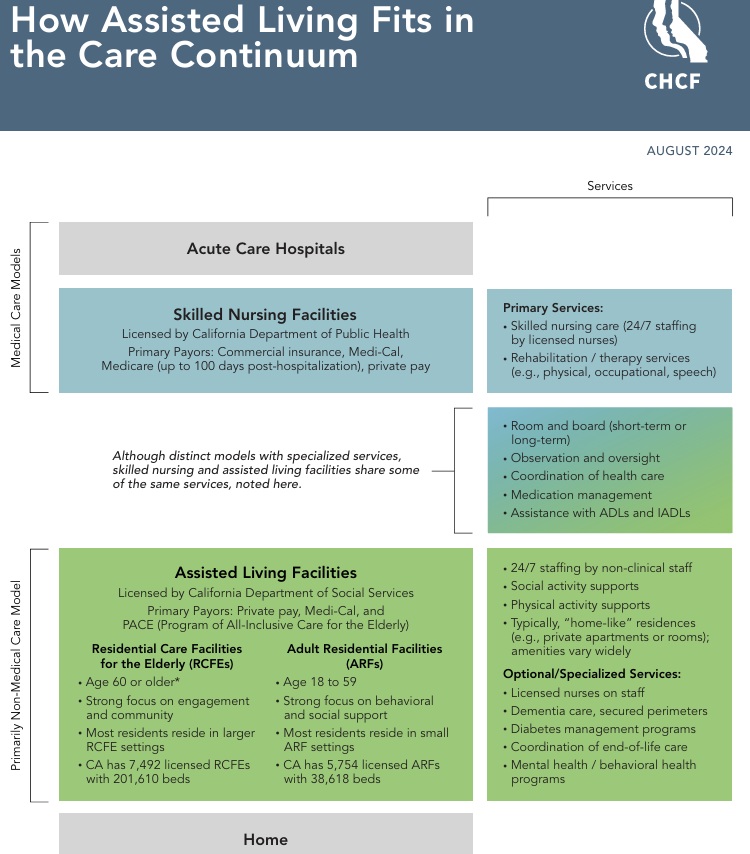
Learn more chcf.org what-is-assisted-living/
https://cahealthadvocates.org/pace-a-comprehensive-care-option-that-helps-older-adults-stay-in-their-communities/?mc_cid=614e35cc56&mc_eid=d8ceac2e29
freedom blue