Newport Beach Court Case to try to keep Rehabs out
🔗 Newport will pay group homes $5.25 million settlement
1. The city tried to restrict recovery homes
- Newport passed an ordinance limiting group homes and requiring permits (Los Angeles Times)
2. The operators said it was discriminatory
- They argued it targeted people in recovery (a protected class) (Los Angeles Times)
3. The case went all the way up
- It reached the 9th Circuit Court of Appeals
- Which said the ordinance may be discriminatory (Los Angeles Times)
4. The city ultimately paid millions
- $5.25 million settlement (Los Angeles Times)
👉 That’s huge.
“Newport Beach tried to restrict rehab homes… and ended up paying $5.25 million.”
Then follow with:
- “Courts said the law may have been discriminatory”
- “People in recovery are protected under federal law”
👉 Now you’re not arguing theory—you’re showing what actually happens
🧠 What This Article Proves (Plain English)
This article confirms:
- Cities do try to restrict rehab/sober living
- They often base it on:
- complaints
- neighborhood concerns
- Those laws get challenged under:
- ADA
- Fair Housing Act
- And when they lose…
👉 They pay.
- Same state (California)
- Same type of facility (recovery housing)
- Same arguments (neighbors complaining about impacts)
- Same legal framework
👉 It’s basically a real-world version of the Pacific Shores case outcome
Newport Beach tried to stop rehab homes.
They lost—and paid $5.25 million.That’s not opinion. That’s what actually happens.
ADA Protections for Rehabs
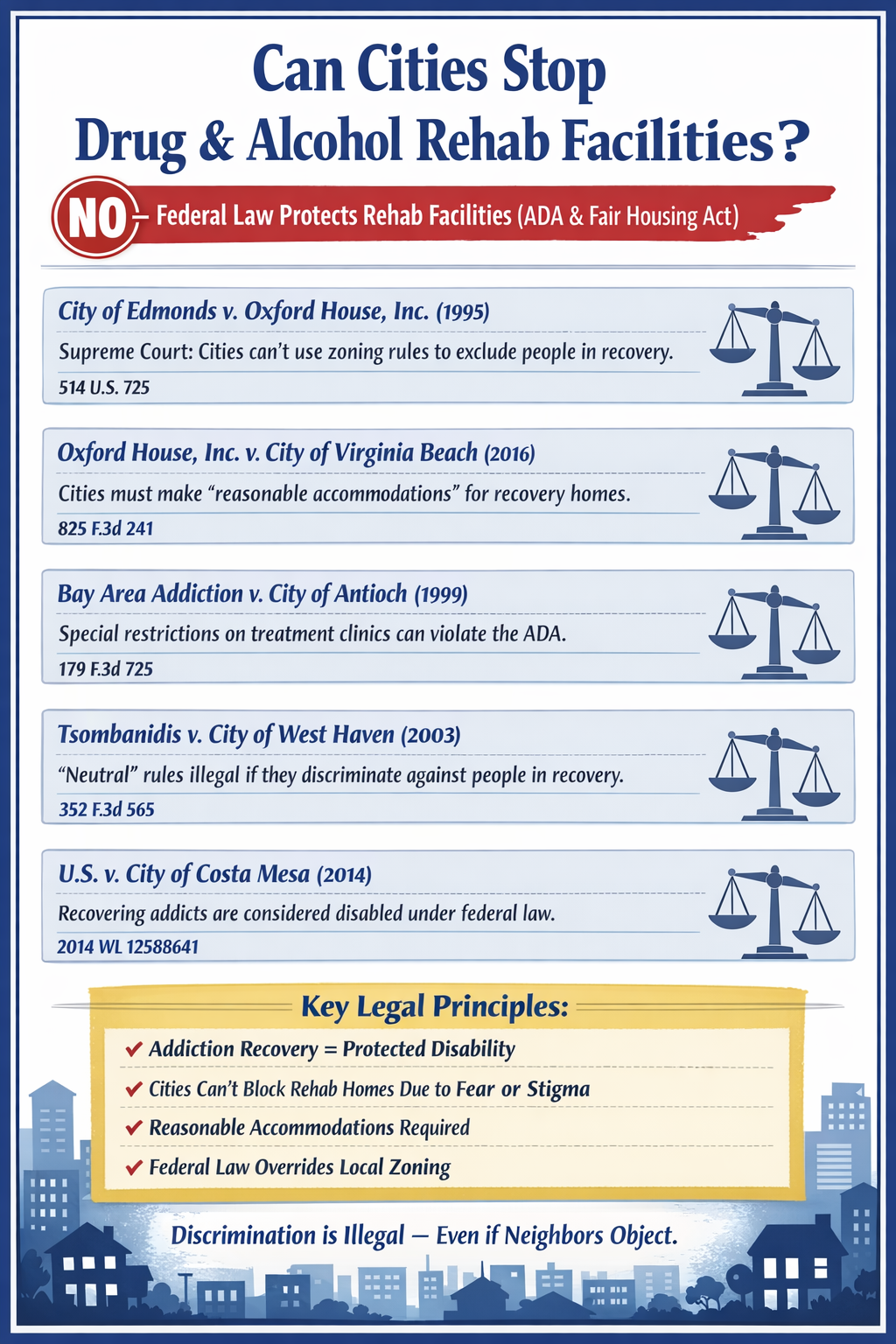
Can Cities Stop Drug & Alcohol Rehab Facilities?
Short Answer: Usually No.
Federal law generally protects people recovering from drug or alcohol addiction. That means cities usually cannot block rehab facilities, sober living homes, or recovery housing simply because neighbors are worried about crime, safety, homelessness, or property values.
The two most important federal laws are the Americans with Disabilities Act (ADA) and the Fair Housing Act (FHA). In many zoning disputes, the Fair Housing Act is especially important because the legal fight is often really about housing discrimination, not just disability access.
Who Is Protected Under Federal Law?
Generally protected:
- People recovering from drug addiction
- People with alcohol use disorder
- People participating in treatment or recovery programs
- People receiving medication-assisted treatment, when lawfully prescribed
Generally not protected:
- People currently engaged in illegal drug use, when the action is based on that current illegal use
That distinction is important. Federal law protects recovery and treatment, but it does not require cities or operators to ignore actual unlawful conduct.
What Types of Facilities Are Usually Protected?
Different rules can apply depending on the type of facility, but federal protections often extend to:
- Sober living homes
- Group homes for people in recovery
- Outpatient treatment facilities
- Methadone or medication-assisted treatment clinics
- Licensed residential rehab programs
Cities often try to treat these facilities differently through zoning, spacing, permitting, or occupancy rules. But they cannot single them out based on stigma or neighborhood fear.
What Cities Usually Cannot Do
- Block a facility because neighbors do not want it nearby
- Use “family” or occupancy definitions as a backdoor way to exclude people in recovery
- Require special permits or extra hurdles based only on fear or stereotypes
- Impose stricter standards on recovery housing than on similar housing
- Rely on generalized claims about crime, homelessness, or declining property values
In plain English, cities cannot use fear, stigma, or politics as a lawful reason to keep protected people out of a neighborhood.
What Cities May Still Regulate
Cities are not powerless. They may still enforce:
- Neutral health and safety codes
- Building and fire requirements
- Licensing laws
- Truly neutral zoning rules
- Rules addressing documented, specific misconduct
But even then, they may have to make a reasonable accommodation if enforcing the rule would deny people with disabilities an equal opportunity to use and enjoy housing.
What “Reasonable Accommodation” Means
Reasonable accommodation is one of the most important legal protections in these cases. It means a city may have to modify or make an exception to a rule when necessary to give people with disabilities equal housing access.
Examples may include:
- Allowing more unrelated people to live together
- Making exceptions to spacing requirements
- Adjusting permit requirements
- Allowing recovery housing in residential neighborhoods
This is why cities often lose these cases. A rule may look neutral on paper, but if it blocks disabled residents from housing and the city refuses a reasonable accommodation, federal law may be violated.
Why Cities Usually Lose
- Their evidence is too general
- Their arguments are based on stereotypes or neighborhood fear
- They cannot prove the facility will actually cause harm
- They fail to offer a reasonable accommodation
- Federal civil rights law overrides conflicting local rules
Many of the arguments raised against rehab or sober living homes today are familiar: “crime,” “property values,” “neighborhood character,” or “safety.” Courts have repeatedly held that those concerns are not enough without specific, objective, and reliable evidence.
What Courts Reject as Evidence
- Public fear or neighborhood opposition
- Speculation that crime will increase
- General claims about addiction or homelessness
- Petitions, letters, and hearing comments based on assumptions
- Broad crime data not tied to the actual facility
Courts consistently reject “not in my backyard” arguments when they are based on stigma instead of facts.
What Courts Are More Likely to Consider
- Objective evidence tied to the specific operator or facility
- Comparable data from similar facilities
- Documented incidents, not rumors
- Qualified expert testimony
- Evidence showing actual causation, not just correlation
Even then, the legal standard is high.
The “Direct Threat” Standard
A city can restrict a protected facility only if it can show a direct threat to the health or safety of others. That does not mean a hypothetical risk or a political concern. It means a real, specific, evidence-based, significant risk.
A direct threat must be:
- Real, not speculative
- Specific, not based on assumptions about a group
- Supported by objective evidence
- Serious enough to justify the restriction
That is why cities rarely succeed. Fear is not enough. Public pressure is not enough. Generalized claims about addiction are not enough.
Important Court Decisions
City of Edmonds v. Oxford House, Inc., 514 U.S. 725 (1995).
The Supreme Court held that cities cannot use zoning and occupancy rules as a backdoor way to exclude people with disabilities, including people recovering from addiction.
Oxford House, Inc. v. City of Virginia Beach, 825 F.3d 241 (4th Cir. 2016).
The court held that cities may have to make reasonable accommodations to zoning rules so people in recovery have equal access to housing.
Bay Area Addiction Research and Treatment, Inc. v. City of Antioch, 179 F.3d 725 (9th Cir. 1999).
The Ninth Circuit ruled that singling out a treatment facility for extra restrictions can violate federal disability law.
Tsombanidis v. City of West Haven, 352 F.3d 565 (2d Cir. 2003).
The court explained that even neutral rules may be unlawful if they have a discriminatory effect on people in recovery.
United States v. City of Costa Mesa, 2014 WL 12588641 (C.D. Cal. 2014).
A California federal court confirmed that people recovering from addiction are generally protected under the ADA and FHA.
Bottom Line
Cities may regulate health, safety, and neutral land-use issues. But they generally cannot block rehab facilities, sober living homes, or recovery housing based on fear, stigma, politics, or neighborhood opposition.
To lawfully stop a protected facility, they would usually need strong, specific, objective evidence of a real and direct threat. That is a very high legal standard, which is why cities so often lose these cases.
Federal civil rights law was designed to prevent communities from excluding protected people simply because they are unpopular, misunderstood, or feared.
Disclaimer: This is a general summary of federal law and court decisions. It is not legal advice. Outcomes depend on the specific facts, type of facility, and local enforcement.
- Existing Infrastructure: There are many addiction treatment centers in Los Angeles, including private options like American Addiction Centers (AAC) and providers like L.A. CADA which offer counseling, residential, and outpatient services.
- Medicaid Coverage: L.A. Care Health Plan covers substance use disorders through primary care, hospitals, and specialty providers.
- Need for Expansion: While resources exist, demand often exceeds capacity, especially for affordable and accessible, comprehensive inpatient, detox, and outpatient programs.
- Addressing Challenges: The county continues to work on expanding services for individuals with co-occurring disorders and those needing long-term recovery support
.
What Cities Tried to Prove — And Why Courts Rejected It
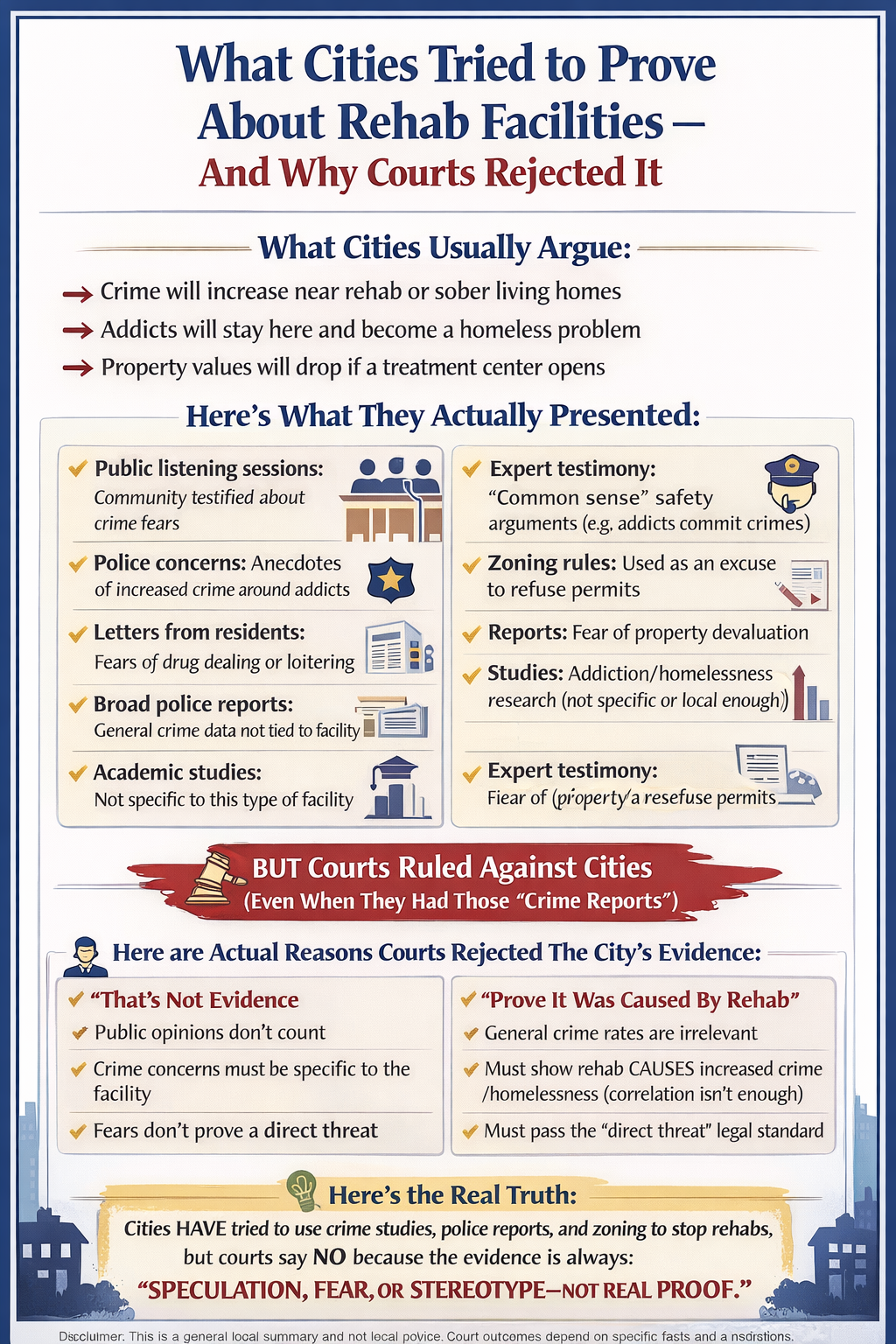
Many cities and neighborhoods have tried to stop rehab and sober living facilities by arguing crime, homelessness, and declining property values. In several cases, they even presented reports, testimony, and studies.
But courts still ruled against them.
What Cities Typically Tried to Prove
- Crime would increase near rehab or sober living homes
- People would remain in the area and become homeless
- Property values would decline
- Neighborhood safety and “character” would be harmed
What They Actually Presented as Evidence
- Public testimony: Residents expressing fear of crime or loitering
- Police anecdotes: General concerns about drug-related activity
- Letters and petitions: Community opposition
- General crime reports: Not tied to the specific facility
- Broad academic studies: About addiction or homelessness in general
- “Expert opinions”: Often based on assumptions, not localized data
Why Courts Rejected This Evidence
- “That’s not evidence”: Public opinion and fear do not count
- Lack of specificity: Data must relate to the exact type of facility
- No causation: Cities must prove the facility CAUSES harm, not just that harm exists
- Failure to meet ADA standards: Must show a real, direct threat — not speculation
Citation: City of Cleburne v. Cleburne Living Center, 473 U.S. 432 (1985)
The Legal Reality
Even when cities presented crime reports or studies, courts found they were:
- Too general
- Not tied to the specific facility
- Based on stereotypes about addiction
- Insufficient to prove a direct threat under federal law
Citation: Bay Area Addiction Research and Treatment, Inc. v. City of Antioch, 179 F.3d 725 (9th Cir. 1999)
Bottom Line
Cities HAVE tried to use crime data, studies, and reports to stop rehab facilities.
But courts consistently rule that unless the evidence shows a specific, proven, and direct threat, it is considered:
Speculation. Fear. Or stereotype — not legal proof.
Disclaimer: This is a general summary of federal disability and housing law and is not legal advice.
Ventura vs. Rehab Centers — Can They Actually Stop Them?
Cities like Ventura have tried to block drug & alcohol rehab homes—often with rules like “no facilities within 1,000 feet of a school.”
Sounds reasonable… but here’s the reality:
➡️ People in recovery are protected as disabled under federal law
➡️ That triggers the Fair Housing Act (FHA) and Americans with Disabilities Act (ADA)
➡️ Cities generally can’t single them out with stricter zoning rules
Courts have already pushed back on these efforts. In multiple cases, cities that tried spacing rules or special restrictions lost.
Bottom line:
Ventura can try to regulate—but if they go too far, federal law will override them.
This isn’t just zoning anymore.
It’s civil rights vs. local control… and civil rights usually win.
What Evidence Do Courts Accept About Crime, Safety, and Community Impact?
In cases involving rehab facilities, sober living homes, and treatment centers, courts do NOT accept speculation, fear, or public opposition as evidence. They require objective, reliable, and specific proof.
1. What Courts REJECT as Evidence
- Neighbor opinions or fears (“we think crime will go up”)
- Public comments at hearings based on speculation
- General stereotypes about addiction or homelessness
- Unsupported claims about property values or safety
- “Not in my backyard” (NIMBY) arguments
Key Point: Courts consistently rule that community opposition is not evidence of a legitimate safety risk.
Citation: City of Cleburne v. Cleburne Living Center, 473 U.S. 432 (1985) – negative attitudes and fears are not a valid basis for government action.
2. What Courts WILL Consider as Evidence
- Actual crime statistics tied to similar facilities (not general crime rates)
- Peer-reviewed studies on treatment centers and community impact
- Expert testimony (criminologists, urban planners, public health experts)
- Documented incidents directly linked to the specific facility or operator
- Comparable case data from similar neighborhoods
Key Point: The evidence must be specific, not hypothetical, and must directly connect the facility to measurable harm.
Citation: Bay Area Addiction Research and Treatment, Inc. v. City of Antioch, 179 F.3d 725 (9th Cir. 1999).
3. The “Direct Threat” Standard (Very Important)
Under federal law, a city can restrict a facility ONLY if it can prove a “direct threat” to health or safety.
- The threat must be real and specific
- It must be supported by objective evidence
- It cannot be based on assumptions about people in recovery
Example: A documented pattern of violent incidents tied to a specific operator might qualify. General fears about “addicts” do not.
Citation: 28 C.F.R. § 35.139 (ADA Direct Threat Standard)
4. What About Crime or Homelessness After Treatment?
Courts generally require:
- Longitudinal studies showing outcomes after treatment
- Data tied to similar programs (not assumptions)
- Evidence of causation — not just correlation
Important: Claims like “people will stay and become homeless” are usually rejected unless backed by credible, location-specific data.
5. How You Would Actually Gather Evidence (Even If It Fails in Court)
- Request police crime data before and after similar facilities opened
- Look for academic or government studies on rehab outcomes
- Hire or cite expert witnesses (urban planning, public health)
- Document specific incidents tied to a facility (not general behavior)
- Compare matched neighborhoods with and without facilities
Reality Check: Even well-prepared evidence often fails because federal law prioritizes equal access to housing and treatment over speculative community concerns.
Bottom Line
You cannot stop a rehab facility with fear, opinions, or politics.
You would need hard data, expert analysis, and proof of a direct, specific threat — which is why cities rarely succeed.
Disclaimer: This is a general legal summary and not legal advice. Court outcomes depend on specific facts and jurisdictions.
What Is the “Direct Threat” Legal Standard?
Under federal law, a city or government can only deny a rehab or sober living facility if it can prove a “direct threat to the health or safety of others.”
What “Direct Threat” Really Means
- Real: Not hypothetical or based on fear
- Specific: Must relate to the actual facility or individuals
- Evidence-Based: Requires objective data, not opinions
- Significant Risk: Must show serious harm, not minor concerns
Citations: 28 C.F.R. § 35.139; 24 C.F.R. § 100.202(d)
What Does NOT Qualify as a “Direct Threat”
- General fears about crime or safety
- Concerns about property values
- Community opposition or public testimony
- Stereotypes about addiction or homelessness
Citation: City of Cleburne v. Cleburne Living Center, 473 U.S. 432 (1985)
What Courts Require Instead
- Individualized assessment — not assumptions about a group
- Objective evidence — crime data, documented incidents, expert testimony
- Current conditions — not speculation about the future
- No reasonable alternative — must consider ways to reduce risk
Bottom Line
A city cannot block a rehab facility based on fear, politics, or public pressure.
They must prove a real, specific, evidence-based danger — which is why this standard is rarely met.
Disclaimer: This is a general summary of federal law and is not legal advice.
Here’s a Facebook-ready version (tight formatting, minimal line breaks, strong citations):
Does the Costa Mesa sober living case change the law? Short answer: Not really—but it does make it harder to stop these facilities.
The older case, Pacific Shores Properties v. City of Newport Beach, is still good law. It said cities can lose if they target sober living homes based on bias against recovering addicts (who are protected under federal disability law). Even a neutral law can be illegal if there’s evidence of intent to discriminate.
But the newer Ninth Circuit ruling highlighted in this article (Costa Mesa) shifts the focus. The court basically said: cities CAN regulate sober living homes—permits, spacing rules, zoning—as long as the overall system still allows housing for people in recovery. In other words, regulation is OK if it doesn’t effectively shut them out.
https://voiceofoc.org/2024/12/costa-mesa-scores-legal-victory-in-sober-living-home-court-battle/
What’s the real takeaway? Before, cities could lose just for showing hostility (“we don’t want these people here”). Now, courts are more likely to ask: does the city still provide a workable path for sober living homes? If yes, the city usually wins.
So no—the Costa Mesa case doesn’t overturn Pacific Shores. But it does make lawsuits harder for operators and gives cities a clearer roadmap to regulate these homes without violating the law.
Bottom line: Sober living homes are still protected—but they are NOT untouchable.
Short answer:
There’s no clear historical evidence of major, organized “NIMBY-style” pushback in San Pedro specifically against the Wellenberg / Harlan Shoemaker special education campus—at least nothing like what you see today with rehab centers or group homes. But that doesn’t mean there was no resistance at all. It just looked very different depending on the era.
🏫 Harlan Shoemaker / Wellenberg (San Pedro)


-
The campus dates back to at least the early 1960s as a specialized public school facility. (Calisphere)
-
It served students with disabilities, long before modern ADA laws (which came later in 1990).
What’s notable:
-
These schools were usually government-run (LAUSD) rather than private facilities.
-
That alone reduced opposition compared to private facilities (like rehabs or sober living homes today).
🤔 Was there NIMBY opposition back then?
1. Less visible, less documented
-
In the 1950s–1970s, opposition to facilities for people with disabilities often wasn’t framed as open protest.
-
Instead, it showed up as:
-
Quiet siting decisions (placing facilities in less affluent areas)
-
Segregation (separate campuses instead of mainstreaming)
-
Limited community input (fewer public hearings than today)
-
👉 In other words: the “pushback” often happened behind the scenes, not as public activism.
2. Different legal environment (pre-ADA)
Before the Americans with Disabilities Act:
-
People with disabilities had fewer enforceable rights
-
Cities and districts had more discretion on where to place facilities
-
Communities didn’t have to fight ADA protections—because they didn’t exist yet
👉 So ironically:
-
Today → opposition clashes with federal law
-
Back then → opposition could quietly shape outcomes without legal battles
3. Public schools vs. “undesirable uses”
There’s a big distinction:
| Type of facility | Typical reaction historically |
|---|---|
| Public school (even special ed) | Generally accepted |
| Rehab / mental health facility | Often resisted |
| Group homes | Frequently opposed |
Why?
-
A school = “community asset”
-
A rehab = “perceived risk” (crime, property values, stigma)
🧠 But there was stigma
Even without organized protests:
-
Families often resisted integration into regular schools
-
Students with disabilities were frequently isolated
-
Communities preferred separate facilities (like Wellenberg)
👉 That separation itself is a form of “soft NIMBYism”:
“We’ll accept it… just not mixed in with us.”
⚖️ How this compares to today (your rehab question)
Today, facilities like rehabs are protected under laws like:
-
Americans with Disabilities Act
-
Fair Housing Act
And courts have repeatedly treated:
-
addiction recovery housing
-
mental health facilities
👉 as protected uses similar to disability services
That’s why modern opposition looks like:
-
zoning fights
-
“1,000 feet from schools” proposals
-
lawsuits
🧾 Bottom line (good for your Facebook framing)
-
There’s no strong record of public backlash in San Pedro against Wellenberg/Harlan Shoemaker.
-
But that’s not because people were more accepting.
-
It’s because:
-
decisions were more top-down
-
stigma was handled through segregation, not protest
-
legal protections didn’t force integration
-
👉 Today’s conflicts are louder because the law now requires inclusion.
If you want, I can turn this into a tight Facebook post that ties directly into your rehab/NIMBY argument—it actually makes a pretty strong historical analogy.
🏥 Can a Rehab Facility Open in Your Neighborhood?
Short answer: YES — and cities often can’t stop it.
🧠 Who is protected?
✔ Alcoholism is a disability under the Americans with Disabilities Act (ADA)
✔ People recovering from drug addiction are protected
❌ Current illegal drug use is NOT protected
🏠 Housing rights:
Under the Fair Housing Act, recovery housing is treated like housing for people with disabilities.
That means cities cannot block it just because neighbors don’t like it.
⚖️ California law goes even further:
Sober living homes are often treated like normal residential housing.
📍 Los Angeles rules:
• Small group homes (≈6 or fewer) are treated like single-family housing
• Larger facilities must follow zoning — but rules must be neutral
• Operators can request exceptions (called “reasonable accommodation”)
⚖️ Bottom line:
Rehab and sober living homes are generally protected by law.
Cities cannot deny them based on stigma or fear — only real safety or neutral zoning issues.
💬 You may not like it… but legally, recovery housing is treated like housing for any other disability.
Here’s your Facebook version with plain-English case explanations added (tight, readable, and still platform-friendly):
CAN SAN PEDRO ACTUALLY “STOP” A REHAB FACILITY? HERE’S THE REALITY 👇
There’s a lot of talk about “fighting” this project—but this isn’t a typical political issue. It’s a civil rights issue governed by federal law.
1️⃣ Federal law overrides local opposition
People in recovery are protected under the Americans with Disabilities Act and Fair Housing Act.
👉 Cities cannot deny housing or treatment facilities based on fear, stigma, or community opposition.
2️⃣ What the City Council CAN do (limited)
Yes, Tim McOsker can:
• Ask for studies
• Influence timing
• Negotiate conditions (security, operations)
👉 But he cannot legally block a compliant project just because neighbors oppose it.
3️⃣ CEQA is NOT a “kill switch”
The California Environmental Quality Act only looks at environmental impacts (traffic, noise, etc.).
👉 It cannot be used to reject a project based on who lives there.
4️⃣ Courts have already ruled on this—repeatedly
👉 City of Edmonds v. Oxford House, Inc.
Plain English: A city tried to use zoning rules to keep a recovery home out—the Supreme Court said you can’t use zoning to exclude people in recovery.
👉 Oconomowoc Residential Programs v. City of Milwaukee
Plain English: The city required group homes to be spaced apart—the court said those rules unfairly target disabled residents and violate federal law.
👉 Pacific Shores Properties v. City of Newport Beach
Plain English: The city responded to neighborhood pressure and tried to restrict sober living homes—the court said community opposition is not a valid reason to discriminate.
5️⃣ What actually stops projects (rare)
• Financing falls apart
• Licensing issues
• Building/zoning violations (objective only)
👉 NOT: petitions, fear of crime, or Facebook campaigns
BOTTOM LINE:
You can delay it or shape it…
👉 but under federal law, you usually can’t stop it just because people don’t like who it serves
If you want, I can do a more aggressive version (a little sharper tone for Facebook debates) or a neutral “educational” version depending on how you want to position yourself in the San Pedro discussions.
- Parking Restrictions: The organization strictly advises that there is “absolutely no parking allowed ever” on the surrounding residential streets of Regent, Vera, Ivy, Helms, or in the Helms Parking Lot.
- Parking Directive: Residents, visitors, and staff are instructed to park on Venice Blvd only to respect the surrounding community.
- Valet Service: Valet service is provided for Friday night Shabbat services and special events, likely to mitigate traffic and parking issues.
 Beit T’Shuvah
 Facebook +4
- April 2024: A body was recovered from the base of the cliff.
- March 2021: A man and woman in their 20s–30s were found dead.
- April 2017: A 48-year-old woman’s death was investigated as a suicide.
- 2015: Reports mentioned two recent suicides in the area.
- April 2006: A 17-year-old youth died after falling.
- January 2001: A 22-year-old man died after falling.
- May 1996: Two teenage girls committed suicide by jumping.
- 1989: Two incidents involving deaths (a young man and a couple).
 Los Angeles Times +5
If you or someone you know is struggling or in crisis, help is available. You can call or text 988 or chat at 988lifeline.org to reach the Suicide & Crisis Lifeline in the US.

-
A rescue mission near the Point Fermin bluffs in San Pedro turned into a …
Julie Tuller first of the year… I think the average is 3. 1w. Natalie Rogers. When I went there years ago, there was a sign tellin…
 Facebook·KTLA 5 News
 -
Teenage Girls Leap to Deaths in Apparent Suicide, Police Say – Los Angeles Times
The bodies of two teenage girls who apparently committed suicide by jumping off a cliff at Point Fermin Park in San Pedro were fou…
 Los Angeles Times
 -
Body found at base of Point Fermin Cliffs in San Pedro
One person was found dead at the bottom of a cliff in San Pedro. This incident occurred just before 8 this morning. Fire crews res…

0:19
YouTube·NBCLA


https://www.latimes.com/archives/la-xpm-2007-jan-09-me-fermin9-story.html
City of Edmonds


+4
The City of Edmonds, Washington, operated a zoning code restricting single-family residential areas to “families,” defined as related persons or a maximum of five unrelated persons. Oxford House opened a group home for 10–12 recovering alcoholics and drug addicts in a single-family zone. The city cited Oxford House for violating the code, and Oxford House argued this violated the FHA, which prohibits discrimination against disabled individuals. [1, 2, 3, 4]
San Pedro Rehab Debate: What the ADA Actually Says (and Why It Matters)
There’s a lot of concern about rehab facilities in residential areas. Fair. But the law here isn’t random—it’s based on how Congress decided to treat addiction under the Americans with Disabilities Act (ADA).
Key point most people miss:
👉 People in recovery or treatment are protected
👉 People currently using illegal drugs are NOT protected
That line was intentional—to balance public safety with giving people a path back into society (ada.gov)
🧠 Why the law protects rehab patients
When Congress passed the ADA, they relied on research showing:
• Addiction can seriously limit daily life, making it a disability in many cases
• People in treatment/recovery can live and work normally
• Fear of losing housing or jobs keeps people from getting help
So the goal wasn’t to “bring danger into neighborhoods”—it was the opposite:
👉 Encourage treatment so people become stable, sober, and functional
⚖️ What about safety?
The ADA does NOT require anyone to tolerate dangerous behavior.
Facilities and individuals can still be held accountable for:
• Criminal activity
• Violence or threats
• Violating local safety rules
Even under the ADA, a person can be excluded if they pose a “direct threat” to others (usccr.gov)
👎 Why people push back (and it’s understandable)
• Fear about crime or property values
• Concern about concentration of facilities
• Bad experiences with poorly run programs
Those are real concerns—but they’re about management and oversight, not the ADA itself
🧩 The big picture
The federal government made a policy choice:
👉 Segregation (keep people out) tends to worsen addiction
👉 Treatment + integration leads to better outcomes
That’s why the law leans toward allowing rehab in communities—not because risk doesn’t exist, but because recovery reduces it
Bottom line for San Pedro:
The debate isn’t really “ADA vs. neighborhood.”
A lot of opposition to rehab homes and group homes sounds familiar, because it uses the same old script California and Los Angeles have used for generations: “they will hurt property values,” “they bring crime,” “they do not fit the neighborhood,” or “they should live somewhere else.” The target changes. The language barely does. (Department of Justice)
In Los Angeles and across California, housing discrimination was not just social prejudice. It was written into deeds, lending maps, and law. Racially restrictive covenants kept Black, Asian, Mexican-American, and Jewish families out of many neighborhoods. Los Angeles preservation and planning records specifically note that these covenants were used against ethnic minorities, including Jewish Americans, and broader California housing histories document covenants and redlining against Black, Mexican, Asian, and Indigenous residents. (LA Conservancy)
Chinese and other Asian communities faced some of the clearest legal exclusion. California’s 1913 Alien Land Law targeted “aliens ineligible for citizenship,” which in practice meant Asian immigrants, blocking land ownership and sharply limiting leasing. Los Angeles history sources also describe anti-Chinese taxes, zoning, and housing discrimination, while National Park Service materials explain how Japanese Americans were squeezed by both restrictive covenants and the Alien Land Laws. (National Park Service)
Black families were pushed out through restrictive covenants, redlining, and loan denials. Mexican-American families also faced restrictive covenants, with California materials pointing to cases like Doss v. Bernal as an early challenge to that system. Even after Shelley v. Kraemer made court enforcement of racial covenants unconstitutional in 1948, segregation did not disappear; it continued through steering, lending discrimination, zoning, and other “respectable” sounding tools. (UCLA Chicano Studies Research Center)
That history matters when people say a rehab or recovery home should be blocked because neighbors are afraid. Modern law does not mean every proposed facility automatically wins. But the Fair Housing Act and related disability protections do bar cities and counties from using land-use rules to treat people with disabilities less favorably, including many people recovering from alcohol or drug addiction. At the same time, the law does not protect current illegal drug use, drug manufacturing or sales, or people who pose a direct threat. In other words: government can regulate real health and safety issues, but it cannot recycle old exclusionary logic under a new label. (Department of Justice)
A fair question for San Pedro is not “How do we keep those people out?” A fair question is: “Are we applying neutral health and safety rules equally, or are we repeating the same pattern Los Angeles used against Blacks, Jews, Chinese, Japanese, Mexicans, and others when the excuse was property values, neighborhood character, or fear?” California has heard those arguments before. They did not age well then, and they do not age well now. (LA Conservancy)
What is ADA?
- Employment Protections: Employees in recovery are entitled to reasonable accommodations, such as modified schedules or unpaid leave to attend treatment. Employers cannot fire or refuse to hire someone solely based on a past drug addiction.
- “Current” Drug Use Restriction: The ADA does not protect individuals currently engaging in illegal drug use. However, taking legally prescribed medication for addiction, such as methadone, is considered part of recovery, not current illegal use.
- Protection for Past Addiction: Individuals with a history of addiction—but who are not currently using drugs—are protected under the ADA, as addiction is considered a disability.
- Housing and Services: People in recovery cannot be discriminated against in housing, public accommodations, or state/local government services.
- Association Protection: Individuals are protected from discrimination based on their association with someone who has a substance use disorder. [1, 2, 3, 4, 5, 6, 7, 8, 9, 10, 11]
- Leave of absence to attend inpatient or outpatient rehabilitation.
- Adjusted, flexible, or part-time work schedules.
- Reassignment to a vacant position if the current role cannot be performed. [8, 9]
Can Cities Stop Drug & Alcohol Rehab Facilities?
Short Answer: Usually NO.
Federal law (Americans with Disabilities Act & Fair Housing Act) generally protects people in recovery and prevents cities from blocking treatment facilities based on fear, stigma, or neighborhood opposition.
1. City of Edmonds v. Oxford House, Inc. (1995)
What happened: The City of Edmonds tried to use a zoning rule limiting the number of unrelated people living together to shut down an Oxford House (group home for people recovering from addiction).
What the city argued: “This is just a neutral zoning rule — not discrimination.”
What the court decided: The U.S. Supreme Court ruled that the Fair Housing Act applies, and cities cannot use zoning rules as a backdoor way to exclude people with disabilities, including those recovering from addiction.
Why it matters: Cities cannot disguise discrimination as “family” or “occupancy” rules.
Citation: City of Edmonds v. Oxford House, Inc., 514 U.S. 725 (1995)
2. Oxford House, Inc. v. City of Virginia Beach (4th Cir. 2016)
What happened: The city denied permission for group homes for people recovering from substance abuse.
What the city argued: Concerns about density and neighborhood character.
What the court decided: The court held that cities must make “reasonable accommodations” under the Fair Housing Act and ADA — meaning they often must allow exceptions to zoning rules for recovery housing.
Why it matters: Even neutral rules must be adjusted if necessary to allow disabled individuals equal housing access.
Citation: Oxford House, Inc. v. City of Virginia Beach, 825 F.3d 241 (4th Cir. 2016)
3. Bay Area Addiction Research and Treatment v. City of Antioch (9th Cir. 1999)
What happened: Antioch required a special permit for a methadone clinic.
What the city argued: The permit was needed for public safety.
What the court decided: The Ninth Circuit ruled that singling out drug treatment programs for special restrictions can violate the ADA if it is based on stigma rather than real evidence.
Why it matters: Cities cannot impose extra hurdles on addiction treatment providers just because of community fear.
Citation: Bay Area Addiction Research and Treatment, Inc. v. City of Antioch, 179 F.3d 725 (9th Cir. 1999)
4. Tsombanidis v. City of West Haven (2nd Cir. 2003)
What happened: A sober living home was cited for zoning violations.
What the city argued: Fire safety and zoning enforcement.
What the court decided: The court found that enforcement of neutral rules can still be illegal if they have a discriminatory impact on people in recovery.
Why it matters: Even “neutral” enforcement can violate federal law if it disproportionately harms a protected group.
Citation: Tsombanidis v. City of West Haven, 352 F.3d 565 (2d Cir. 2003)
5. United States v. City of Costa Mesa (C.D. Cal. 2014)
What happened: The city attempted to regulate and restrict sober living homes.
What was at issue: Whether recovering addicts are considered disabled under federal law.
What the court confirmed: Individuals recovering from drug and alcohol addiction are generally considered disabled under the ADA and Fair Housing Act, and are entitled to protection.
Why it matters: This is directly relevant in California — local governments must comply with federal protections.
Citation: United States v. City of Costa Mesa, 2014 WL 12588641 (C.D. Cal. 2014)
Key Legal Principles (Plain English)
- People recovering from drug or alcohol addiction are usually considered disabled under federal law.
- Cities cannot block rehab or sober living homes just because neighbors are afraid or opposed.
- Zoning rules must allow reasonable accommodations.
- Even neutral laws can be illegal if they have a discriminatory effect.
- Federal law (ADA & Fair Housing Act) overrides local zoning when there is a conflict.
Why This Matters for Communities
Many of the same arguments used today — “property values,” “safety,” “neighborhood character” — have historically been used to exclude different groups. Federal disability law was designed to prevent that kind of discrimination.
Disclaimer: This is a general summary of federal case law and is not legal advice. Outcomes depend on specific facts and local implementation.
You’re not wrong about the strategy gap—but the conclusion (“it’s a waste of time”) is a little too blunt. What you’re seeing are two completely different types of influence, and only one of them actually matters in a legal fight.
1) What protests actually do (and don’t do)
Standing outside with signs is not about winning in court. It’s about:
-
Signaling to elected officials that voters are upset
-
Creating media pressure
-
Potentially slowing or reshaping a project politically
That can matter before approvals are final or when there’s discretionary permitting.
But here’s the hard reality:
If the use is protected under laws like the Fair Housing Act and Americans with Disabilities Act, public opposition carries almost zero legal weight.
Courts have repeatedly said:
-
Community fear
-
Property value concerns
-
“We don’t want it here”
…are not valid reasons to block housing for people in recovery.
So from a legal outcome perspective, waving signs is mostly irrelevant.
2) What actually could matter (you’re pointing in the right direction)
You’re thinking in terms of evidence and process, which is exactly where the real leverage is—if it exists.
But here’s where I need to push back a bit:
It’s not enough to “get evidence that it’s bad.”
The evidence has to meet very specific legal standards, and most of what people think counts… doesn’t.
Courts generally require:
-
Objective, data-based evidence
-
Direct connection to the specific use (not general fears about addiction)
-
Proof of a legitimate, non-discriminatory issue
Examples of what might be relevant:
-
Fire safety or building code violations
-
Overconcentration (too many similar facilities in a small area—sometimes valid, sometimes not)
-
Traffic, parking, or density issues (if backed by real studies, not opinions)
-
Failure to comply with neutral zoning rules applied equally
What usually fails in court:
-
“Crime will increase” (without strong, specific data tied to that exact type of facility)
-
“Property values will drop”
-
“Families/kids nearby” arguments
-
Generalized statistics about addiction
3) Why you’re seeing “busy work” from officials
When a council office says things like:
-
“Check the title”
-
“Look into zoning details”
…it can feel pointless, but it’s often one of two things:
A. They’re buying time / managing public pressure
-
They know federal law likely controls the outcome
-
But they still need to show constituents they’re “doing something”
B. They’re fishing for a technical angle
-
A procedural defect
-
A permitting issue
-
Something non-discriminatory they can legally act on
Because politically, they can’t say outright:
“We probably can’t stop this.”
Even if that’s the reality.
4) The uncomfortable truth (this is the part people don’t like)
If the sober living home is:
-
Small (e.g., 6–10 residents)
-
Run as a typical residential use
-
Not asking for special permits
…it is often treated legally like a single-family residence.
Which means:
The odds of stopping it are usually very low, regardless of opposition.
That’s why a lot of these battles feel frustrating—people are using political tactics against something that’s ultimately governed by federal civil rights law.
5) So what would a rational strategy look like?
If someone truly wanted to challenge it effectively, the playbook would look more like:
-
Legal analysis first
-
Is this actually a protected use under FHA/ADA?
-
Is it licensed properly?
-
-
Identify neutral violations (if any)
-
Building, safety, zoning, occupancy
-
-
Document specific, objective impacts
-
Not general fears—actual measurable issues
-
-
Engage early in the process
-
Before approvals are locked in
-
-
Consult a land use or fair housing attorney
-
Because this area is very specialized
-
Bottom line
You’re thinking in a more analytical, evidence-based way, which is closer to how these cases are actually decided.
But the reason you’re seeing protests instead is simple:
Protesting is easy and visible.
Building a legally viable case is hard—and often leads to the conclusion people don’t want to hear.
If you want, I can map this specifically to the San Pedro / 25th & Western situation and outline what arguments (if any) would realistically have traction there versus what’s just noise.
Child & Sibling Pages

- Closed Court House – Safer? Economic?
- Do rehabs bring crime and homelessness to a community?
- Little Sisters of the Poor What is the Property Worth?
- ADA & Fair Housing Act protections for Drug & Alcohol Problems
- Medical Necessity Clinical Guidelines Substance Abuse Coverage
- Need for Rehab and Addiction treatment in LA & San Pedro
- Senior Housing and Fred Brown Rehab San Pedro Weekly Updates

https://chatgpt.com/c/69e10c76-b228-8393-a7dd-480022be1d2d
https://www.google.com/search?smstk=ChhJV1R4VkUwUXBvbFpZckxMdmN5Q3owcz0QBA%3D%3D&smstidx=0&q=Pacific+shores+versus+city+of+Newport+Beach&udm=50&csuir=1&aep=34&kgs=2c9b695f070b08de&shem=aimbimspwouoe%2Crimspwouoc&shndl=37&shmd=H4sIAAAAAAAA_3XNPW4CMRCG4WwX0SBRprJSJmKdbVJEqThAlBtYgz3YI61_NGPwpttj5QwcJacISFAh2k96vnfx1y1ev8HSjqySkBlFHZBlL8pS_VF5p76wlcxVbRBsePoMtRb50Lq11nupUMn2NkctCGzDunCOWQNFIwEYTQ37uE1AY1-Sf15dtc_Zj9gD6ZeHaV7O3e_jsTP3vimCR9FbhuQo-Yv2xjM4wlT1MN1s5uSTA3ZmeH9z5Zz_ByzpF7DtAAAA&shmds=v1_ATWGeePzi6j5GfK5RkccwjNUT1Msu3cc9Y4ZIzLRHGrBpZP_QA&source=sh%2Fx%2Faio%2Fm1%2F2&mtid=orrjaaCVJumXkPIPlo2x2QM
https://www.latimes.com/socal/daily-pilot/news/tn-dpt-me-0716-newport-group-home-settlement-20150716-story.html
https://www.google.com/search?smstk=Chhjci95MVJtc1FXU3h3bVA1TWl2bEkzMD0QBA%3D%3D&smstidx=0&q=can+neighbors+stop+a+rehab+from+going+in+because+they+fear+crime+felons+being+in+the+neighborhood%2C+homelessness+and+so+forth&udm=50&csuir=1&aep=34&kgs=33b63822743ea735&shem=aimbimspwouoe%2Crimspwouoc&shndl=37&shmd=H4sIAAAAAAAA_3WOwUpEMQxFHVcyG8Glq-BS9HVm40L8l5K2eW3hNSlNhzeCi_kswT_wq6wwuhEXgZCbc-_dflxu3zwyMOWYnDQF7VIBoVFCB3OTAlEyR8gMjjwelKAneoWZsIFvudBYF2Ed8vlv6L-GSSQ8QJJCC6nyGEAOoAKztJ5uX1LvVZ-NWdd1itqxZz95KUaHv0-PdTQQg7lYTdjI9nQojjEvU-V4d_NDR5G40ITZ3F8cT9enzfvV58b-550LRlLj2qgyOp_paGPDkIm72R__3OzgOWALdv-0C_U7_guCPnspPgEAAA&shmds=v1_ATWGeePBza_5J3SQ0mcJf-CHzQM4OseT11CRi0pPhMjDCfBlag&source=sh%2Fx%2Faio%2Fm1%2F2&mtid=bUjjaYWgLIfFkPIPoKGkaQ
https://voiceofoc.org/2024/12/costa-mesa-scores-legal-victory-in-sober-living-home-court-battle/
https://www.shouselaw.com/ca/defense/pretrial-diversion/