

Do Treatment Centers Increase Crime? Evidence vs. Opinion
When evaluating projects involving substance abuse or mental health treatment, it is important to distinguish between admissible evidence and unsupported claims.
✔️ What the Research Shows
• Peer-reviewed economic studies show treatment facilities are associated with reductions in violent and property crime.
• Public health research finds crime near treatment centers is comparable to convenience stores and lower than liquor stores.
• Expanded access to treatment is linked to lower homicide rates and overall crime reductions.
• Treatment programs reduce recidivism and criminal behavior compared to incarceration alone.
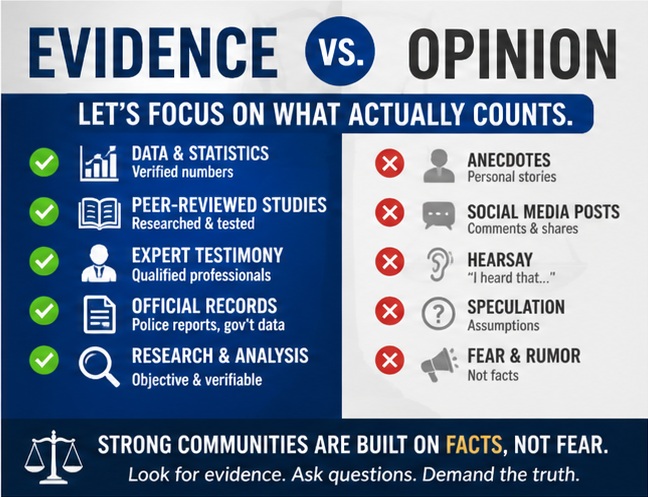
⚠️ What Does NOT Qualify as Evidence
• Anecdotes or personal experiences
• Social media posts or public comments
• Speculation about future impacts
• Statements without verifiable data or expert support
Under California law, courts rely on admissible evidence—not hearsay or opinion.
Legal Reference:
California Evidence Code
Start Here: What Concern Are You Researching?
Community debates can get emotional fast. This section is designed to separate documented evidence from rumor, fear, and speculation.
Under California law, courts generally look for admissible evidence: data, expert testimony, official records, and studies—not hearsay, social media comments, or speculation. California Evidence Code §1200 defines hearsay as an out-of-court statement offered for its truth, and hearsay is generally inadmissible unless an exception applies. California Evidence Code §1200
For CEQA issues, economic or social effects alone are generally not treated as significant environmental effects unless they are connected to physical environmental changes. 14 CCR §15131
Do Rehab and Treatment Centers Increase Crime?
Evidence, Research, and What Courts Actually Consider
Concerns about crime are often raised when substance abuse or mental health treatment facilities are proposed.
But when these issues are evaluated using real data, peer-reviewed research, and legal standards of evidence,
the conclusions are often very different from public perception.
✔️ What the Best Available Evidence Shows
1. Treatment Centers Are Associated with REDUCTIONS in Crime
A peer-reviewed economic study published via ScienceDirect found that substance abuse treatment facilities are associated with
reductions in both violent and financially motivated crimes, with particularly strong effects for more serious offenses.
View Study
2. Crime Near Treatment Centers Is Comparable to Everyday Commercial Areas
Research highlighted by :contentReference[oaicite:1]{index=1} found that crime near drug treatment centers
is similar to that near convenience stores and lower than liquor stores.
Johns Hopkins Summary
3. Expanding Treatment Access Reduces Crime and Recidivism
Public health and criminology research consistently shows that access to treatment reduces repeat offenses and criminal behavior compared to
untreated addiction or incarceration alone.
Peer-Reviewed Research
4. Public Health Consensus: Treatment Is a Community Benefit
Researchers emphasize that treatment centers function as essential health infrastructure, similar to urgent care centers, and do not uniquely
increase crime in surrounding communities.
⚠️ Why Public Perception Often Differs from Evidence
Despite strong research findings, public concern is common. This is often due to:
• Anecdotes from unrelated locations
• Media coverage of isolated incidents
• Misunderstanding of addiction and treatment populations
• Fear of change in neighborhood dynamics
While these concerns are understandable, they are not the same as measurable, verifiable evidence.
⚖️ What Actually Counts as Evidence in Court
If a project is challenged legally, courts rely on admissible evidence under the :contentReference[oaicite:2]{index=2}.
Admissible evidence includes:
• Government data (crime statistics, planning reports)
• Environmental Impact Reports (EIRs)
• Qualified expert testimony
• Peer-reviewed studies
• Official agency findings
Not admissible (in most cases):
• Hearsay (“someone said…”)
• Social media posts
• Personal anecdotes
• Speculation without data
🔍 How Courts Evaluate These Cases (CEQA & Zoning)
In California, many disputes over development projects are evaluated under the
:contentReference[oaicite:3]{index=3} (CEQA).
Courts focus on whether the government properly analyzed environmental and community impacts—not on public opinion alone.
This means decisions are based on documented evidence in the administrative record, including expert reports and agency findings.
📊 Bottom Line
The strongest available evidence does not support the claim that treatment centers increase crime.
In many cases, the research shows the opposite: treatment access is associated with safer communities and reduced criminal activity.
Understanding the difference between evidence and opinion is critical when evaluating complex community issues.
📌 Related Resources
• Medi-Cal Share of Cost Strategies
• Mental Health Coverage & SB 855
• Appeals, Grievances, and IMR
• Covered California Basics