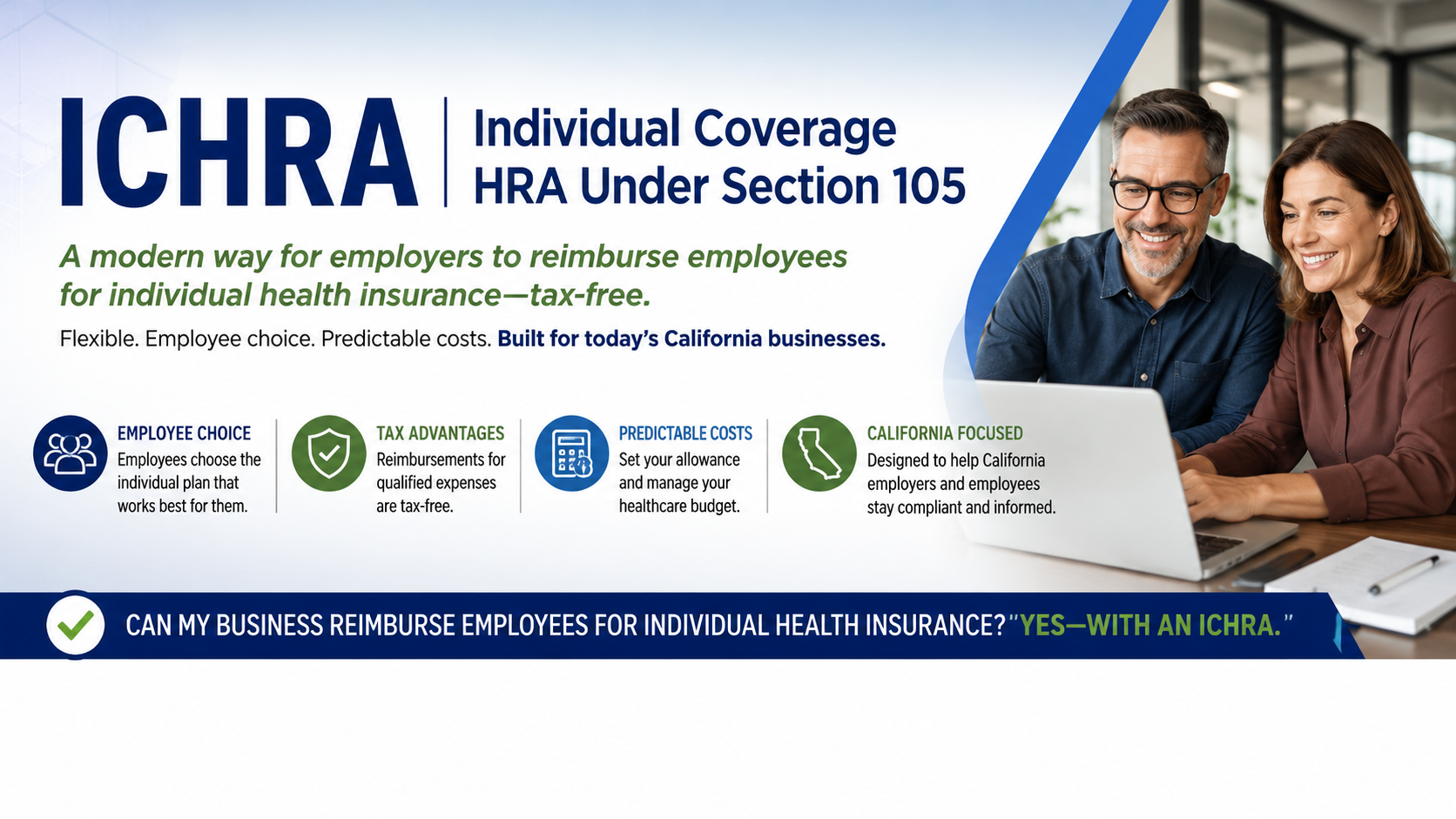
ICHRA: Individual Coverage HRA Under Section 105
An ICHRA, or Individual Coverage Health Reimbursement Arrangement, is a type of Section 105 employer reimbursement plan that lets an employer reimburse employees tax-free for individual health insurance premiums and other qualified medical expenses, if the plan is set up correctly. The employee generally must have qualifying individual health coverage or Medicare coverage for each month they are covered by the ICHRA. Healthcare.gov explains ICHRAs here.
This is different from a traditional small group health insurance plan. With an ICHRA, the employer sets a reimbursement allowance, and the employee buys their own individual policy. That can be helpful when employees live in different areas, want different insurance companies, or when a group plan is too expensive or impractical.
When an ICHRA May Make Sense
An ICHRA may be worth considering when a small employer wants to help employees with health insurance but does not want to sponsor a traditional group health plan. It may also help when employees are spread across different California rating regions, when participation is difficult, or when the employer wants a predictable monthly budget.
Before choosing an ICHRA, compare it with a traditional small group health insurance plan, a QSEHRA, and other Section 105 HRA or MERP options.
Important ICHRA Rules
The employer funds the ICHRA. Employees do not make salary-reduction contributions to an ICHRA. The employer decides the reimbursement amount, but the plan must follow the written plan rules and applicable nondiscrimination, notice, substantiation, and ACA requirements. The IRS has an HRA overview here.
An employer generally cannot offer the same class of employees both a traditional group health plan and an ICHRA. The ICHRA is usually used instead of group coverage for that employee class, not as an add-on to the same group plan.
Employees offered an ICHRA may have special rules for Marketplace premium tax credits. If the ICHRA is considered affordable, the employee generally cannot receive a premium tax credit for Marketplace coverage. If it is not affordable, the employee may be able to opt out of the ICHRA and claim a premium tax credit if otherwise eligible. Healthcare.gov explains employee ICHRA and premium tax credit rules here.
ICHRA vs. QSEHRA
A QSEHRA is generally for small employers that do not offer group health coverage and is subject to annual federal dollar limits. An ICHRA may be available to employers of different sizes and does not have the same fixed federal dollar cap, but it has its own class, affordability, notice, and compliance rules.
California Small Employer Practical Issues
For California employers, the practical question is usually not just “Is an ICHRA legal?” The better question is whether it is better than a traditional small group plan, whether employees can actually find good individual coverage, whether they may lose subsidies, and whether the employer is comfortable with the administration.
Some employees may like choosing their own individual policy. Others may prefer the employer to sponsor a group plan. An ICHRA should be reviewed carefully before replacing existing group coverage.
What Steve Can Help Review
I can help California employers compare the basic choices: traditional small group coverage, QSEHRA, ICHRA, and other Section 105 reimbursement arrangements. The goal is to find the arrangement that is legal, practical, understandable to employees, and not accidentally harmful to someone’s premium tax credit.
| Email Steve About ICHRA | Small Group Options | Section 105 Overview |
Official References
Healthcare.gov: Individual Coverage HRAs for Small Businesses
Healthcare.gov: Individual Coverage HRAs and Marketplace Coverage
IRS: Health Reimbursement Arrangements

“#Individual Coverage ICHRA”
and the EBHRA “Excepted Benefit HRA ” (can’t pay premiums)
Advantages of the Individual Coverage HRA ICHRA include, but are not limited to:
- Funds can be used to reimburse the employee’s premiums for an individual health insurance policy. Get a quote.
- Employer Contribution will affect tax credits – Learn more here
- Reimbursements made to employees do not count towards the employee’s taxable wages.
- The employer can choose to roll-over unused amounts into the following year.
- Coverage can be offered to different classes of employees (e.g.; full-time, part-time, seasonal, salaried, hourly)
- Contrast to Management Carve Outs §2716 Salary Discrimination
- An offer of the Individual Coverage HRA represents an “offer of coverage” under the employer mandate, however, contributions must meet affordability guidelines. (affordability Health Care.gov) The IRS will release further guidelines regarding this later.
- ICHRA will allow businesses the alternative to offer employees a monthly allowance of tax-free money. It allows them to buy individual health coverage tailored to fit their unique needs, control costs, and address ACA compliance for applicable large employers. ICHRA.com *
The ICHRA Individual Coverage HRA also comes with restrictions and regulations including but not limited to:
- An offer of an Individual Coverage HRA cannot be made to any employee that is offered a traditional group health plan.
- If an offer of coverage is made to a class of employees, there is a minimum class size that is required. Size is typically 10% of that specific class of employees. For example, if an employer has 200 employees, a minimum of 20 employees would have to be in a specified class.
- Contributions can be in any amount that the employer chooses, but contributions must be consistent for all employees in a specified class.
- The employer must provide notice of the Individual Coverage HRA to employees.
- The employer must be able to substantiate that the employee is enrolled in an individual plan or Medicare (model notices are available).
- The employer must notify employees on an annual basis that the individual health insurance is NOT subject to ERISA.
- The final rule also created the “Excepted Benefit HRA“ which, starting in January of 2020, will permit employers to finance additional medical care. Employees can use the HRA without having to be enrolled in the group’s traditional health plan.
- The requirements associated with the “Excepted Benefit HRA” include, but are not limited to:
-
-
- The annual contribution is capped at $1,800.
- It must be offered in conjunction with a group health plan, but there is no requirement for the employee to enroll in that plan.
- The “Excepted Benefit HRA” cannot be used to fund group health or Medicare premiums.
- It can fund premiums for dental, vision, or short-term limited duration insurance.
-
- Employers who want to offer the “Individual Coverage HRA” can do so but employees will need to enroll in an individual plan during the open enrollment period. benefitmall.com * TASO FAQ’s * Take Command Heatlh FAQ’s * Health Care.gov * SHRM.org *FAQ’s
FAQ’s, Links & Resources
- Complete ICHRA Guide
- Section 105 Non Discrimination requirements
- CMS.Gov FAQ’s
- SHRM’s New Final Rule Lets Employees Use HRAs to Buy Health Insurance
- people keep.com//what-to-expect-from-the-individual-coverage-hra-ichra-in-2020
- Commission Opinion Letter: Individual Coverage Health Reimbursement Arrangements (ICHRA) under the ADEA EEOC.gov *
What is HRA’s – Health Reimbursement Accounts
- HRA’s – Health Reimbursement Accounts allow an employer to pay or Self Fund say by using a Ben E Lect Program and possibly save thousands of $$$, for his and the employees uninsured medical care for the diagnosis, cure, mitigation, treatment, or prevention of disease, or for the purpose of affecting any structure or function of the body. and deduct them. TASC * (§IRC §213 (d), IRS Publication 502 Allowable Medical Expenses Internal Revenue Code (IRC) §105 * Publication 969)
- There are also NEW provisions to allow reimbursement for Individual Policies purchased by employees.
What is Section 105 MRP Medical Expense Reimbursement
- Under ACA/Obamacare only reimbursement of medical insurance premiums and qualified “preventative care” are allowed. This puts a huge kibosh on the otherwise huge tax savings for small business entrepreneurs. … The co-pays, deductibles, and other non-covered medical is still allowed by the section 105 MRP plan. The bottom line is the math, and for some, the HSA’s Health Savings Accounts (HSA) may be a better route going forward. Legal Wiz.com