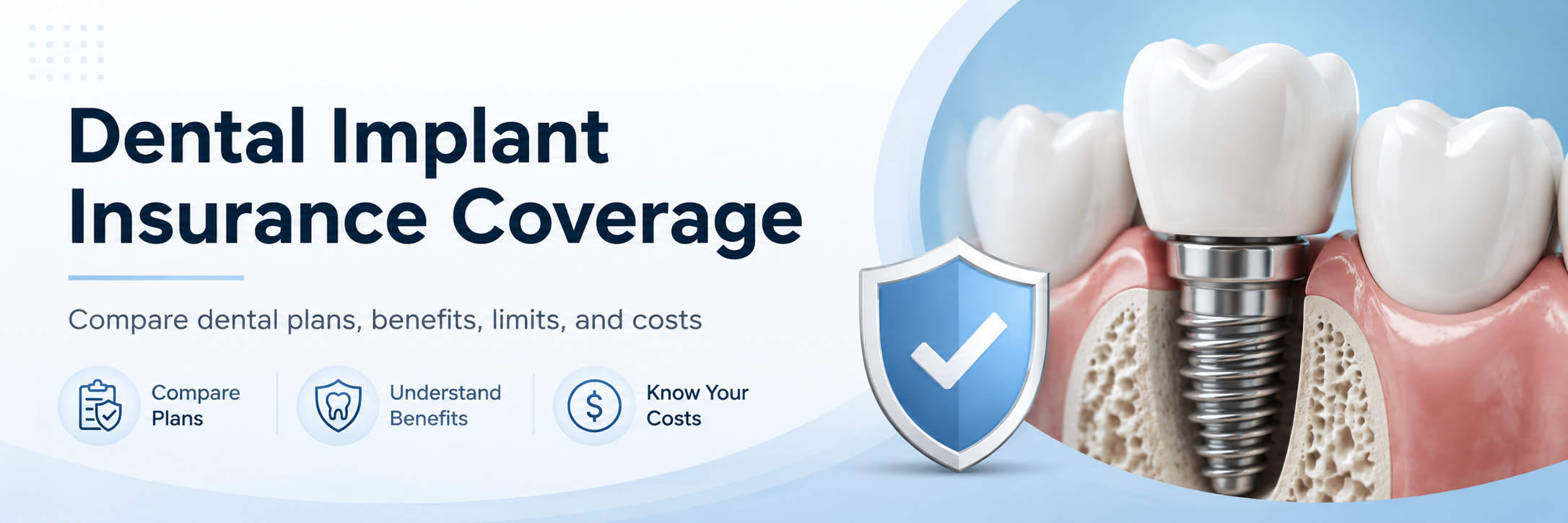
Dental Implant Insurance — Quick Answer
- Yes, some private dental insurance plans may help pay part of the cost of dental implants.
- That does not usually mean the insurance company will pay the entire implant bill.
- Coverage can depend on the particular plan, waiting periods, deductibles, annual maximum benefits, provider networks and exactly which parts of the implant treatment are covered.
- Already been told you need an implant?
- Do not buy a dental plan simply because the brochure says it covers “major dental” or “implants.”
- Compare the actual benefits and limitations before enrolling.
Already Need an Implant?
Check These Before Buying Dental Insurance
- Does the plan specifically provide benefits for dental implants?
- Do not assume that coverage for “major services” automatically means the entire implant procedure is covered.
- What parts of the treatment are covered?
- Ask about the implant itself, abutment, crown or other restoration, extraction, bone grafting and any related treatment your dentist says you need.
- Is there a waiting period?
- If you already know that you need an implant, a waiting period can make a plan much less useful for your immediate treatment.
- Is there a missing-tooth or replacement limitation?
- Some plans have special rules concerning teeth that were already missing before your coverage became effective.
- What is the annual maximum benefit?
- Even a plan that pays a percentage toward implants may stop paying once you reach its annual maximum.
- Does the dentist participate in the plan’s network?
- An in-network dentist may have negotiated fees that can reduce what you pay, depending on the plan.
- Ask for a pre-treatment estimate before beginning expensive work.
- Have the dental office submit the proposed treatment to the insurance company when the plan allows it so you have a better idea of what the plan expects to pay and what you may owe.
- Ready to compare?
Why “50% Coverage” May Not Mean Insurance Pays Half Your Implant Bill
- A dental implant treatment may involve several separate procedures and charges.
- Depending on your treatment, there may be charges for the implant body, abutment, crown or other restoration, extraction, imaging, bone grafting or other services.
- Your plan may treat those services differently.
- One part of the treatment may be covered while another part is excluded, limited or paid at a different percentage.
- The annual maximum can be just as important as the advertised percentage.
- For example, even if a covered service is payable at 50%, the insurance company generally will not pay more than the remaining annual maximum allowed by the policy.
- Other dental claims during the year may also use part of that maximum.
- Compare your estimated total cost — not merely the premium.
- Look at the premium, deductible, covered percentage, annual maximum, waiting period, network price and services that are excluded.
- Not sure which plans to look at?
Ways to Reduce Your Dental Implant Costs
- Compare dental insurance before treatment starts.
- Check whether your dentist is in the plan’s network.
- Depending on the plan, participating dentists may agree to negotiated fees that can lower the amount on which your share of the cost is based.
- Get a written treatment plan and pre-treatment estimate.
- Ask the dentist to identify each procedure that will be performed and the estimated charge.
- Then compare that treatment plan against the insurance benefits before committing to expensive treatment.
- If treatment can safely be done in stages, ask your dentist about the timing.
- Dental plans commonly have annual benefit maximums. If your dentist says treatment can appropriately be spread over different benefit years, that may affect how much insurance is available.
- Your dentist — not the insurance company — should determine whether delaying or staging treatment is medically appropriate.
- Ask your dentist about reasonable alternatives.
- Depending on your dental condition, alternatives might include a bridge, partial denture, full denture or another restorative treatment.
- The best clinical choice is a decision for you and your dentist.
- Dental discount plans are another possibility.
- A discount plan is not insurance. It may instead provide access to negotiated charges from participating dentists.
Can You Use an HSA or Get a Tax Deduction for Dental Implants?
- Dental treatment can qualify as a medical expense under federal tax rules.
- IRS Publication 502 includes dental treatment and artificial teeth among medical and dental expenses that can qualify.
- That does not mean everyone gets an income-tax deduction.
- For an individual itemizing medical expenses, the federal deduction is generally limited to qualifying unreimbursed medical and dental expenses exceeding 7.5% of adjusted gross income.
- If you already have money in a Health Savings Account (HSA), qualified dental expenses may generally be paid with tax-free HSA distributions.
- HSA rules have additional requirements, so review the IRS rules for your particular situation.
- Want more information about HSAs?
- Resources:
Tax rules depend on your individual circumstances. Consult your tax adviser regarding your eligibility for any particular deduction or tax treatment.
Have Medi-Cal or Medicare?
The Rules Are Different
- Do you have Medi-Cal?
- This page is primarily about private dental insurance.
- Medi-Cal has its own rules concerning dental implants, medical necessity, documentation and prior authorization.
- Does Medi-Cal Cover Dental Implants? — Read our dedicated guide.
- Medi-Cal Dental Coverage — Benefits, Dentists & Other Dental Services
- Do you have Original Medicare?
- Original Medicare generally does not cover routine dental care or items such as dentures and dental implants.
- Medicare can cover certain dental services when they are directly related to specific Medicare-covered medical treatment.
- See our Dental & Vision Coverage Under Medicare page.
- Do you have a Medicare Advantage plan?
- Some Medicare Advantage plans include additional dental benefits, but the amount, procedures covered, provider rules and limitations vary by the particular plan and year.
- Check the plan’s current Evidence of Coverage or dental benefit documents rather than assuming that one company’s dental benefit applies to every plan.
- Resource:
Dental Insurance — Related Pages & Get Help
- Compare Dental Insurance Plans
- Main Dental Insurance Page
- Medi-Cal Dental
- Medicare Dental
- Health Savings Accounts
- Want help comparing dental insurance?
- Email me directly at [email protected].
- Schedule a Zoom meeting with Steve Shorr.
- Compare Dental Plans
- Important:
- We are an insurance agency, not a dental office. We do not diagnose dental conditions, recommend dental procedures or perform dental treatment. Your dentist should determine the appropriate treatment, and the actual insurance policy or Evidence of Coverage controls what the plan pays.

What are Dental #Implants?
Dental implants (ADA Codes) may be thought of as artificial tooth roots which allow the fabricated teeth to be firmly attached to the mouth. One may consider the jaw bone as a piece of wood and a dental implant as a screw
Learn more from REAL Dentists:
- American Academy of Implant Dentistry
- VIDEO – Dr. Kuzma
- southland dental care.com/the-myth-are-dental-implants-really-necessary
- dr palani.com/video-library
- Dental implant surgery is a procedure that replaces tooth roots with metal, screwlike posts and replaces damaged or missing teeth with artificial teeth that look and function much like real ones. Read more Mayo Clinic
- Dental Implants: What You Should Know FDA
Write implants off your Taxes – using Health Savings Accounts
- The average cost of placing a single dental implant ranges from $1,600 to $2,200, not including the cost of a restoration. Redd Road *
- Implants may be covered under health insurance, if there is a “medical necessity” like cancer, major accident or skeletal deformity. View sample Delta policy page 40 #32.
- You can include in medical expenses the amounts you pay for dental treatment. This includes fees paid to dentists for X-rays, fillings, braces, extractions, dentures, etc. including artificial teeth (IRS Publication 502 Page 5 & 7)
- Implants are done when one doesn’t want a bridge because it more permanent and look better even in the back of the mouth and in view of this it’s considered cosmetic.
- Unfortunately, implants are not generally a covered benefit. Check out the Delta Dental No Wait Plan. Alternatives for Implants
Limitations:
The replacement of lost or stolen dentures, crown and bridge work, dental procedures and charges incurred as part of implants (placement or removal) and prosthetic devices placed on implants (fixed or removable, for example: bridges, crowns) are not covered. Smile Saver Brochure
Implants
- Answers.com
- Blue Shield Small Group Dental Plans – Dental Implant Explanation
- Alternatives for Implants
- Some questions that a patient could ask a dentist include:
If dental implants are not covered, are too expensive, or your dentist says you are not a good candidate, there may be other ways to replace or save a tooth.
Gum Disease Treatment
If you have a tooth that is loose and may be “hopeless,” it might still be saved with gum disease treatment . If the gums are receding and there has been bone loss around the tooth, that doesn’t mean that the tooth is guaranteed to be lost.
With gum disease treatment, we can clean out the infection around your tooth, and hopefully the tooth will heal. Sometimes we might splint the loose tooth or teeth to natural teeth that are stable. This can help stabilize the loose teeth and give them time to heal. Then you’ll still have your natural tooth for longer, potentially the rest of your life. This costs significantly less than a dental implant. And Pinhole ® Gum Therapy can be used to restore the natural contour of your gums.
Caveats: For a tooth that is designated “hopeless,” the success rate is lower than that for dental implants. And because we’re preserving your natural tooth, it will continue to look as it had, so if you’re unhappy with the appearance of this threatened tooth, it might not be the best choice. Plus, sometimes the infection is so serious that we want to remove teeth to better control the risk that the infection could spread to other parts of your body.
Root Canal Therapy
If your tooth is threatened by an infection inside the tooth, we can use root canal therapy to clean out the tooth and make it stable again. The tooth will be reinforced and topped with a dental crown . The success rate for root canal therapy is comparable to that for dental implants, and it has the benefit of retaining your natural tooth. Plus the dental crown means that the appearance of the tooth will be improved, too. If you later need to replace the treated tooth, you will usually be able to get a dental implant, and in the meantime, you get to enjoy the benefits of having a natural tooth rather than an implant. Cost is slightly less than for a dental implant.
Caveats: Whether a root canal is appropriate or not depends on the state of your tooth. If the tooth root is damaged, a root canal is not recommended. Sometimes an infected tooth can be a serious risk and needs to be extracted right away. Extraction is best for badly damaged or seriously infected teeth.
Dental Bridge
If you can’t save the tooth with either gum disease treatment or root canal therapy, you can often get a dental bridge that will perform the same function as a dental implant. With a dental bridge, the replacement tooth is supported by dental crowns on teeth next to the missing tooth.
Dental bridges are fully fixed in your mouth. They’re not loose and won’t slip out, so your diet won’t be impacted, and they can look as good as dental implants. Plus the dental crowns on neighboring teeth can be very helpful if they have been damaged.
Caveats: Dental bridges don’t stimulate your jawbone and gums the way a dental implant does. This may not matter, but it can potentially cause collapse of the gums under the replacement tooth. And if the supporting teeth aren’t fully healthy and strong, they may be put at risk by having a dental bridge placed over them. That’s because two teeth are now being asked to do the work of three. Because of this restriction, we only recommend dental bridges in limited situations where they don’t cause much increased risk to your natural teeth.
The Denture Fountain of Youth®, which replaces all your natural teeth. This type of denture looks natural and encourages better biting and chewing function. While not as good as implant-supported dentures, they are close. Kuzma *
Experts say 90% of patients with complete tooth loss opt for dentures. Ivy Rose *
VIDEOS
- Interviews – Testimonials VIDEO –
Learn More
Links, FAQ’s & Resources
- American Academy of Implant Dentistry – Implants vs Dentures & Bridges They have nice explanatory pictures too!
- Health Savings Accounts?
FAQ’s
Medical Necessity #Orthodonture
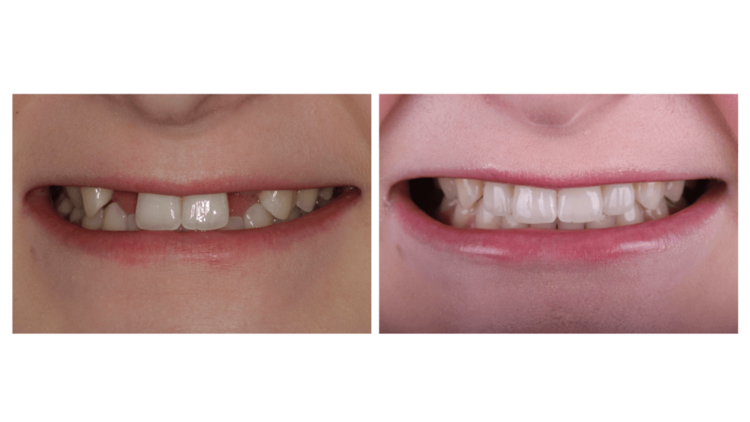
- QUESTION I was born without my upper lateral incisors so I guess that would b considered congenital Maxillofacial deformity Denti Cal – Smile CA 1-800-322-6384 Here’s the Medi Cal Ombudsmans website
- Our main webpage on Medical Necessity
- Medically necessary orthodontic treatment is orthodontic treatment that is rendered by an orthodontist or pediatric dentist to satisfy a demonstrated need for significant functional improvement of the teeth, jaws or related anatomy and is not rendered primarily for esthetic improvement.
- In order to demonstrate need for significant functional improvement, a patient must present with one or more of the following general conditions that can be definitively diagnosed (using generally accepted clinical standards) to be directly related to their malocclusion or jaw relationship:
- Severe impairment of oral function
- Chronic moderate pain or chronic severe pain that cannot be adequately managed through alternative treatments.
- Traumatic injury to the orofacial structures that requires reparative treatment with orthodontic appliances.
- Craniofacial anomaly or systemic disorder involving the dentition (see list).
- A malocclusion which, if left untreated, substantiates a prognosis of:
- o Premature loss and/or severe debilitation of an essential tooth or teeth
- o Severe debilitation of the dentition, periodontium, and/or temporomandibular joint(s).
- o A sustained or deteriorating condition that in an advanced state will no longer be treatable through orthodontic means alone and that, in an advanced state, will require more invasive or complicated treatment such as orthognathic surgery.
- Furthermore, medically necessary orthodontic treatment should be prescribed within generally accepted standards of orthodontic practice (evidence-based when possible). Read More Medically Necessary Orthodontic Treatment Med Mutual
- Missing lateral incisors in Lexington & Replacement with Wing Bridges
- Hypodontia (Missing Teeth)
- Para Regs – Medi-Cal – Scope of Benefits – General and Dental
- CLINICAL DENTISTRY GUIDELINES Liberty Dental
- Medically Necessary Orthodontic Care AAO
- https://www.dental.dhcs.ca.gov/MCD_documents/providers/ortho_packet.pdf
- Medically Necessary Orthodontic Treatment Med Mutual
- Clinical Guidelines for Implant Treatment in Patients with Down Syndrome nih.gov
- Immediate Implants: Clinical Guidelines for Esthetic Outcomes
- THE MEDI-CAL DENTAL PROGRAM ORTHODONTIC SEMINAR PACKET
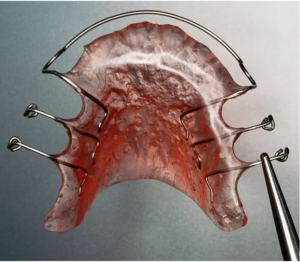
- Hawley Retainer Picture from Diamond Braces.com

- Maxillofacial Surgery Cleveland Clinic
- Denti Cal Beneficiary Handbook