Grant Applications vs. Reality — Why They Don’t Always Match
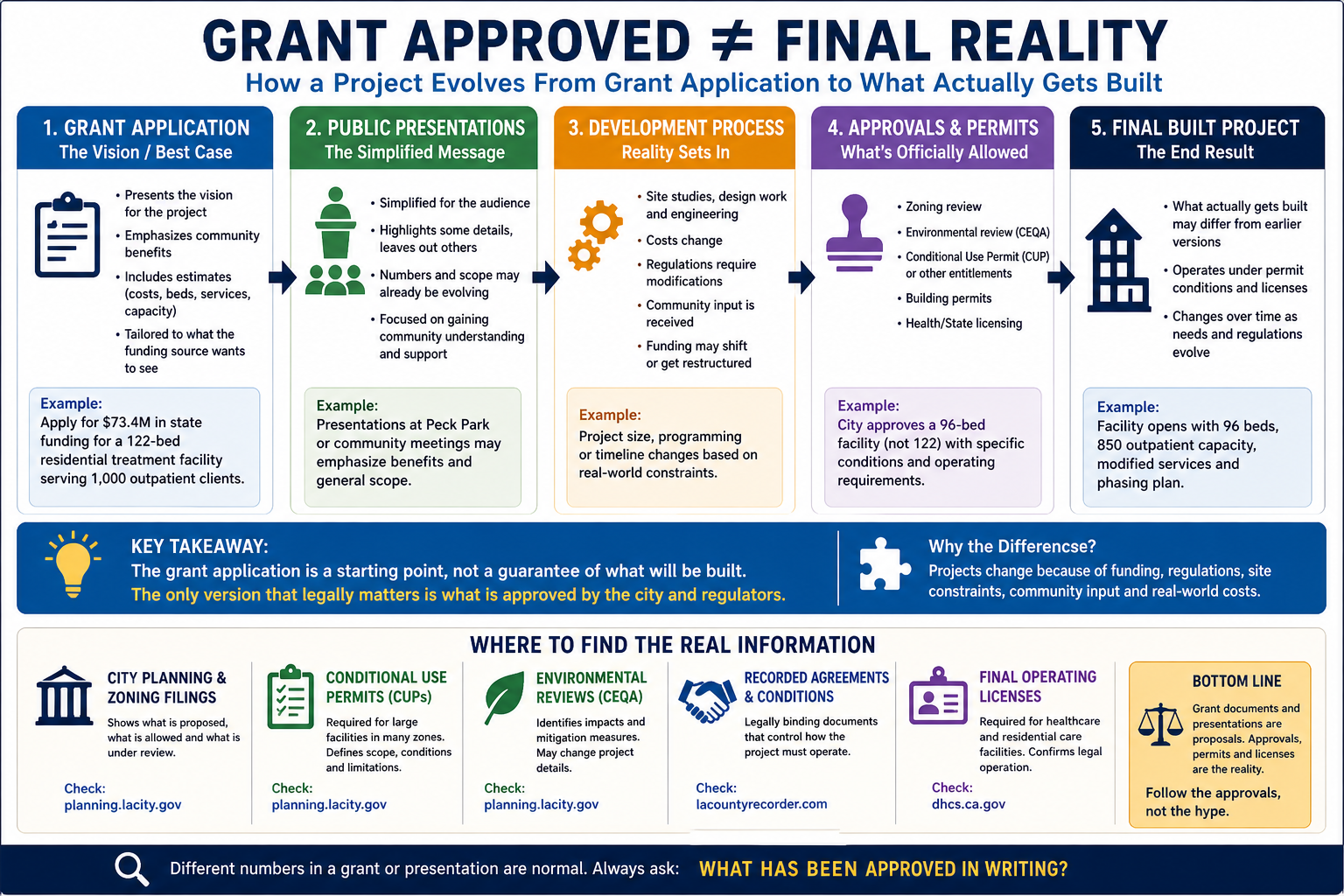
This document outlines the application process, requirements, and project details for funding a behavioral health infrastructure project at Serenity Recovery Campus in Los Angeles County.
Project Overview and Location
- The Serenity Recovery Campus in San Pedro, Los Angeles County, is an adaptive reuse project with existing operations and planned completion by December 2028.1
- It aims to expand behavioral health infrastructure addressing regional unmet needs through construction, renovation, and service integration.2
Service Offerings and Care Levels
- The facility will provide comprehensive services including residential SUD treatment, withdrawal management, outpatient, peer respite, and recovery housing.
- It will serve high-need populations such as justice-involved individuals, homeless persons, veterans, and those with co-occurring disorders.3
Community Needs and Regional Impact
- The project addresses documented gaps like 129 unmet residential SUD beds in LA County’s South region.4
- It offers a regional model connecting clients across Southern California to integrated, least restrictive care options.5
Alignment with State and Local Priorities
- The project targets urgent care needs, promotes health equity, and offers community-based alternatives to incarceration and hospitalization.
- It leverages existing county and state investments in housing, workforce, and crisis services to ensure sustainability.6
Population Focus and Referral Pathways
- The campus serves a large, diverse population with 86% experiencing homelessness and 90% justice-involved.
- Referrals come from government contracts, healthcare providers, community organizations, and crisis services, ensuring broad access.
Step-up and Step-down Care Connections
- The integrated campus model facilitates seamless transitions across care levels, maintaining treatment relationships and reducing unnecessary restrictions.7
Funding and Service Payor Structure
- The project anticipates 94% Medi-Cal funding and 6% from other sources, with no private insurance, Medicare, private pay, or other payors expected.
- Diversified revenue streams support comprehensive services, including residential, outpatient, ECM, and justice-involved programs, serving primarily Medi-Cal eligible populations.8
Long-term Service Funding Strategy
- Property acquisition with Bond BHCIP funds ensures ownership, eliminating lease costs for 30 years.9
- FBRS’s 40+ years of operational history, diversified county and justice contracts, strong financial growth, and institutional support validate sustainability over the service restriction period.10
Facility and Campus Details
- Five facilities across three types: residential SUD, outpatient SUD, outpatient OBOT, partial hospitalization, and peer respite.
- Total construction/rehabilitation square footage ranges from 2,450 to 80,899, with funding requests from approximately $1.4M to $58M.
- Facilities will serve expanded treatment slots and beds, with completion dates between 2027 and 2028.
Service Delivery and Integration
- Facilities will provide a full continuum of care, from crisis to recovery, with integrated services across residential, outpatient, and housing.
- Centralized intake, care coordination, electronic health records, and shared care plans facilitate seamless transitions and improve outcomes.11
Population Focus and Special Populations
- Populations include adults, older adults, transition-age youth, and perinatal women.12
- Special populations targeted are people with disabilities, homeless individuals, LGBTQ+, justice-involved, veterans, women, and those with severe mental health conditions.13
Campus Model and Facility Collocation
- The campus spans 5 buildings on 5.2 acres with ocean views, integrating multiple levels of care.
- Facilities include residential treatment, outpatient, OBOT, PHP, peer respite, and recovery housing, funded by BHCIP and match funds.
Housing Components
- Planned housing includes 12 onsite Recovery Bridge Housing beds and 176 offsite beds.14
- Housing supports treatment adherence, stability, and recovery, especially for unhoused and justice-involved populations.15
- Housing will be co-located with treatment facilities, with completion targeted for 2028.
Specialized Facilities and Populations
- Residential SUD treatment facilities will meet licensing standards, expanding capacity and services.16
- Outpatient and OBOT facilities will provide MAT, outpatient treatment, and withdrawal management, with licenses aligned to service levels.17
- Peer respite offers non-clinical, voluntary crisis support for veterans and other populations, emphasizing recovery and self-determination.
Service Integration and Outcomes
- The campus offers a comprehensive, evidence-based model with integrated housing, peer support, trauma-informed care, and medication-assisted treatment.18
- Technology, care coordination, and co-location reduce barriers, improve retention, and support long-term recovery for diverse populations.19
Housing Support and Facility Planning
- Planned long-term housing projects include a 12-bed Peer Respite facility, anticipated completion by 12/31/2028, not co-located with other projects, and operating as an unlocked, non-locked facility.
- Five facilities are proposed: residential SUD treatment, outpatient services, office-based opioid treatment, partial hospitalization, and Peer Respite, with funding requests confirmed.20
Service Populations and Treatment Approaches
- Focus on diverse populations including transition-age youth, adults, perinatal women, older adults, people with disabilities, homeless individuals, LGBTQ+ persons, those with serious mental health conditions, justice-involved individuals, and women.
- Services incorporate trauma-informed care, evidence-based practices like MAT, CBT, motivational interviewing, and trauma counseling, with tailored programs such as employment support, family reunification, and culturally specific services.21
Justice-Involved Population Engagement
- Extensive partnerships with agencies like CDCR, Probation, and local courts support justice-involved referrals.
- The facility will serve multiple justice-involved groups, including youth, adults, pregnant women, and seniors, with referral pathways through corrections, community programs, and mandated treatment.
Cultural Competency and Equity
- Services are tailored for racial and ethnic groups including Black, Latino, Asian, Native American, and LGBTQ+ populations.
- Staff diversity, language services, and collaborations with community organizations ensure culturally responsive care and address minority-specific needs.
Development and Construction Strategy
- The project is in planning and predevelopment, with existing site control, schematic design, and environmental assessments completed.
- Rapid development plans include acquiring the property by 04/01/2027, with streamlined permitting, reuse of existing structures, and minimal environmental impact.
Financial Planning and Budget
- Total development cost estimated at approximately $80.7 million, with funding covering acquisition, planning, permits, construction, and service startup.
- The budget includes detailed cost estimates from qualified professionals, contingency plans for overruns, and strategies for cost containment through scope management and value engineering.22
Property Acquisition and Site Details
- The site at 2100 S Western Ave, owned by 9 Gem Capital Group, will be acquired using Bond BHCIP funds, with a planned closing date of 04/01/2027.
- The property has existing entitlements, and acquisition will involve a formal purchase agreement, title review, and community engagement events.
Community Engagement and Public Events
- Events include ceremonies honoring the Sisters of the Poor, stakeholder meetings, community celebrations, and open houses aligned with project milestones.
- The project emphasizes transparency, honoring legacy, and fostering community relations throughout development.
Project Cost Management and Permitting
- Cost strategies involve early buyouts, value engineering, and phased implementation.
- Permits will be expedited, utilizing existing infrastructure and minimal new approvals, with construction starting within three months of funding.23
Land and Site Development
- The site’s land costs are valued at $45 million, with acquisition costs totaling over $48 million, including closing, legal, appraisal, and insurance fees.
- No additional land improvements or encumbrances are planned, and the property is not on tribal land or owned by a government entity.
Project Milestones and Publicity
- Future milestones include groundbreaking, ribbon-cutting, and community open houses, with no recent publicity or negative coverage reported.
- The project maintains ongoing communication and community involvement to ensure transparency and support.
Developer and Project Costs
- Total developer costs amount to $675,000, covering overhead, consultants, administration, and contract fees.24
- The overall project costs funded by grants and cash match total approximately $80.7 million, with grant funding at $73.4 million and cash match at $7.3 million.
Funding Breakdown and Match Requirements
- The requested bond funding is $73,400,878.62.
- Match amounts include $7 million in secured cash, $5 million pledged philanthropic support, and additional match categories such as property and sunk costs.
- There is a noted discrepancy between the cash match in the budget ($7,340,554) and the section total ($7 million), which was corrected.
Sources of Capital and Match
- Capital sources include other grants, bond investments, equity, and debt, but specific amounts are not provided.
- Cash match sources include local funding, philanthropic support, and other funds, totaling over $7 million.
- Property and sunk costs are also designated as match sources, with sunk costs valued at $500,000.
Letters of Support and Required Documentation
- Multiple letters of support from government officials, community stakeholders, and health agencies are included, with some pending or previously declined.
- Key supporting documents include organizational resolutions, development team contracts, design plans, financial pro formas, and site control documents.
- All documents must be properly labeled and submitted by the deadline, with specific requirements for tribal, corporate, and co-applicant entities.
Application Certification and Privacy
- The applicant certifies authority to submit and confirms the accuracy of all information.25
- Privacy notices inform that application data may be publicly disclosed under the California Public Records Act.26
- Certification includes acknowledgment of privacy policies and consent to data collection for application processing and potential follow-up.27
Ways to Pay for Senior Care, Long-Term Care, and Support Services
The senior housing debate is not only about zoning or neighborhood concerns. For many families, the real question is how care can actually be paid for. Below are related resources on Medicare, Medi-Cal, long-term care, home health, skilled nursing, IHSS, and senior housing support.
Start here:
- Medicare
- Senior Housing Support and Finding a Place
- Long Term Care Insurance
- Long-Term Care vs. Medicare
- Freedom Blue - Short Term In Home Care
- Retirement Accounts - Planning
- Medi-Cal Long-Term Care, Nursing Home, and Estate Recovery Planning
These pages do not solve every housing problem, but they can help families understand what Medicare covers, what it does not cover, when Medi-Cal may help, and when private or family resources are still needed.