“How to Eliminate Medi-Cal Share of Cost with the 250% Working Disabled Program”
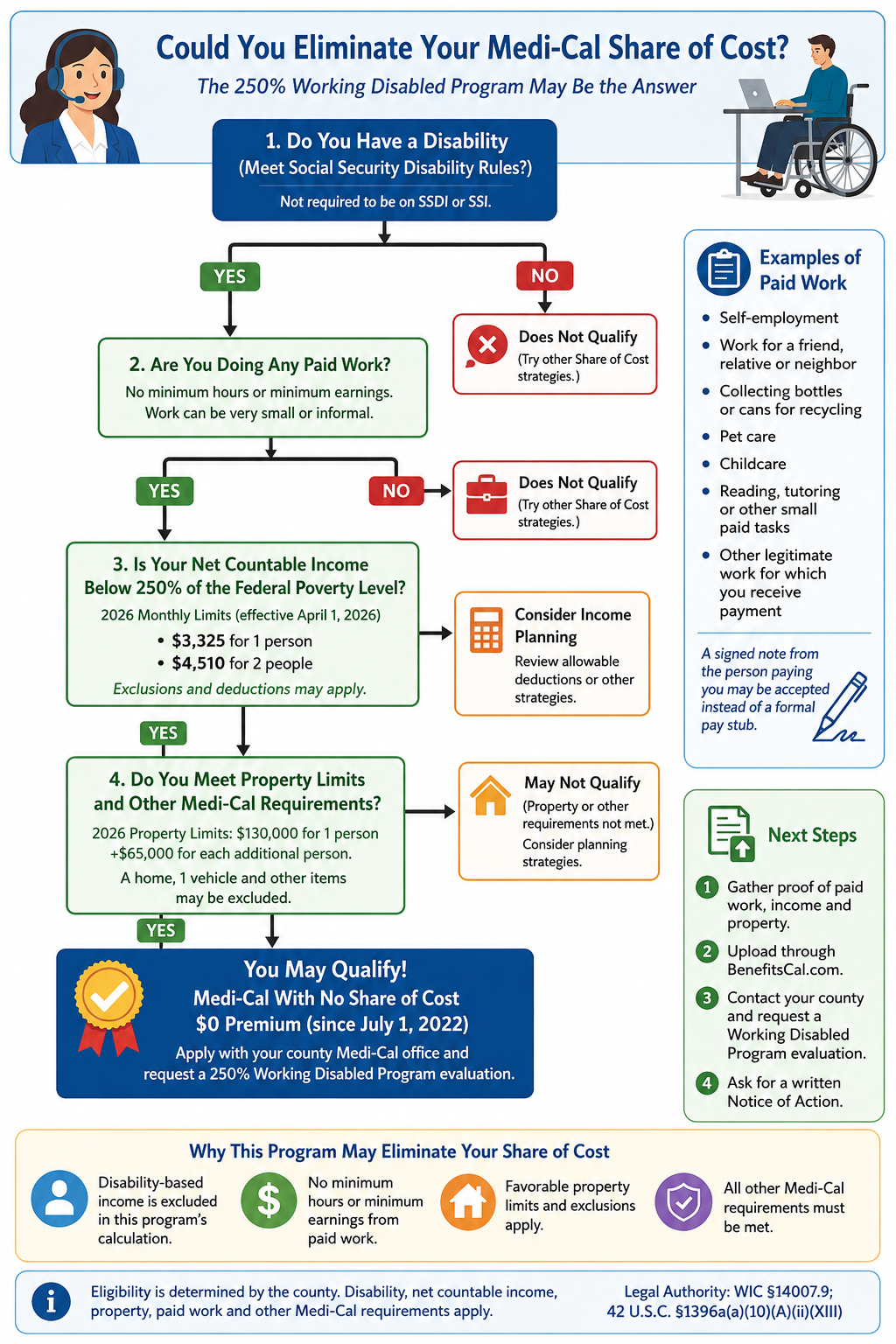
 Eligibility subject to county Medi-Cal determination. Must meet disability, income, and program requirements.
Sources for the eligibility graphic:
California Department of Health Care Services — 250% Working Disabled Program;
DHCS Medi-Cal Eligibility Division Information Letter I 25-10 and consumer flyer;
CANHR — 250% Working Disabled Program;
California Welfare and Institutions Code §14007.9; and
42 U.S.C. §1396a(a)(10)(A)(ii)(XIII).
The chart is a preliminary screening guide. The county Medi-Cal office makes the actual eligibility determination. Disability, net countable income, property, paid-work and other Medi-Cal requirements apply.
How the 250% Working Disabled Program May Eliminate a Medi-Cal Share of Cost
California’s 250% Working Disabled Program may allow a person with a disability who performs some paid work to receive Medi-Cal without a monthly Share of Cost. The program’s monthly premium is currently $0.
This is not an automatic conversion. The person must satisfy the disability, paid-work, net countable income, property and other Medi-Cal eligibility requirements, and the county must approve the case.
Who May Qualify?
- Disability:
The applicant must meet the Social Security disability definition used by the program. A person does not necessarily have to be receiving an SSDI or SSI cash payment, and the usual substantial-gainful-activity test is not applied in the same manner for this Medi-Cal category.
See DHCS All County Welfare Directors Letter 19-12. - Some paid work:
The person must be working for pay, but there is no minimum number of hours and no minimum amount that must be earned. - Net countable income:
Eligibility is based on net countable income, not simply total or gross monthly income. Disability-based income is excluded under the special Working Disabled Program calculation, and earned-income deductions may also apply. - Income below 250% of the Federal Poverty Level:
For 2026, effective April 1, 2026, the 250% monthly figures are $3,325 for one person and $4,510 for two people. Because exclusions and deductions apply, a person’s actual gross income may be higher.
See the official DHCS 2026 Federal Poverty Level chart. - Property requirements:
Beginning in 2026, the countable property limit is generally $130,000 for one person, plus $65,000 for each additional household member. A home, one vehicle, certain retirement accounts and other property may be excluded. The county must apply the complete property rules to the individual case. - Other Medi-Cal requirements:
California residency and all other applicable financial and nonfinancial Medi-Cal rules must also be met.
Paid Work Can Be Very Small or Informal
The DHCS Working Disabled Program consumer flyer explains that paid work may include:
- Self-employment;
- Working for a friend, relative or neighbor;
- Recycling bottles or cans;
- Pet care;
- Childcare;
- Reading, tutoring, sorting mail or performing another small paid task; or
- Other legitimate work for which the person receives payment.
The work must actually be performed and paid, but it does not have to be a traditional job with regular hours or a formal payroll department.
A Formal Pay Stub Is Not Always Required
When there is no regular pay stub, DHCS says that a signed note from the person paying the applicant may be used. The note should identify:
- The person performing the work;
- What work was performed;
- The dates or approximate frequency of the work;
- The amount paid; and
- The payer’s name, signature and contact information.
Self-employed applicants may use receipts, invoices, payment records, bank records or other reasonable documentation of the work and income. The county may request additional verification when necessary.
Why Someone With Disability Income May Still Qualify
The income test is more favorable than simply adding together every dollar received. Under California Welfare and Institutions Code §14007.9:
- Disability-based income is excluded from the Working Disabled Program income calculation;
- Only the countable portion of earned income is included after applicable deductions;
- Certain retirement accounts are excluded from countable property; and
- A person may retain earnings in a separately identifiable account under the program’s rules.
For that reason, someone should not assume that SSDI or another disability payment automatically makes the person ineligible. The county must perform the complete Working Disabled Program calculation.
How to Request a Working Disabled Program Evaluation
A person who already has Medi-Cal with a Share of Cost generally does not need to submit a completely separate Medi-Cal application. DHCS instructs beneficiaries to contact their county and ask to be evaluated for the Working Disabled Program.
- Gather proof of paid work.
Use pay stubs, receipts, invoices, self-employment records or a signed statement from the person paying for the work. - Gather income and property information.
Include proof of wages, disability income, other income, bank accounts and any other documents requested by the county. - Upload the documents through BenefitsCal.
Keep copies and confirmation showing what was uploaded and when.
See our BenefitsCal proof and upload instructions. - Contact the county Medi-Cal eligibility worker.
Do not merely upload documents and wait. Ask the worker to confirm that the documents were received and specifically request a Working Disabled Program evaluation. - Use the program’s complete name.
This helps prevent the request from being treated as a routine income change or ordinary Share of Cost recalculation. - Request a written Notice of Action.
The written notice should show whether the program was approved or denied and explain the person’s hearing rights if the county’s decision is disputed.
Suggested message to the county:
“Please evaluate my Medi-Cal eligibility specifically under the 250% Working Disabled Program pursuant to California Welfare and Institutions Code §14007.9. I have uploaded proof of my paid work, income and other requested information. Please confirm receipt of my documents and issue a written Notice of Action showing the county’s eligibility decision.”
What About IHSS?
The county Medi-Cal eligibility worker—not the IHSS social worker—determines eligibility for the Working Disabled Program. When Medi-Cal approves the new eligibility category and removes the Share of Cost, provide the written Medi-Cal Notice of Action to the IHSS worker so the related county records can be reviewed and updated.
What If the Person Does Not Qualify?
The Working Disabled Program is only one possible way to reduce or eliminate a Medi-Cal Share of Cost. A person who cannot perform paid work, does not meet the disability rules or does not satisfy another requirement may still be able to use allowable health-insurance premiums or medical expenses to reduce countable income.
- Review our main Medi-Cal Share of Cost page.
- Use our Share of Cost calculator.
- Read the Center for Health Care Rights plain-English Share of Cost guide,
which explains the use of health, dental, vision, Medicare and other allowable expenses.
Not Sure Which Share of Cost Strategy Applies?
Send us the monthly Share of Cost, the types and amounts of income received, and whether the person performs any paid work. We can help identify the questions and documents to take to the county. The county makes the final Medi-Cal eligibility determination.
Plain-English and Legal References
- California Department of Health Care Services — Working Disabled Program.
Current program overview, county contact instructions, $0 premium and property limits. - DHCS Medi-Cal Eligibility Division Information Letter I 25-10 and Working Disabled Program flyer.
Plain-English explanation of paid work, informal work arrangements, acceptable proof and the absence of minimum hours or minimum earnings. - California Advocates for Nursing Home Reform — 250% Working Disabled Program.
Consumer-oriented explanation of income, work, property and disability requirements with supporting citations. - CANHR — Aged, Blind and Disabled Medi-Cal Programs fact sheet.
Related explanation of regular Aged and Disabled Medi-Cal, Share of Cost calculations and allowable deductions. - Center for Health Care Rights — Medi-Cal Share of Cost guide.
Plain-English explanation of Share of Cost and the use of health-insurance premiums and medical expenses. - DHCS All County Welfare Directors Letter 19-12.
Detailed eligibility, work, income and verification instructions to counties. Any premium amounts shown in this older letter have been superseded by the later $0-premium guidance. - DHCS Medi-Cal Eligibility Division Information Letter 22-31.
Confirms that Working Disabled Program premiums were reduced to $0 effective July 1, 2022. - California Welfare and Institutions Code §14007.9.
California statutory authority for the 250% Working Disabled Program, income exclusions, property provisions and the state’s authority not to impose premiums. - 42 U.S.C. §1396a(a)(10)(A)(ii)(XIII).
Federal Medicaid authority allowing coverage of working individuals with disabilities whose income is below 250% of the federal poverty level. - DHCS 2026 Federal Poverty Level Calculation Chart.
Official 2026 monthly income figures, effective April 1, 2026 for the Working Disabled Program.
Important:
This page provides general educational information and is not a guarantee of Medi-Cal eligibility. Eligibility and the effective date of any change are determined by the applicant’s county Medi-Cal office after reviewing the complete facts and documentation.
General Information on Share of Cost
Center for Health Care Rights.com 
- There are 2 ways to reduce or eliminate the Medi-Cal Share of Cost:
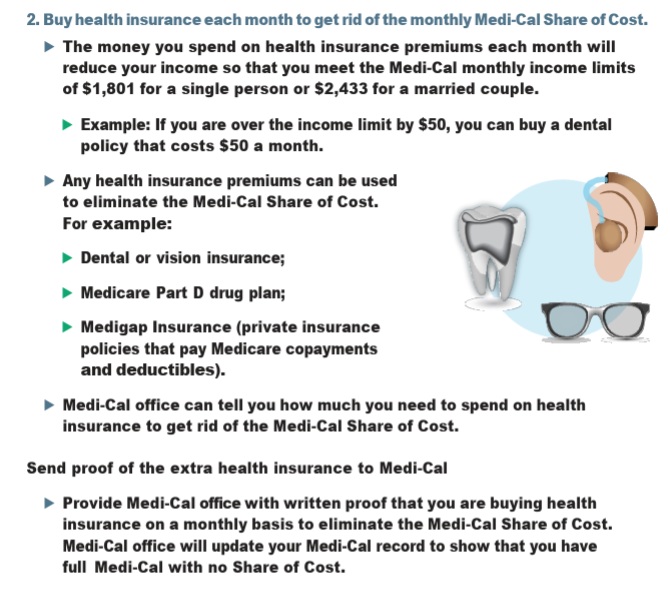
- 2. Buy health insurance each month to get rid of the monthly Medi-Cal Share of Cost.
- ► The money you spend on health insurance premiums each month will reduce your income so that you meet the Medi-Cal monthly income limits of $1,801 for a single person or $2,433 for a married couple.
- ► Example: If you are over the income limit by $50, you can buy a dental policy that costs $50 a month.
- ► Any health insurance premiums can be used to eliminate the Medi-Cal Share of Cost. For example:
- ► Dental or vision insurance;
- ► Medicare Part D drug plan;
- ► Medigap Insurance (private insurance policies that pay Medicare copayments and deductibles).
- ► Your Medi-Cal Social Worker can tell you how much you need to spend on health insurance to get rid of the Medi-Cal Share of Cost.
- Send proof of the extra health insurance to Medi-Cal
- ► Provide Medi-Cal office with written proof that you are buying health insurance on a monthly basis to eliminate the Medi-Cal Share of Cost. Medi-Cal office will update your Medi-Cal record to show that you have full Medi-Cal with no Share of Cost.

- See My Medi Cal information

- 2. Buy health insurance each month to get rid of the monthly Medi-Cal Share of Cost.
Worksheets to calculate the amount to spend for Medi Cal
with no share of cost
- Aged & Disabled, Medically Needy, and Working Disabled Medi-Cal Programs January 2026 CANHR

- Resources & Links
- reddit.com/r/IHSS/ discussion group for IHSS problems...
- Disability Benefits 101 Medi Cal Categories
Related Child & Sibling Pages
- 250% Working Disabled Program
- Annual Renewal Medi Cal & Share of Cost
- Appeals Medi Cal
- Calculate Instantly Medi Cal Share of Cost and Zero it out!
- FAQ’s Share of Cost
- Medi Gap to lower share of cost
- Medical expenses to lower share of cost
- Proof Needed for Medi-Cal Uploads to BenefitsCal

How to Eliminate Medi-Cal Share of Cost
Using the 250% Working Disabled Program
A Little-Known Strategy
-
There is a Medi-Cal program that may allow you to:
-
Work (even part-time)
-
Keep full Medi-Cal coverage
-
Eliminate your Share of Cost (SOC)
-
-
This program is called the 250% Working Disabled Program (WDP)
👉 Eligibility subject to county Medi-Cal determination. Must meet disability, income, and program requirements.
🚨 You May Qualify with Very Small Income
-
There is no minimum number of hours required to work (DHCS guidance)
-
Even:
-
Part-time work
-
Self-employment
-
Very small income
-
may qualify as “working” (DHCS Working Disabled Program page)
👉 This is one of the most overlooked Medi-Cal strategies
- Email us [email protected]
What This Means for You
-
Instead of:
-
Paying a high monthly share of cost
-
-
You may qualify for:
-
Full Medi-Cal coverage
-
With a $0 or low monthly premium (DHCS WDP program updates)
-
👉Email us [email protected]
Why the Working Disabled Program Works
-
Disability-based income (such as SSDI) is not counted the same way as earned income (program methodology explained in WDP materials)
-
Earned income is:
-
Partially excluded
-
Not counted dollar-for-dollar (SSI income rules applied to Medi-Cal)
-
-
Eligibility is based on income up to:
-
250% of the Federal Poverty Level (DHCS program description)
-
👉Example (Simplified)
-
SSDI income: $2,500/month
-
Small part-time work: $300/month
Result:
-
Only part of the $300 is counted
-
SSDI may not disqualify eligibility
👉 The person may qualify for:
-
Full Medi-Cal
-
No Share of Cost
(Eligibility determined by county based on full rules)
Share of Cost vs Working Disabled Program
-
Share of Cost Medi-Cal
-
Pay large medical expenses before coverage begins
-
-
Working Disabled Program
-
Coverage starts immediately
-
May have:
-
$0 premium
-
Or a small monthly premium
-
-
👉 This is why many people switch when eligible
- Email us [email protected]
Quick Eligibility Check
-
Are you considered disabled under Social Security rules?
-
Yes / No
-
-
Do you have ANY earned income (even small)? DHCS.Gov
-
Yes / No
-
-
Is your income likely under about 250% of the Federal Poverty Level?
-
Yes / No / Not sure
-
If You Answered YES to All 3:
👉 You may qualify for the Working Disabled Program
👉 You may be able to eliminate your Share of Cost
- Email us [email protected]
Asset Rules (Important Update for 2026+)
-
California previously eliminated asset limits
-
Asset limits are reinstated as of 2026
-
Current limits:
-
$130,000 (individual)
-
+$65,000 per additional household member
-
👉Some assets may still be excluded (home, vehicle, etc.)
- Email us [email protected]
Important: County Approval Required
-
The Working Disabled Program is:
-
Administered by your county Medi-Cal office
-
-
You must:
-
Apply through the county
-
Documentation required (work + disability)
-
Provide documentation of:
-
Disability
-
Earned income
-
-
👉When This Strategy Works Best
-
You currently have a high share of cost
-
You can perform any level of work
-
You want predictable coverage instead of monthly spend-down
Most Agents Don’t Tell You This – it’s rather technical..
-
There are ways to reduce or eliminate Share of Cost that:
-
Do not involve spending thousands on medical bills
-
Do not require giving up income
-
👉 The Working Disabled Program is one of those strategies
- Email us [email protected]
Not Sure If You Qualify?
We can help you evaluate:
-
Your income
-
Your work situation
-
Your current share of cost
👉 Request a Share of Cost Review
👉 Schedule a Zoom Consultation
- Email us [email protected]
- Social Security Publication 10095 Working while disabled how we can help
- Medi Cal working while disabled dhcs.gov
- Share of Cost vs
- Working Disabled Program vs
- Dental, Vision, Insurance Premium Strategy
| Feature | Share of Cost Medi-Cal | Working Disabled Program | Insurance Expense Strategy |
|---|---|---|---|
| Monthly Cost | High / unpredictable | Low fixed premium | Variable |
| Requires Work | No | Yes (any level) | No |
| Income Treatment | Strict | Favorable exclusions | No change |
| Asset Rules (2026+) | Yes | Yes | Yes |
| Coverage | Full Medi-Cal after SOC met | Full Medi-Cal | Full Medi-Cal after SOC |
| Best Use | No other options | Working individuals | Temporary SOC reduction |
Share of Cost vs Working Disabled Program
-
Share of Cost:
-
Pay thousands before coverage starts
-
-
Working Disabled Program:
-
Full Medi-Cal immediately
-
Possibly $0 cost
-
Can You Eliminate Your Medi-Cal Share of Cost?
You May Qualify Even If You Only Earn $50–$100 Per Month
Start Here:
-
Do you currently have a Medi-Cal Share of Cost (SOC)?
-
No → You may already qualify for full Medi-Cal
-
Yes → Continue below
-
Step 1: Do You Have Any Earned Income?
-
Yes → Go to Step 2
-
No → Go to Step 4
Step 2: Are You Disabled (SSDI or Similar Criteria)?
-
Yes → You may qualify for the Working Disabled 250% FPL Program (WDP)
-
Replace SOC with a zero premium
-
Keep full Medi-Cal coverage
(42 U.S.C. § 1396a(a)(10)(A)(ii)(XIII))
-
-
No → Go to Step 3
Step 3: Can You Work Even a Small Amount?
-
Yes → Consider creating earned income
-
Even part-time work may qualify you for WDP
(DHCS Medi-Cal Eligibility Procedures Manual § 5H)
-
-
No → Go to Step 4
Step 4: Do You Have Medical or Dental Expenses?
-
Yes → Consider the Dental or other Insurance Expense Strategy
-
Use dental premiums or Medical expenses like adult diapers to meet or reduce SOC
-
-
No → Go to Step 5
Step 5: Can Your Income Be Adjusted?
-
Yes → Consider Income Structuring
-
Reduce countable income
- Qualifying Health & Dental Coverage our webpage
-
Lower or eliminate SOC
-
-
No → SOC may still apply, but strategies may reduce impact
Step 6: Asset Check (2026 and Beyond)
-
Do your assets exceed:
-
$130,000 (individual)
-
+$65,000 per additional person
-
-
Yes → Planning may be needed before qualifying
-
No → Continue with strategy above
(California asset limits reinstated effective 2026 – DHCS / CANHR / CA Health Advocates)
- Email us [email protected]