Late Enrollee for Group Employer Plans
SEP’s Special Enrollment?
Special Enrollment for Small Group Health Plans
A Special Enrollment Period is a limited time when an employee or dependent may be able to enroll in an employer group health plan outside the regular open enrollment period. In a small group plan, this usually comes up when someone has a qualifying event, such as losing other coverage, getting married, having a baby, adopting a child, or becoming newly eligible as a dependent.
For employer group health plans, these rights are often called HIPAA special enrollment rights. In many cases, the employee must request enrollment within 30 days after the qualifying event. The exact deadline and paperwork can depend on the employer’s plan rules, the insurance carrier, and the type of event. Check with the evidence of coverage or administrative guide.
Common small group triggering events may include:
- Loss of other group health coverage
- Loss of individual health coverage
- Marriage
- Birth of a child
- Adoption or placement for adoption
- A dependent becoming eligible for coverage
- Loss of Medi-Cal or CHIP coverage
- Becoming eligible for premium assistance through Medi-Cal or CHIP
- Scroll down for more detail
This is different from an employer’s normal waiting period for a new employee. A waiting period usually applies when someone is first hired or first becomes eligible. A special enrollment event usually applies when the employee or dependent already missed or declined coverage, but later has a qualifying life event that gives them another chance to enroll.
Questions This Page Helps Answer
- Can an employee enroll in small group health insurance after renewal – open enrollment?
- What events trigger a special enrollment right?
- Is losing other coverage a reason to enroll in the employer plan?
- Can a spouse or child be added after marriage, birth, or adoption?
- How long does the employee have to request enrollment?
- What is the difference between a waiting period and special enrollment?
- What happens if the employee misses the deadline?
Related Special Enrollment Situations
Special enrollment rules can apply to employer group plans, individual Covered California plans, and Medicare Advantage plans. The rules are not all the same, so it is important to know which type of coverage you are dealing with.
Individual & Covered California Special Enrollment
If someone loses employer coverage, moves, gets married, has a child, or has another qualifying life event, they may qualify for an individual or Covered California Special Enrollment Period.
Learn About Individual & Covered California Special Enrollment Periods
Medicare Advantage Special Enrollment
Medicare beneficiaries may have separate Special Enrollment Periods for Medicare Advantage or Part D plans after events such as moving, losing employer coverage, qualifying for Medi-Cal, or leaving a plan’s service area.
Learn About Medicare Advantage Special Enrollment Periods
Bottom line: if there has been a recent change in coverage, family status, eligibility, or residence, do not assume the employee has to wait until the next open enrollment. Check the small group special enrollment rules right away, because deadlines can be short.
Special Open Enrollment – Late Enrollee
Employer Group Plans
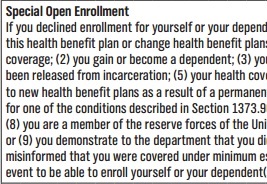
- If you or your dependent(s) (including a spouse/domestic partner), didn’t enroll in an Employer Group plan when you were first employed, you may be able to enroll yourself or your dependent(s) in this health benefit plan or change health benefit plans as a result of certain “triggers” or events.
- Check our listing of the most common employee applications…You may find an easier to read list there.
- Special Annual Open Enrollment for entire group – Don’t have to meet contribution or Participation requirements
- You may not quote this page. Follow the links and make sure the reference applies to you. Email us at [email protected] for assistance.
- Individual & Family SEP – Covered CA
.
- Qualifying triggering events, Special Enrollment including:
. - (1) you or your dependent loses minimum essential coverage;
- A. Voluntary loss doesn’t count into the Individual Market and probably not for group. Health Care.Gov * As President Trump said Insurance is very complicated.
- Per Blue Cross webinar – have to actually receive Medi Cal disenrollment to qualify
- Special enrollment (for qualifying events)
- Employees and/or dependents that experience a qualifying event have 60 days to submit a completed application. Coverage will begin on the event date.
- Below lists examples of qualifying events:
- Open enrollment (not applicable for life and disability coverage)
- Marriage or Declaration of Domestic Partnership
- Birth or adoption of a child
- Involuntary loss of coverage
- Death Divorce or legal separation Blue Cross Administrative Manual
- (2) you gain or become a dependent;
- (3) you are mandated to be covered as a dependent pursuant to a valid state or federal court order;
- (4) you have been released from incarceration;
- (5) your health coverage issuer substantially violated a material provision of the health coverage contract;
- (6) you gain access to new health benefit plans as a result of a permanent move;
- I don’t see a move in the CFR maybe it’s just a CA rule? Just a Blue Cross rule, in their application.
- Individual Rules on permanent moves. It’s virtually the same wording, gain access as a result of a permanent move. See also the Insurance Company Interpretations available on that page.
- (7) you were receiving services from a contracting provider under another health benefit plan, for one of the conditions described in Section 1373.96(c) of the Health and Safety Code and that provider is no longer participating in the health benefit plan;
- See our webpage on continuity of care
- (8) you are a member of the reserve forces of the United States military or a member of the California National Guard, and returning from active duty service;
- or
- (9) you demonstrate to the department that you did not enroll in a health benefit plan during the immediately preceding enrollment period because you were misinformed that you were covered under minimum essential coverage.
- You must request special enrollment within 60 days from the date of the triggering event to be able to enroll yourself or your dependent(s) in this health benefit plan or change health benefit plans as a result of a qualifying triggering event. Specimen Policy Page 121 * Blue Cross Group Employee Application * CFR 54.9810-6 Health Care Reform Regulation on Special Enrollment for Employer Plans
- Learn more
- Code of Federal Regulations CFR §146.117 Special enrollment periods.
- Special Enrollment Periods ECFR.gov
- Qualifying Life Events – insurance.ca.gov
- Section 125 Cafeteria Plans Cornell Law What changes are permitted – Special Enrollment Periods?
- CFR 147.104 Guaranteed Availability of coverage
- Work Changes Require Health Choices…Protect Your Rights DOL.Gov
- A. Voluntary loss doesn’t count into the Individual Market and probably not for group. Health Care.Gov * As President Trump said Insurance is very complicated.
- 1357.500. definitions shall apply:
- (f) “Late enrollee” means an eligible employee or dependent who has declined enrollment in a health benefit plan offered by a small employer at the time of the initial enrollment period provided under the terms of the health benefit plan consistent with the periods provided pursuant to Section 1357.503 and who subsequently requests enrollment in a health benefit plan of that small employer, except where the employee or dependent qualifies for a special enrollment period provided pursuant to Section 1357.503.
- 10753 (l) “Late enrollee” means
- an eligible employee or dependent who has declined health coverage under a health benefit plan offered by a small employer at the time of the initial enrollment period provided under the terms of the health benefit plan consistent with the periods provided pursuant to Section 10753.05 and who subsequently requests enrollment in a health benefit plan of that small employer, except where the employee or dependent qualifies for a special enrollment period provided pursuant to Section 10753.05.
- It also means any member of an association that is a guaranteed association as well as any other person eligible to purchase through the guaranteed association when that person has failed to purchase coverage during the initial enrollment period provided under the terms of the guaranteed association’s health benefit plan consistent with the periods provided pursuant to Section 10753.05 and who subsequently requests enrollment in the plan, except where the employee or dependent qualifies for a special enrollment period provided pursuant to Section 10753.05.
Learn more⇒
Can one #change plans if they have a qualifying event like a new born or only enroll or add dependents?
Question
I have a PPO through my employer, and I am having a baby in September of this year. I thought that it was either a California or Federal law that this was a qualifying event and meant that I could change health plans. The screenshot from the CA department of Insurance that I’ve enclosed seems to say that. However, my employer says that isn’t the case and that only applies to individual plans.
What do you think?
Answer
- It appears that unlike Individuals who can change plans during a qualifying event – trigger, group plans only allow dependents to be added or new enrollment, not to change plans. This opinion is based on:
- Insurance Company Administrative Pages
- shrm.org/
- Qualifying Life Events – insurance.ca.gov
- Individual/Family and Group health coverage sold in California only allows new membership during an annual open enrollment period. Enrollment works this way because if people were allowed to purchase insurance anytime, people could wait until they got sick and the system wouldn’t work.
- There are exceptions to the annual open enrollment period. These are called qualifying life events and if you experience one or more of them, you can buy new coverage or change your existing coverage.
- Below is a list of the qualifying life events:
- Individuals *
- Employer Group
Anthem Blue Cross
Group #Administrator Manual
- Authoritative answers to questions like:
- Adding or Terminating Employees
- Our Video explanation - 2nd Video
- Late Enrollee's Page 32
- Cal COBRA Information
- Our Video explanation - 2nd Video
- Adding or Terminating Employees
- New Enrollment Checklist
-
Blue Cross #Underwriting Rules 10/25

- Eligibility Guidelines