

Will Medicare Cover My Doctor?
Quick answer: Most doctors who accept Original Medicare also accept Medicare “assignment.” That means they accept Medicare’s approved amount as full payment for covered services. Medicare explains that accepting assignment gives you the lowest cost because the provider accepts the Medicare-approved amount as payment in full.
Medicare.gov
Where people get confused is the difference between a participating doctor, a non-participating doctor, and a doctor who has opted out of Medicare completely.
The Three Medicare Doctor Categories
| Doctor Type | What It Means | Can They Charge Extra? |
|---|---|---|
| Participating | Accepts Medicare assignment for covered services. | No excess charge. |
| Non-Participating | Accepts Medicare, but may not accept assignment for every service. | May charge up to 15% above Medicare’s approved amount. California Health Advocates calls this an excess or limiting charge. Source |
| Opted Out | Does not bill Medicare and usually requires a private contract. | Yes. Medicare generally does not pay, except in limited emergency or urgent situations. Medicare.gov |
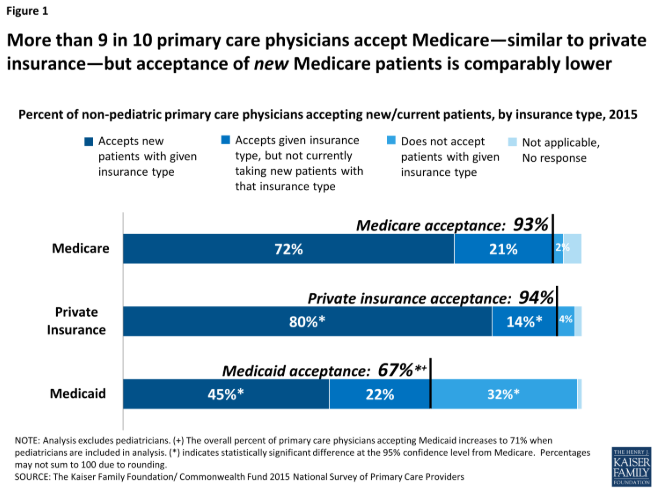
Important reassurance: Fully opted-out doctors are uncommon. KFF reported that about 1% of non-pediatric physicians formally opted out of Medicare in 2024, although the percentage is higher in some specialties such as psychiatry.
KFF
What About Medicare Supplement Plan G?
Medigap Plan G can be helpful if you run into Part B excess charges. A non-participating provider may charge up to 15% more than the Medicare-approved amount. Plan G is one of the Medicare Supplement plans that can cover those Part B excess charges, subject to Medicare’s rules and the policy terms.
This does not mean Plan G lets you see a doctor who has opted out of Medicare and have Medicare pay the bill. An opted-out doctor is a different situation. Medicare generally is not involved unless a limited exception applies.
What Should You Do Before Seeing a Doctor?
- Ask the doctor’s office: “Do you accept Original Medicare assignment?”
- Do not just ask: “Do you take Medicare?” That answer may not tell you whether they accept assignment.
- Check Medicare’s provider tool when possible, but confirm directly with the doctor’s billing office.
- If you have a Medicare Supplement, ask whether your plan covers Part B excess charges.
- If the doctor is opted out, ask for the private contract and fees in writing before treatment.
Trying to Keep Your Doctor?
If you are turning 65, leaving employer coverage, comparing Medicare Advantage with a Medicare Supplement, or trying to keep a particular doctor, this issue matters. Original Medicare with a Medicare Supplement often gives broader provider access than many Medicare Advantage networks, but you still want to confirm whether your doctor accepts Medicare assignment.
Frequently Asked Questions
What does Medicare assignment mean?
It means the provider accepts the Medicare-approved amount as full payment for covered services.
Can a doctor charge more than Medicare allows?
A non-participating provider may charge up to 15% above Medicare’s approved amount for certain services. A participating provider cannot bill you an excess charge for covered services.
Is an opted-out doctor the same as a non-participating doctor?
No. A non-participating doctor still works with Medicare in some situations. An opted-out doctor has left Medicare billing and usually uses a private contract.
Does Plan G cover Medicare excess charges?
Plan G can cover Medicare Part B excess charges. That is one reason people comparing Plan G and Plan N should understand how excess charges work.
Is this usually a big problem in Los Angeles?
In most routine situations, no. Many doctors who accept Medicare also accept assignment. The bigger issues tend to come up with certain specialists, concierge-style practices, psychiatrists, or doctors who have opted out of Medicare completely.


What does Medicare Assignment Mean?

Find Doctors and Hospitals that participate on Medicare’s Official Website
What is Concierge Medicine or Opt Out?
What does Medicare Assignment Mean?
- Medicare Assignment means that your doctor, provider, or supplier agrees (or is required by law) to accept the Medicare-approved amount as full payment for covered services.
- Medicare Assignment and Costs FACT Sheet pdf 10-19-23 CA Health Care Advocates HI Cap
- If your doctor, provider, or supplier accepts assignment:
- Your out-of-pocket costs may be less.
- They agree to charge you only the Medicare deductible and coinsurance amount and usually wait for Medicare to pay its share before asking you to pay your share.
- They have to submit your claim directly to Medicare and can’t charge you for submitting the claim.
- Non-participating providers haven’t signed an agreement to accept assignment for all Medicare-covered services, but they can still choose to accept assignment for individual services. These providers are called “non-participating.”
- Here’s what happens if your doctor, provider, or supplier doesn’t accept assignment:
- You might have to pay the entire charge at the time of service.
- Your doctor, provider, or supplier is supposed to submit a claim to Medicare for any Medicare-covered services they provide to you.
- If they don’t submit the Medicare claim Form
- If they don’t submit the Medicare claim Form
- They can charge you more than the Medicare-approved amount, but there’s a limit called “the limiting charge.”
- The provider can only charge you up to 15% over the amount that non-participating providers are paid.
- Non-participating providers are paid 95% of the fee schedule amount (Medicare Physician Fee Schedules (MPFS)) (How to Use the MPFS Lookup Tool) . Medicare.Gov Assignment *
- Note that Medi Gap plans will pay the excess charge
- Medicare Advantage – doesn’t really apply, as you have to use that Insurance Companies physicians list

Bibliography, Resources & Links
- Medicare.Gov Assignment Explanation
- See Opt Out – Concierge Rules below
- CA Health Care Advocates on assignment Fact Sheet
- Medicare Provider Finder
- Epoch Times – When MD no longer accepts Medicare – Patients left holding the bag.
- Kaiser Foundation – Primary Care MD’s accepting Medicare
- Our webpage on negotiated fees & surprise billing

💡 What an Excess Charge Is
If a doctor or provider accepts Medicare but does not accept Medicare “assignment,” they may bill more than the Medicare-approved amount for a service — up to 15% extra. This extra is called a Part B excess charge (sometimes also referred to as the limiting charge). (Humana)
Example:
-
Medicare “approved amount” for a visit: $200
-
Provider doesn’t accept assignment and charges full 15% excess:
→ Excess charge = $30
→ You would normally owe: Part B coinsurance (20% of $200 = $40) + $30 excess = $70 total out-of-pocket for that visit. (Humana)
📍 How Often It Happens in Los Angeles (and the U.S. Generally)
Here’s what data and industry info suggest:
🧑⚕️ Rare for Most Doctors
-
Most doctors accept Medicare assignment and do not bill excess charges — often cited as about 98% of physicians, meaning less than 2% of doctors bill excess charges. (MedigapSeminars)
-
Common specialties where excess billing is slightly more likely include:
-
Mental health/psychiatry
-
Certain surgical consultants or out-of-network specialists
(because they negotiate differently or don’t take assignment) — but it’s still a small percentage. (Reddit)
-
So in Los Angeles, too, the vast majority of clinicians (e.g., primary care, most specialists) accept Medicare assignment and won’t bill excess charges. If you see a non-participating provider, only that visit is at risk of an excess charge.
🩺 Common Scenarios Where You Might See an Excess Charge
1. Visiting a Specialist Who Doesn’t Accept Assignment
Some specialists in LA may accept Medicare but not assignment — e.g., some dermatologists, mental health professionals, or anesthesiologists at outpatient clinics.
In such a case, you could be billed up to 15% above Medicare’s approved rate for an outpatient service. (Humana)
Example:
A dermatologist procedure with a Medicare approved rate of $1,000 could have up to $150 extra added if the doctor bills excess.
2. Out-of-Network Diagnostic or Outpatient Procedures
Providers you didn’t choose (e.g., anesthesiologist in a hospital or imaging provider at a clinic) sometimes don’t take assignment — making excess charges possible. (Reddit)
3. Low-Utilization Services with Non-Participating Providers
If you see a provider infrequently who doesn’t take assignment, you might incur an excess charge — but still not very often, given most providers accept assignment. (MedigapSeminars)
💳 How Often a Medicare Plan G Pays for It
📌 Medigap Plan G covers Part B excess charges at 100%.
That means if a doctor bills an excess charge, Plan G will pay that extra amount — after your Medicare Part B deductible is met — so you would not pay the 15% yourself. (Humana)
So in a scenario like:
-
Provider bills 15% over Medicare approved amount
-
You have Medigap Plan G
→ Plan G pays those excess charges — you don’t. (Humana)
Even if that happens rarely, Plan G protects you from having any surprise out-of-pocket on excess charges.
🧠 Bottom Line: Likelihood + Plan G’s Protection
| Situation | Likelihood in LA | Plan G Coverage? |
|---|---|---|
| Primary care visit | Very low chance of excess charges | ✔ Covered |
| Specialist visit (who accepts assignment) | Very low | ✔ Covered |
| Specialist visit (non-participating) | Some chance | ✔ Covered |
| Outpatient diagnostic/consult | Occasional chance | ✔ Covered |
👉 Most doctors you see in LA will not bill excess charges — but if they do, Plan G will pay it for you.
📌 Tips to Avoid Excess Charges Altogether
-
Ask before your appointment whether the provider “accepts Medicare assignment.”
-
Use the Federal Medicare provider lookup tool to check assignment status.
-
Rarely, emergency or hospital-based providers may not accept assignment — Plan G still protects you. (Medicare)
If you want, I can also help estimate how much excess charges might cost annually for common services in Los Angeles (like office visits, imaging, or outpatient surgery).

Blue Shield of California Authorized Agent - Broker


Introduction to #MediGap
Publication 02110

- 2025 Official Medicare Guide to choosing a Medi Gap Policy # 02110
- MORE Information and Links
- Matrix - Spreadsheet of what Medicare Pays, Medi Gap pays and what little you pay
Certain doctors and other health care providers who don’t want to enroll in the Medicare program may “opt out” of Medicare. You can still see these providers, but they must enter into a private contract with you (unless you’re in need of emergency or urgently needed care).
Medicare won’t pay for any services you get under a private contract, so you’ll pay the provider’s entire charge out of your own pocket. You and your provider will set up your own payment terms through the private contract. Medicare and You * Medicare.Gov Assignment * Medicare.Gov Concierge *
Medicare.gov Rules on Concierge Care Fortune
Details on how to opt out of Medicare for MD’s – Assoc. of American Physicians & Surgeons – Note the rules on notifying patients
Tell me more about Concierge
Fees run around $1,200 to $5k/year. For this you get faster service, a closer relationship with your MD, more preventative care and house calls. Kiplinger.com * Wikipedia *
Most traditional concierge medicine physicians continue to accept insurance plans and government programs, and patient visits are billed in the traditional manner.
Insurance companies don’t pay for concierge services at this time—the retainer fee is paid out-of-pocket. But it’s not hard to imagine why insurance companies would like the idea—concierge physicians report less payout, fewer hospital admissions, and improved care to prevent chronic conditions, like hypertension, high cholesterol and diabetes, which are costly to treat. Insurance would be used for outside lab tests, X-rays, visits to specialists and hospitalizations. TheHealthJournals.com *
In DPC direct primary care, the doctor does not accept third party reimbursements, like Medicare. The membership fees paid by the patients cover basic visits, and some services are charged separately. PhysicianPractise.Com *
Where to find a Concierge MD?
Our FAQ’s
- So, does the patient pays a yearly concierge fee plus fees for all services? Medicare pays nothing?
- It’s not as simple as the question sounds. Depends if the MD opted out of Medicare as he’s a direct primary care doctor. Depends on what service you get and where. Say you just use Concierge for Preventative, but serious things use a Medicare doctor? In the contract in my very brief review, you’re only opting out of the services the Opt Out agreement coverage.
- Read the Opt Out agreement carefully.
- It’s not as simple as the question sounds. Depends if the MD opted out of Medicare as he’s a direct primary care doctor. Depends on what service you get and where. Say you just use Concierge for Preventative, but serious things use a Medicare doctor? In the contract in my very brief review, you’re only opting out of the services the Opt Out agreement coverage.
- Medicare Video – Physician Compare
- Blue Shield Statement Medi Gap uses ANY Medicare MD!
- Care Compare Video
- Video on how to use Medicare Provider Finder VIDEO

- Our Webpage on Medicare Assignment – Doctor Participating or Not?
- Compare Hospitals – Search Medicare.gov
- Medicare Guide to Choosing a Hospital Publication # 10181
- Hospital Readmission Penalty Look Up
- Long-Term Acute Care Hospital (LTACH) Clinical Guidelines – Oscar
- US News & World Report America’s Best Hospitals