
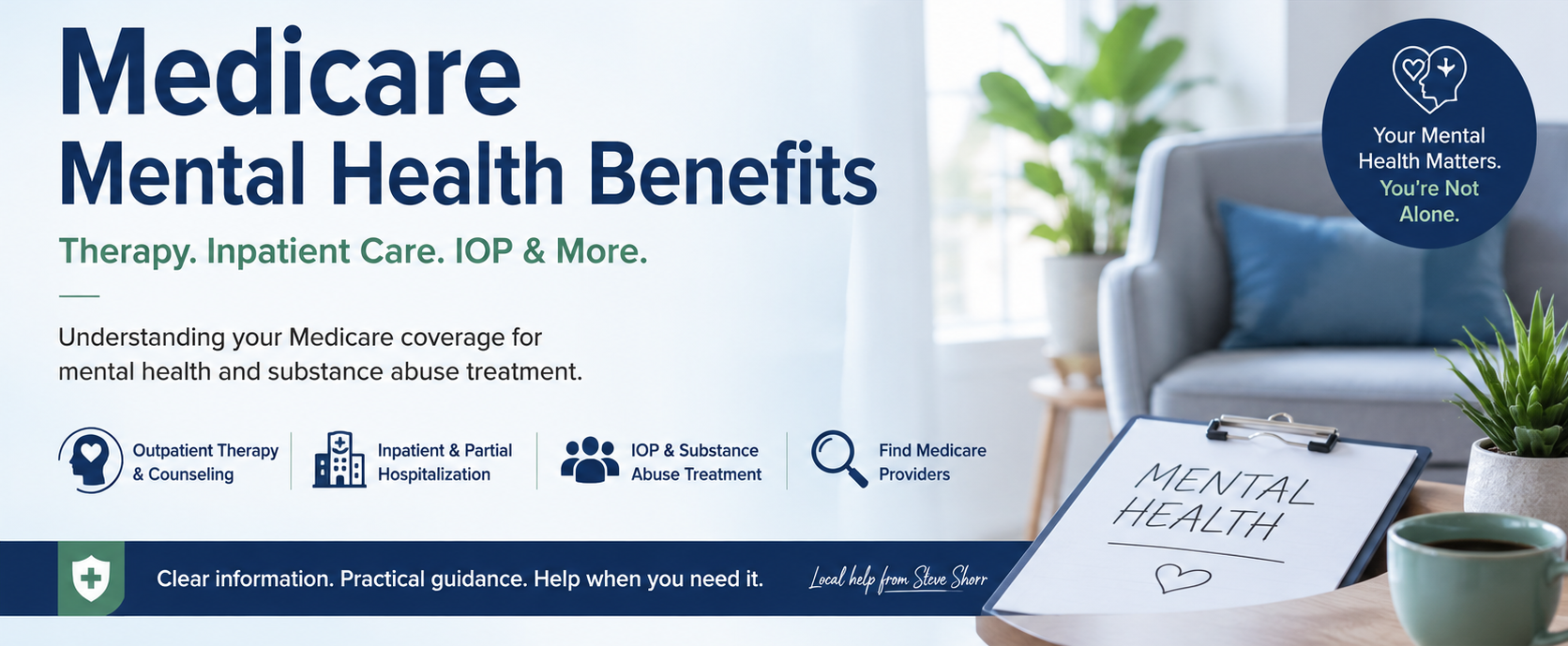
Medicare Mental Health Benefits
Medicare can cover mental health care — but the rules depend on where you receive treatment, what type of provider you use, and whether the care is inpatient, outpatient, partial hospitalization, or an intensive outpatient program.
This page is a plain-English starting point for Medicare beneficiaries and families trying to understand therapy, psychiatric care, depression screening, substance abuse treatment, and mental health provider access under Medicare.
- Official Medicare Outpatient Mental Health Coverage |
- Medicare Mental Health Benefits 10184 PDF
- Medicare Provider Finder
Outpatient mental health care under Medicare Part B
Medicare Part B generally covers outpatient mental health services when they are medically necessary and provided by Medicare-approved professionals. This may include individual therapy, group therapy, psychiatric evaluation, medication management, diagnostic testing, family counseling when it helps with treatment, and certain services related to substance use disorder treatment.
Medicare also recognizes several types of mental health professionals, including psychiatrists, clinical psychologists, clinical social workers, nurse practitioners, physician assistants, marriage and family therapists, and mental health counselors.
After the Part B deductible, you typically pay 20% of the Medicare-approved amount if the provider accepts Medicare assignment. If services are received in a hospital outpatient department, there may also be a facility copayment or coinsurance.
Read Medicare’s outpatient mental health rules
Inpatient mental health care under Medicare Part A
Medicare Part A may cover inpatient mental health care when you are formally admitted as an inpatient. This can be in a general hospital or a psychiatric hospital. However, if the care is in a psychiatric hospital, Medicare has a 190-day lifetime limit for inpatient psychiatric hospital services.
This is one reason it is important to understand whether care is being billed as inpatient hospital care, outpatient observation, partial hospitalization, or another level of care.
Read Medicare’s inpatient mental health rules
Partial hospitalization and intensive outpatient programs
Some people need more than weekly therapy, but do not need a full inpatient hospital stay. Medicare may cover partial hospitalization or intensive outpatient program services when the program meets Medicare requirements and the care is medically necessary.
These programs may be relevant for serious depression, anxiety, substance use disorder, or other behavioral health conditions where structured treatment is needed but 24-hour inpatient hospitalization is not required.
Substance abuse treatment and Medicare
Medicare mental health coverage can include services related to substance use disorder treatment. Depending on the facts, this may involve outpatient counseling, physician services, hospital-based treatment, partial hospitalization, intensive outpatient services, medications, or other covered care.
For California law, parity, medical necessity, and substance abuse treatment issues, see my related pages:
- Substance Abuse Treatment & SB 855
- Medical Necessity Clinical Guidelines & Substance Abuse Coverage
- California Mental Health Parity & SB 855
How to find a Medicare mental health provider
You can use Medicare’s official provider search tool to look for doctors, therapists, psychologists, psychiatrists, hospitals, and other Medicare-participating providers. If you have a Medicare Advantage plan, you should also check the plan’s own provider directory because network rules may apply.
You may also want to see my related page:
Related mental health pages on this website
- Autism — Essential Benefits & Health Coverage
- Resources — Mental Health
- Care Courts — Laura’s Law
- Conservatorships — LPS
- Jail & Prison Mental Health Services
- MLN Booklet Medicare & Mental Health
Need help sorting out Medicare coverage?
Medicare mental health benefits can be confusing because the answer may depend on Original Medicare, Medicare Advantage, provider participation, facility billing, prescription drug coverage, and whether the care is outpatient, inpatient, partial hospitalization, or intensive outpatient treatment.
If you are reviewing Medicare coverage, Medicare Supplement options, Medicare Advantage, or how mental health care fits into your overall insurance choices, I can help you look at the moving parts.


#Medicare & You - Mental Health
- Medicare & Mental Illness Publication # 10184
- Find therapists who accept Medicare Assignment
- Medicare Billing Etc Guidelines for Professionals
- Our Webpage on Medicare & Mental Health
- Mental Health
- Medicare.Gov on Mental Health
- EOC Evidence of Coverage - Plain English,
- Los Angeles Consumer Resources #Directory

- Los Angeles Times on low cost & free therapy alternatives
- NPR Mental Health & COVID
- Guide to Mental Health Benefits (The Mighty)
 Compliance Assistance Guide from DOL.Gov Health Benefits under Federal Law

- Mental Health Videos
- Veteran's Mental Health
- CMS Learning Aid for Mental Health Professionals
Medicare Part B Outpatient Mental Health
- Medicare Part B (Medical Insurance) covers mental health services and visits with:
- Psychiatrist or other doctor
- Clinical psychologist
- Clinical social worker
- Clinical nurse specialist
- Nurse practitioner
- Physician assistant
- NAMI’s List of Mental Health Professionals
- Mental Health America’s list
- Your therapist must accept Medicare Assignment
- Part B covers outpatient mental health services, including services that are usually provided outside a hospital, like in these settings:
- A doctor’s or other health care provider’s office
- A hospital outpatient department
- A community mental health center
- Part B also covers outpatient mental health services for treatment of inappropriate alcohol and drug use.
- Part B helps pay for these covered outpatient services:
- One depression screening per year. The screening must be done in a primary care doctor’s office or primary care clinic that can provide follow-up treatment and referrals.
- Individual and group psychotherapy with doctors or certain other licensed professionals allowed by the state where you get the services.
- Family counseling, if the main purpose is to help with your treatment.
- Testing to find out if you’re getting the services you need and if your current treatment is helping you.
- Psychiatric evaluation.
- Medication management.
- Certain prescription drugs that aren’t usually “self administered”(drugs you would normally take on your own), like some injections.
- Diagnostic tests.
- Partial hospitalization.
- A one-time “Welcome to Medicare” preventive visit. This visit includes a review of your potential risk factors for depression.
- A yearly “Wellness” visit. This is a good time to talk to your doctor or other health care provider about changes in your mental health so they can evaluate your changes year to year.
- Who’s eligible?
- All people with Part B are covered.
- Your costs in Original Medicare
- You pay nothing for your yearly depression screening if your doctor or health care provider accepts assignment.
- 20% of the In Original Medicare, this is the amount a doctor or supplier that accepts assignment can be paid. It may be less than the actual amount a doctor or supplier charges. Medicare pays part of this amount and you’re responsible for the difference.
- Medicare-approved amount for visits to a doctor or other
- The Part B The amount you must pay for health care or prescriptions before Original Medicare, your prescription drug plan, or your other insurance begins to pay.
- If you get your services in a hospital outpatient clinic or hospital outpatient department, you may have to pay an additional An amount you may be required to pay as your share of the cost for a medical service or supply, like a doctor’s visit, hospital outpatient visit, or prescription drug. A copayment is usually a set amount, rather than a percentage. For example, you might pay $10 or $20 for a doctor’s visit or prescription drug. See Medicare Mental Health Booklet * Medicare.Gov
- If you have a Medicare Advantage Plan – Check the Summary or EOC Evidence of Coverage for more benefits.
- Medicare Advantage Plans – Part C
- Sample EOC – Use Ctrl – F & Search for Mental Health MAPD plans must give at least the benefit you would get under Original Medicare
- See our webpages on
- Mental Health – ACA/Health Reform Mandated Essential Benefit
- Mental Health – Outpatient – Therapist – Medicare
- Resources – Mental Health – Conservatorship – FSP
- Organizing, Hoarding, & Cluttering
- Pre-Existing Conditions – ACA No more!
- Preventative Care – Wellness Visit – Medicare
- Corona Virus – How does Insurance Cover it? – Relief Programs
- Social Determinants of Health Togetherness – Loneliness
- Medicare Advantage
- SNP Special Needs Plans