
Organizing, Hoarding & Cluttering: Start Here
Do you—or someone you care about—have a clutter problem? The first step is not to judge or diagnose the person. Start by looking at how much of the home can still be used safely and whether possessions are causing distress, family conflict, health concerns, or problems with everyday activities.
Ordinary clutter, chronic disorganization, and hoarding disorder are not necessarily the same thing. Hoarding becomes more concerning when possessions prevent rooms from being used as intended and cause serious problems in daily life.
This page can help you compare real clutter examples, understand the different types of help available, locate therapists and professional organizers, and learn when health insurance may help pay for mental-health treatment.
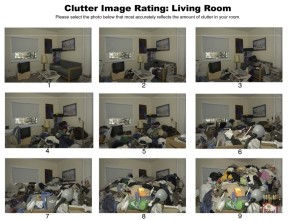
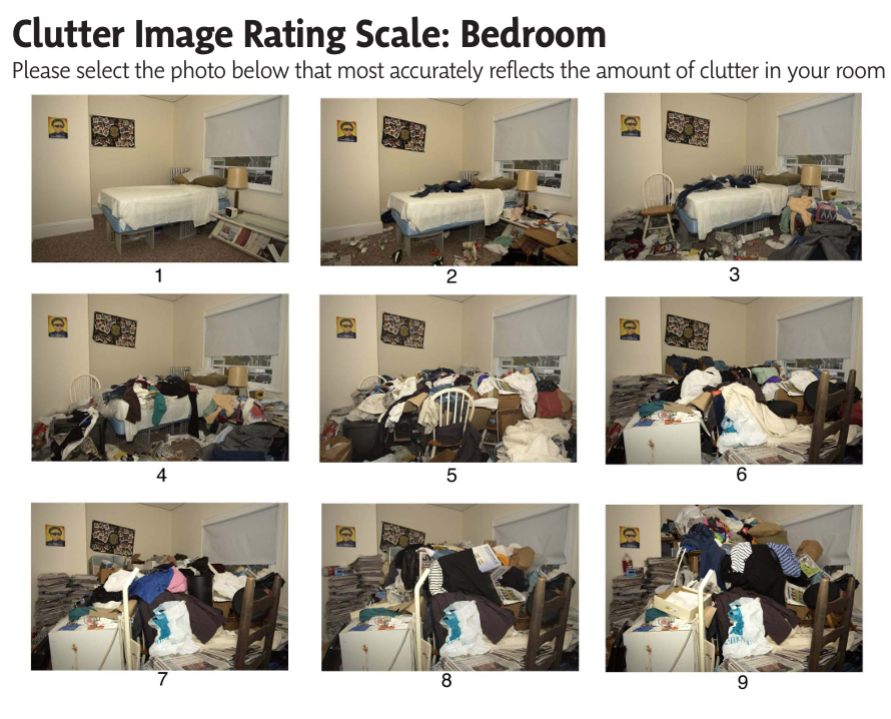
Compare Your Room with the 1–9 Clutter Image Rating Scale
The Clutter Image Rating Scale uses photographs of bedrooms, living rooms, and kitchens at nine different levels of clutter. Select the photograph that most closely resembles the room you are concerned about.
The International OCD Foundation explains that a room rated around picture 4 or higher may indicate a probable hoarding problem that deserves further assessment. The photograph alone does not diagnose hoarding disorder. A fuller assessment also considers difficulty discarding possessions, excessive acquiring, emotional distress, safety, and interference with everyday life.

Select the photograph that most closely resembles the room. This visual scale is a screening tool, not a medical diagnosis.
What Kind of Help May Be Appropriate?
Everyday clutter or a temporary backlog: Family assistance, a written clean-up plan, or a general professional organizer may be enough. Concentrate on one usable area at a time rather than attempting to reorganize the entire home in one day.
Chronic disorganization: Consider an organizer who has experience with chronic disorganization, ADHD, aging, or persistent difficulty managing possessions. The International OCD Foundation’s organizer directory includes professionals with specialized education.
Possible hoarding disorder: A mental-health professional with specific training in hoarding disorder may be appropriate. Treatment may address excessive acquiring, difficulty discarding, decision-making, emotional attachment to possessions, and the ability to use rooms safely. Cognitive behavioral therapy designed for hoarding disorder may include sorting and decision-making practice, skills training, and work within the home.
A team may sometimes be needed: A therapist, professional organizer, family member, physician, social worker, housing representative, or other professional may each address a different part of the problem.
Find the Right Kind of Help
There is no single professional who is right for every clutter or hoarding situation. Choose the resource that most closely matches the problem you are trying to solve.
- Find a hoarding-trained therapist: Search the International OCD Foundation Resource Directory for therapists, clinics, treatment programs, support groups, and other resources in your area.
- Find a specialized professional organizer: Review the IOCDF professional-organizer directory, which includes organizers with specialized education in hoarding and chronic disorganization.
- Help a family member: Read the IOCDF guidance on helping a loved one with hoarding disorder before arranging a cleanout or throwing away possessions.
- Find peer support: Clutterers Anonymous meetings are available in face-to-face, telephone, and virtual formats.
Does Health Insurance Cover Hoarding or Clutter Help?
Health insurance should not normally be expected to pay for ordinary housecleaning, junk removal, storage, home repairs, hauling services, or general professional organizing. Those services are generally not considered medical treatment.
Insurance may help pay for evaluation and medically necessary mental-health treatment when a person has hoarding disorder or another covered mental-health condition. Coverage depends on the type of insurance, the treatment requested, medical necessity, the provider network, authorization requirements, and the terms of the particular policy.
California’s mental-health coverage protections require state-regulated commercial health plans to cover medically necessary treatment of mental-health and substance-use disorders. That does not mean that every service connected with the condition is automatically covered.
Before treatment begins, check the plan’s Evidence of Coverage, behavioral-health provider directory, deductible, copayments, authorization rules, and whether the therapist participates in the plan. Learn more on our pages about mental-health and substance-use coverage and medical necessity and insurance appeals.
Email Steve About California Coverage
Set a Zoom Meeting
Steve Shorr Insurance provides insurance information and enrollment assistance. We do not diagnose hoarding disorder, provide therapy, or arrange housecleaning and organizing services.
Helping a Family Member Without Making Things Worse
Family members may understandably want to remove everything quickly. However, secretly discarding possessions or forcing a cleanout can cause intense distress, anger, and mistrust. It may clear the home temporarily without addressing the reasons the clutter accumulated.
A better starting point is usually to speak calmly, listen without ridicule, and identify a limited shared goal. Examples might include clearing an exit, making the stove usable, opening access for plumbing repairs, or creating a safe path to the bathroom.
- Do not call the person lazy, dirty, irrational, or irresponsible.
- Do not secretly discard possessions unless an immediate emergency requires action.
- Do focus first on health, fire, fall, sanitation, and emergency-access risks.
- Do involve the person in decisions whenever reasonably possible.
- Do consider assistance from a therapist familiar with hoarding disorder.
Read the International OCD Foundation’s complete guidance on helping a loved one with hoarding disorder.
Safety, Housing and When the Problem Cannot Wait
Even when a person is not ready to address all of the clutter, certain hazards should receive prompt attention. The immediate goal may be safety and access—not creating a perfectly organized home.
Warning signs include:
- Blocked doors, hallways, stairs, windows, or emergency exits.
- No safe path to the bed, bathroom, kitchen, electrical panel, or heating equipment.
- Falling objects, unstable piles, or an increased risk of trips and falls.
- Fire hazards, overloaded electrical outlets, or combustible material near heaters or stoves.
- Mold, spoiled food, pests, animal waste, or loss of working plumbing or electricity.
- Emergency personnel being unable to enter or move through the home.
- An inspection notice, lease violation, threatened eviction, or condemnation concern.
The International OCD Foundation provides additional information about housing and safety problems connected with hoarding disorder.
For an immediate fire, medical, or life-threatening emergency, call 911. For a mental-health or emotional crisis, call or text 988.
A Personal Connection: Jeanne Shorr and the Organizing Profession
This subject is personal to me. My mother, Jeanne Shorr, was one of the Los Angeles women involved in the beginning of what became the National Association of Professional Organizers.
According to the official NAPO history, professional organizers began meeting informally in Los Angeles in 1983. The association formally organized in 1985, and Jeanne Shorr was named among its five founding members.
The organization is now known as the National Association of Productivity & Organizing Professionals. Professional organizing can be valuable, but severe hoarding may also require mental-health treatment and specialized assistance.
Peer Support and Self-Help Resources
Clutterers Anonymous: Clutterers Anonymous is a clutter-focused 12-step fellowship. Visitors can review its “Am I a Clutterer?” questions and locate face-to-face, telephone, and virtual meetings.
AA Fourth Step worksheets: Many visitors have used our AA Twelve Steps and Fourth Step worksheets. These worksheets concern Alcoholics Anonymous and personal inventory. They are not a hoarding assessment and are not a substitute for professional mental-health treatment.
Related Help on This Website
#NAPO (National Assoc. of Professional Organizers)
Jeanne Shorr – Founder (Steve’s Mother)

- The National Association of Professional Organizers (NAPO), launched in 1983 by a small group of women in Los Angeles, now boasts 4,000 members who go into homes, help owners figure out what’s worth keeping and push them to purge the rest. See article in Time Magazine.
- 1983 – A group working as professional organizers began to meet informally in Los Angeles and decided to give their meetings a name, the Association of Professional Organizers (APO).
- 1985 – The association formalized by electing officers, who later that year would be named the founding members: Beverly Clower, Stephanie Culp, Ann Gambrell, Maxine Ordesky, and Jeanie Shorr. (Steve’s Mother)

Covered CA Certified Insurance Agent
Get Covered CA quotes and Direct Quotes too
InsuBuy International Medical Coverage –
Instant Quotes & Enrollment

Coverage for Travel - $50k Emergency under Medicare Medi Gap or MAPD Advantage may not be enough!
Dr. Oz Video De Clutter youtube.com

Big Bang Theory – Fortress of Shame VIDEO
More Videos
- Ted Talks – Jennifer discovered the ten-item wardrobe concept VIDEO while living in Paris with Madame Chic and her family. In this talk she shares her endearing story, tips on how you can make a ten-item wardrobe work for you, and why
- Story of Stuff
- Full Box Shredding
- Getting Rid of Mental Clutter – Not giving a F*** Ted Talks
- Facebook Video Tour – No clutter – He’s taken “my advice” what if all your stuff is lost or destroyed, what would you replace? If you wouldn’t replace it, get rid of it now. LA Times 11.24.2016 .
-
-
Challenges in Treating Hoarding in Midlife and Older Adults –
How to #clear clutter
Letting Go
- 34 + items to toss
- Why we obsess over clearing out stuff ‘Swedish death cleaning’ is less about sparing our loved ones from hassle, and more about how we’re remembered Read More LA Times
- marcandangel.com/5-things-you-should-know-about-letting-go/
- marcandangel.com/8-effective-ways-to-let-go-and-move-on/
- real homes.com/15-minute-declutter-method-for-any-room
- Can Occupational Therapy Address the Occupational Implications of Hoarding?
- ot everyday.ca/theres-help-for-hoarding
- Hoarding Scale – Activities of Daily Living
- Homeless and hoarding in L.A.: The special struggles and anxieties of unhoused people
- Depression and Cleaning: How to Tackle House Cleaning if You’re Struggling Everyday Health.com 1/2025
#Organization & Storage Solutions
- The Container Store
- home-storage-solutions-101.com/decluttering
- Get Organized Wizard.com
- social work today.com
- hope organizers.com
- Shredding
- professional shredding services.com so cal shred.com
- Speakers
- Resources & Links
- bustle.com/red-flags-to-watch-out-for-when-you-go-over-to-someones-place
- Face to Face Meetings LA Area
- Find a Hoarding Therapists in CA Psychology Today
#Resources & Information on OCD Obsessive Compulsive Disorder
- International OCD Foundation iocdf.org
- OCD Los Angeles
- renewed freedom center.com
- Anxiety Disorders
- OCD Support Group
- Gate Way OCD Institute – a new beginning 714.549.1030
- Los Angeles Body Dysmorphic Disorder & Body Image Clinic
https://milivcounty.gov/wp-content/uploads/Full-Clutter-Hoarding-Scale.pdf