

Do You Qualify for a Medicare Special Needs Plan (SNP)?
- Some Medicare beneficiaries qualify for a Medicare Special Needs Plan, also called an SNP. These are Medicare Advantage plans designed for people with certain chronic conditions, people who have both Medicare and Medi-Cal, or people who need institutional-level care.
- The goal is simple: the plan should fit your medical situation, your doctors, your prescriptions, and your county.
Do Any of These Apply to You?
| ✔ Diabetes | ✔ Chronic Heart Failure |
| ✔ End-Stage Renal Disease (ESRD) | ✔ Chronic Lung Disorders |
| ✔ Cardiovascular Disease | ✔ Dementia / Alzheimer’s |
| ✔ Medicare & Medi-Cal | ✔ Institutional or Nursing Facility Care |
Which Type of SNP Might Apply to You?
| Situation | Plan Type |
|---|---|
| Diabetes, heart failure, ESRD, or another qualifying chronic condition | C-SNP — Chronic Condition Special Needs Plan |
| You have both Medicare and Medi-Cal | D-SNP — Dual Eligible Special Needs Plan |
| You live in a nursing facility or require institutional-level care | I-SNP — Institutional Special Needs Plan |
- Frequently Asked Questions
- Why Consider a Special Needs Plan?
- Special Needs Plans are designed around the needs of specific populations. Depending on the plan and your location, benefits may include coordinated care, disease management programs, prescription drug coverage, transportation assistance, dental benefits, vision benefits, hearing benefits, over-the-counter allowances, and other services.
- For individuals with diabetes, a C-SNP may offer enhanced support for managing blood sugar, medications, physician coordination, diabetic supplies, and preventive care.
- Do I have to be insulin dependent to qualify for a diabetes SNP?
- Not necessarily. Eligibility depends on the plan and qualifying medical condition. Some plans may accept individuals diagnosed with diabetes regardless of insulin use.
- Can I keep my doctor?
- That depends on whether your physician, medical group, hospital, and specialists participate in the plan’s network. Always verify provider participation before enrolling.
- Does Medicare cover Continuous Glucose Monitors (CGMs)?
- Many Medicare beneficiaries qualify for CGM coverage when Medicare requirements are met. Coverage rules can change, so verify current eligibility before enrolling.
- What if I have both Medicare and Medi-Cal?
- You may qualify for a D-SNP designed specifically for dual eligible beneficiaries. These plans coordinate Medicare and Medi-Cal benefits and may simplify administration of your healthcare coverage.
- What if I have kidney failure or dialysis?
- If you have End-Stage Renal Disease, you may qualify for a Special Needs Plan designed around ESRD or dialysis care, depending on plan availability in your county.
- Is the “best” SNP always the one with the most extra benefits?
- No. Extra benefits are helpful, but the most important questions are whether your doctors are in-network, your prescriptions are covered, your medical group works with the plan, and the plan fits your condition.
- Not Sure If You Qualify?
- Every situation is different. Plan availability varies by county, provider network, prescription list, medical condition, and whether you also have Medi-Cal.
- If you would like help determining whether you qualify for a Special Needs Plan, comparing available plans, or checking whether your doctors participate, contact Steve Shorr for assistance.
We do not offer every plan available in your area. Any information we provide is limited to those plans we do offer in your area. Please contact Medicare.gov or 1-800-MEDICARE to get information on all your options.
Related Child & Sibling Pages
- Anthem Blue Cross Select HMO MediBlue Plus & SNP
- Blue Shield 65 Plus – Inspire HMO
- Dual SNP Medi Cal & Medicare Medi Medi
- Enrollment Dates for MAPD – Medicare Advantage & Part D Rx
- MAPD UnitedHealthCare
- SCAN MAPD Medicare Advantage
- SNP Special Needs Plans Medicare Advantage

Medicare MAPD Special Needs #SNP
& Chronic Condition – C-SNP Plan?
Definition:
To enroll in a Medicare SNPs you must have one of these specific diseases or characteristics. Medicare SNPs tailor their benefits, provider choices, and drug formularies to best meet your specific needs. Medicare.gov
There are three different types of SNPs:
- Chronic Condition SNP (C-SNP)
- Dual Eligible SNP (D-SNP) Medicare & Medi Cal
- Institutional SNP (I-SNP) cms.govSpecialNeedsPlans *
Medicare SNPs CMS.gov also see Special Needs Plans are subtype of Medicare Advantage Plan.
- Can I get my health care from any doctor, other health care provider, or hospital?
- You generally must get your care and services from doctors, other health care providers, or hospitals in the plan’s network (except emergency care, out-of-area urgent care, or out-of-area dialysis).
- Prescription drugs
- Yes. All SNPs must provide Medicare prescription drug coverage (Part D).
- Do I need to choose a primary care doctor?
- Generally, yes.
- Do I have to get a referral to see a specialist?
- In most cases, yes. Certain services, like yearly screening mammograms, don’t require a referral.
- What else do I need to know about this type of plan?
- A plan must limit membership to these groups:
- 1) people who live in certain institutions (like nursing homes) or who require nursing care at home, or
- 2) people who are eligible for both Medicare and Medicaid, or
- 3) people who have specific chronic or disabling conditions (like diabetes, End-Stage Renal Disease, HIV/AIDS, chronic heart failure, or dementia).
- Check with us, there might be additional rules [email protected]
- A plan must limit membership to these groups:
- Plans will coordinate the services and providers you need to help you stay healthy and follow doctors’ or other health care providers’ orders.
- Scan Foundation Summary on Chronic Care Act
- Forbes *
- Social Services
- UnitedHealthcare VIDEO on SNP Plans
- SNP plans may also offer home-delivered meals, transportation for nonmedical needs, pest control, indoor air quality equipment (e.g., air conditioner for someone with asthma), and minor home modifications (e.g., permanent ramps, widening of hallways or doorways to accommodate wheelchairs).
- Learn More
- Health IT.gov *
- Model of Care - HRA - Blue Shield Promise
- Modern Health Care *
- Oscar TeleHealth
- Medicare Managed Care Manual Chapter 16-B: Special Needs Plans
- Taking Stock of Medicare Advantage: Special Needs Plans Commonwealth Fund
- Our webpage on
- Proposed Rule 2023 to lower out of pocket Medicare Part D prescription drug costs and improve consumer protections, reduce disparities, and improve health equity in Medicare Advantage (MA) and Part D. CMS.Gov Fact Sheet *
-
SNP enrollment is year around.
- GA Beginners Guide to D SNP's
- Learn More
Chronic Conditions #List
- Chronic alcohol and other dependence
- Autoimmune disorders
- Cancer (excluding pre-cancer conditions)
- Cardiovascular disorders
- Chronic heart failure
- Dementia
- Diabetes mellitus
- End-stage liver disease
- End-Stage Renal Disease (ESRD) requiring dialysis (any mode of dialysis)
- Severe hematologic disorders
- HIV/AIDS
- Chronic lung disorders
- Chronic and disabling mental health conditions
- Neurologic disorders
- Stroke cms.gov/C-SNPs * Medicare – List of conditions for Special Needs Plans
Chronic care management services
- If you have 2 or more serious, chronic conditions (like arthritis, asthma, diabetes, hypertension, heart disease, osteoporosis, and other conditions) that are expected to last at least a year, Medicare may pay for a health care provider’s help to manage those conditions.
- This includes a comprehensive care plan that lists your health problems and goals,
- other health care providers, medications, community services you have and need, and
- other information about your health.
- It also explains the care you need and how your care will be coordinated.
- Your health care provider will ask you to sign an agreement to provide this service. If you agree, he or she will prepare the care plan,
- help you with medication management,
- provide 24/7 access for urgent care needs,
- give you support when you go from one health care setting to another,
- review your medicines and how you take them, and
- help you with other chronic care needs. You pay a monthly fee, and the Part B deductible and coinsurance apply. medicare.gov/10050-Medicare-and-You
Links & Resources on Chronic Care
- Nolo.Com
- CA Health Advocates.org
- CA Dept of Aging – HICAP (Local SHIP) – Center for Health Care Rights – 1-800-434-0222
- Medicare Managed Care Manual – SNP Chapter 16 B
- Wikipedia
- Management Services
- Aetna.com Model of Care
- The MOC provides the basic framework under which the SNP will meet the needs of each of its enrollees. The MOC is a vital quality improvement tool and integral component for ensuring that the unique needs of each enrollee are identified by the SNP and addressed through the plan’s care management practices. The MOC provides the foundation for promoting SNP quality, care management, and care coordination processes CMS.Gov *
- Cal Broker Magazine
- 10 Things to Know About Medicare Advantage Dual-Eligible Special Needs Plans (D-SNPs) KFF.org
- Taking Stock of Medicare Advantage: Special Needs Plans Commonwealth Fund
- Medicare Special Needs Plans CMS.gov
- What is a Special Needs Plan? CMS.gov
- Special Needs Plans Medicare.Gov
- Congress Considers Strategies To Improve Medicare And Medicaid Integration For Dual-Eligible Individuals Medicare & Medi Cal
#Understanding Medicare Advantage Plans (PDF) #12026

- Set a Zoom Meeting
- We can now do SOC Scope of Appointment, before the Meeting via a 3 minute recorded meeting 2 days before. AHIP Training Module 4 Page 14 *
- #Intake Form – Please email us [email protected] for the form – That way we can better analyze your situation to give you the answers to your needs and questions.
- Get Quotes, Full Information and Enroll
- MANDATED wording!: Think Advisor * ‘‘We do not offer every plan available in your area. Any information we provide is limited to those plans we do offer in your area. Please contact Medicare.gov or 1–800–MEDICARE to get information on all of your options.’’
- We disagree with the above wording, as we can use the same tools on Medicare.gov as they do!
- Visit our general webpage on Medicare Advantage for much more detail and information.
Diabetes C SNP
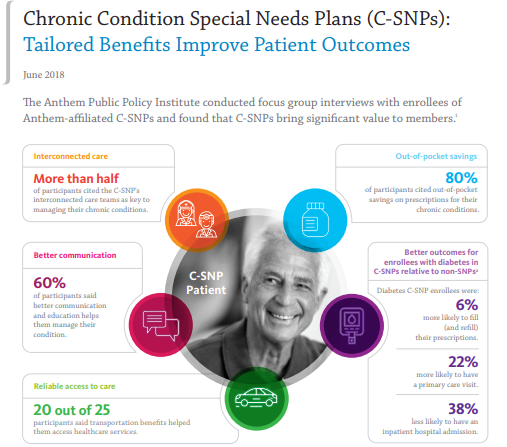
If you have Medicare and diabetes you can enroll in chronic condition special needs plans (C-SNPs). Surveys show members experience better outcomes than you would in regular Medicare Advantage (MA) plan. The survey used a claims-based approach to compare member outcomes on five clinical and utilization measures, Avalere found that enrollees in a diabetes-focused C-SNP were:
• 22 percent more likely to have a primary care visit,
• 10 percent more likely to receive appropriate diabetes testing,
• 38 percent less likely to have an inpatient hospital admission,
• 32 percent less likely to have a readmission, and
• 6 percent more likely to fill (and refill) a prescription for an antidiabetic medication.
These findings held true when controlling for expected differences in enrollees’ demographics and health status. The analysis suggests that C-SNPs can improve outcomes for beneficiaries with diabetes compared to non-SNPs. AnthemInc.com * Avalere.com *

Blue Cross Anthem Authorized Broker
- Instant quotes & #Enrollment for Individual & Family
- Employer Small Group Health Proposals - Quotes
- We’re here to help you with any enrollment, selection and service questions you might have. Anthem pays us to help you at no extra charge! Check out the brochures below and on either side.