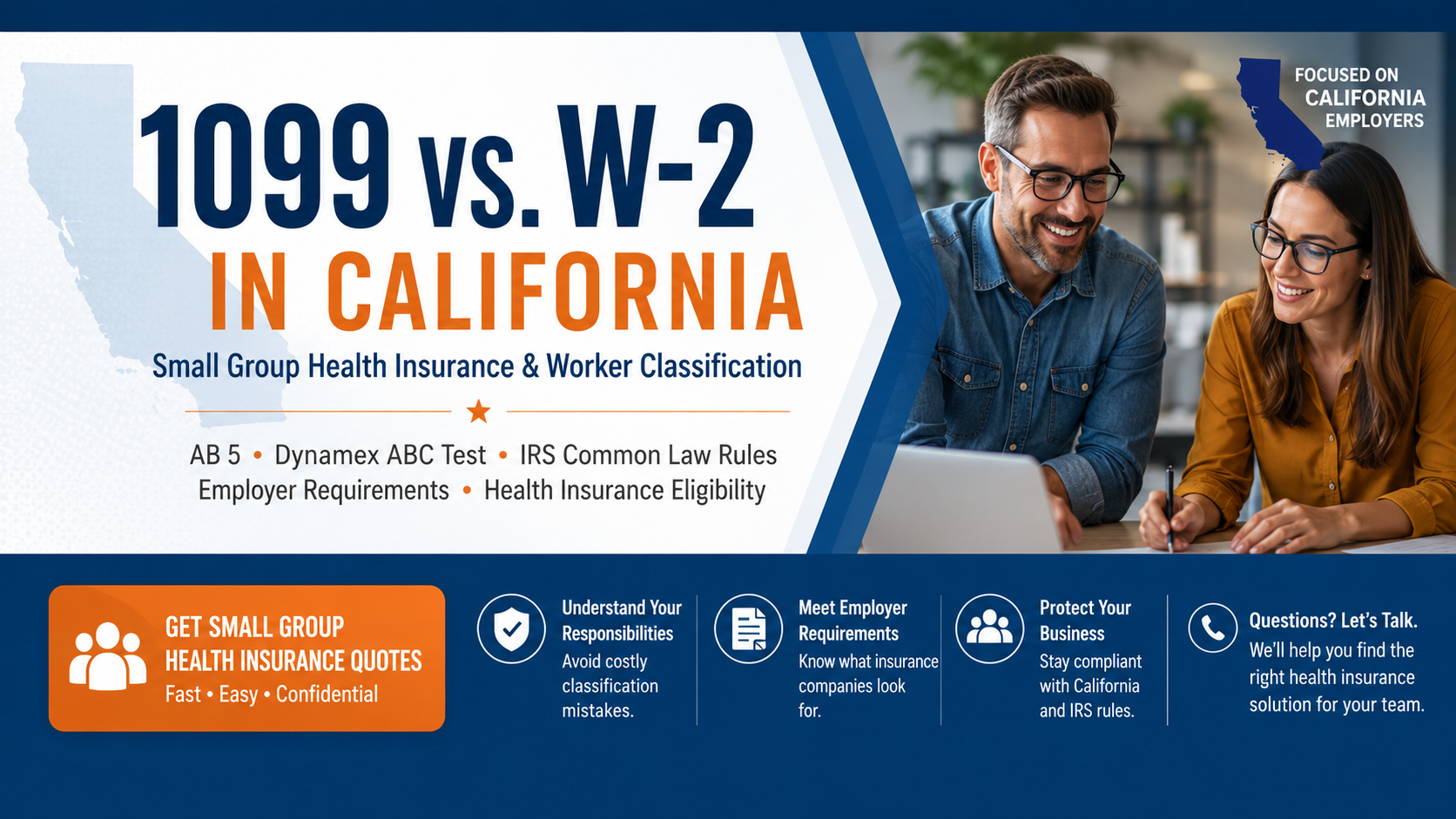
1099 Independent Contractor vs. W-2 Employee in California
Small Group Health Insurance, AB 5, Dynamex & Worker Classification
California employers often ask whether a worker is really a W-2 employee or a 1099 independent contractor. This matters for payroll, taxes, labor law, workers compensation, and small group health insurance eligibility.
In general, a true W-2 employee may be eligible for an employer group health plan. A 1099 independent contractor usually is not enrolled in the employer’s group health plan and may need to buy individual or family coverage instead.
Already a True Independent Contractor?
This page explains whether someone should be classified as a 1099 contractor or W-2 employee.
Once you know you are correctly self-employed, visit our Schedule C and Covered California income page to see how your net business income affects subsidies.
| Get Small Group Quotes | Schedule a Zoom Meeting | Email Steve |
Quick Answer
For California small group health insurance, the key question is usually not just “does the person work for me?” The practical question is: Do you have a bona fide employer-employee relationship with at least one eligible W-2 employee?
A sole proprietor, partner, business owner, spouse of the owner, or 1099 contractor may not be enough by themselves to qualify for small group coverage. Each insurance company may ask for proof such as payroll records, DE-9, DE-9C, wage reports, or other employer documents.
Important: I am an insurance broker, not a labor attorney or CPA. I can help explain how the insurance companies generally look at eligibility, but worker classification questions should also be reviewed with your payroll company, CPA, or employment attorney.
Why This Matters for Health Insurance
If you are trying to set up a California small group health plan, the insurance company will usually want to know who is an employee, who is an owner, and who is an independent contractor.
- Can a 1099 contractor enroll in my group health plan?
- Does my spouse count as an employee?
- Does the owner count as an employee?
- Can a one-person business get group health insurance?
- What payroll documents will the carrier require?
For more on group eligibility, see:
- California Employer Group Health Insurance
- Participation & Premium Contribution Requirements
- Documents to Show a Bona Fide Employer in Business
California AB 5 and the Dynamex ABC Test
California AB 5 put the Dynamex “ABC test” into California law for many worker classification issues. Under this test, a worker is generally presumed to be an employee unless the hiring business can show all three parts of the test are met.
| ABC Test | Plain English Question |
|---|---|
| A | Is the worker free from the control and direction of the hiring business? |
| B | Does the worker perform work outside the usual course of the hiring business? |
| C | Is the worker customarily engaged in an independent trade, occupation, or business of the same type? |
If the answer to one of these questions is “no,” the worker may need to be treated as an employee under California law, unless an exception applies.
- California Department of Industrial Relations: Independent Contractor FAQ
- California AB 5 Text
- Dynamex Operations West, Inc. v. Superior Court
IRS Common Law Employee Rules
For federal tax purposes, the IRS looks at the entire relationship between the business and the worker. The main issue is usually the degree of control and independence.
| IRS Category | What It Looks At |
|---|---|
| Behavioral Control | Who controls what work is done and how it is done? |
| Financial Control | Who controls pay, expenses, tools, profit, and loss? |
| Type of Relationship | Are there contracts, benefits, permanency, or employee-type treatment? |
- IRS: Independent Contractor or Employee
- IRS Form SS-8: Worker Status Determination
- IRS Publication 1779
Can a 1099 Contractor Be Covered by My Group Health Plan?
Usually, no. A 1099 independent contractor is normally not treated as an eligible employee for the employer’s group health plan. The contractor may need individual health insurance, Covered California coverage, Medicare, Medi-Cal, or another arrangement depending on their situation.
- Individual & Family Health Insurance
- Covered California MAGI Income Rules
- Self-Employed Health Insurance Deduction
- Schedule C Income and Covered California
What Proof Might a Carrier Ask For?
When applying for small group health insurance, the carrier may ask for proof that the business is real and that the people applying are eligible employees.
- DE-9 payroll tax report
- DE-9C employee wage listing
- Payroll records
- Business license or entity documents
- Owner/officer information
- Workers compensation information
- Carrier-specific employer forms
Uber, Lyft, Gig Workers and Proposition 22
Uber and Lyft drivers have special rules and programs that may not apply to ordinary small employers. Some rideshare drivers may receive a health care stipend under Proposition 22 rules, but that is different from being enrolled in a regular employer group health plan.
If you are a rideshare driver, your best health insurance option may depend on your income, household size, Medicare status, Medi-Cal eligibility, and whether you qualify for Covered California subsidies.
Frequently Asked Questions
- Can my spouse be my only employee for group health insurance?
- Usually, a spouse by themselves will not be enough to create a small group plan. Carrier rules can vary, so this should be reviewed before applying.
- Can a sole proprietor get small group health insurance?
- A sole proprietor may be able to have a small group plan if there is at least one eligible common-law employee other than the owner or spouse. If there are no employees, individual health insurance is usually the better starting point.
- Can an S-Corporation owner be on the group plan?
- Often yes, but the company may still need at least one eligible employee and must meet the carrier’s underwriting and eligibility rules.
- What if I misclassified someone as a 1099 contractor?
- Worker misclassification can create tax, labor law, workers compensation, wage and hour, and benefit issues. Speak with your CPA, payroll company, or employment attorney.
- Can Steve decide whether my worker is legally an employee?
- No. Steve can help explain how health insurance carriers usually review eligibility, but legal worker classification decisions should be made with qualified tax, payroll, or legal advisors.
Need Help With California Small Group Health Insurance?
If you are trying to set up a small group health plan and are not sure whether you have an eligible employee, send me the basic facts. I can help you understand what the insurance company is likely to ask for and what options may be available.
| Get Small Group Quotes | Schedule a Zoom Meeting | Email Steve |
Steve Shorr Insurance
California Health Insurance Broker since 1975
Email: [email protected]
Steve Shorr
Website Video #Introduction

All our Health plans are Guaranteed Issue with No Pre X Clause
Instant Quote & Subsidy #Calculation
There is No charge for our complementary services, we are paid by the Insurance Company.
- Our Quote Engine Takes all the complexity out of using pencil and paper to figure out the premiums per the Obamacare/ACA rules under CFR §1.36B-3 *
- We are authorized Brokers for Dental, Vision & Covered CA get instant quotes direct and in Covered CA with subsidy calculation for:
- Watch our 10 minute VIDEO that explains everything about getting a quote

Government Brochures
EDD California 2025 Employers Guide #DE44
- Forms & Publications EDD
- FORMS REQUIRED TO GIVE NEW EMPLOYEES
- More workplace protections in 2022 New laws will shield employee health, safety and wages, but some ‘job killer’ bills were axed Los Angeles Times
- Social Security Forms

https://web.archive.org/web/20260209200722/https://individuals.healthreformquotes.com/employer/employer/employee/govt-definitions-employee/
https://hbex.coveredca.com/toolkit/downloads/Subsidies_for_Strike_Lockout_Guide.pdf