
Medi-Cal for Older Adults and People With Disabilities
Compare the principal Medi-Cal eligibility programs available in California in 2026.
People who are age 65 or older, blind, or living with a disability may qualify for Medi-Cal in several different ways. The correct program depends on factors that may include:
- Age or disability status;
- Supplemental Security Income—SSI eligibility;
- Social Security Disability Insurance—SSDI benefits;
- Countable monthly income;
- Countable assets and property rules;
- Whether the person performs paid work while living with a disability;
- Whether the person already has Medicare in addition to Medi-Cal; and
- Allowable health-insurance premiums and medical expenses.
Being over one income limit does not necessarily mean that you are ineligible for Medi-Cal. You may qualify under another Medi-Cal category, receive Medi-Cal with a Share of Cost, or qualify for the 250% Working Disabled Program.
Important: This page primarily discusses people living at home or in the community. Nursing-home and long-term-care Medi-Cal have additional rules involving transfers, spouses, property and long-term-care eligibility. See our pages on qualifying for nursing-home Medi-Cal and Medi-Cal help for care at home and IHSS.
This page provides general educational information. Your county Medi-Cal eligibility office makes the final determination based on your complete circumstances and current program rules. See our Medi-Cal contact and county-help page.
Which Best Describes Your Situation?
- I receive Supplemental Security Income—SSI.
A person approved for SSI in California generally receives automatic full-scope Medi-Cal.
Learn about SSI and automatic Medi-Cal eligibility. - I receive SSDI rather than SSI.
SSDI is based primarily on the person’s work record and is not the same as SSI. Receiving SSDI does not automatically answer whether the person qualifies for Medi-Cal.
Learn how SSDI relates to Medicare, Medi-Cal and SSI. - My SSI stopped after I began receiving SSDI, DAC or another Social Security benefit.
Special Medi-Cal protections may apply under the Disabled Adult Child or Pickle Amendment rules.
Learn about DAC, the Pickle Amendment and keeping Medi-Cal. - My countable income is within the Aged & Disabled Federal Poverty Level limit.
You may qualify for full-scope Medi-Cal without a monthly Share of Cost. Continue through this page for the 2026 limits and general requirements. - My income is above the A&D FPL limit.
You may still qualify for Medi-Cal with a Share of Cost. Allowable insurance premiums, medical expenses or another eligibility category may lower or eliminate that Share of Cost. - I have a disability and perform some paid work.
Ask the county to evaluate your eligibility for the 250% Working Disabled Program. There is no minimum number of hours or minimum amount you must earn.
Learn about the 250% Working Disabled Program. - I already have Medicare.
Medicare and Medi-Cal can work together. Full Medi-Cal may help with Medicare premiums, deductibles and cost sharing.
Learn which program pays first. - I have Medi-Cal and health insurance through an employer.
The order in which the plans pay depends on the type of coverage and coordination-of-benefit rules.
Learn about Medi-Cal and employer insurance. - I am not sure which category applies.
Do not assume that the first income calculation or Share of Cost determination is the only possible result. Ask the county to evaluate every Medi-Cal category that could reasonably apply and issue a written Notice of Action.
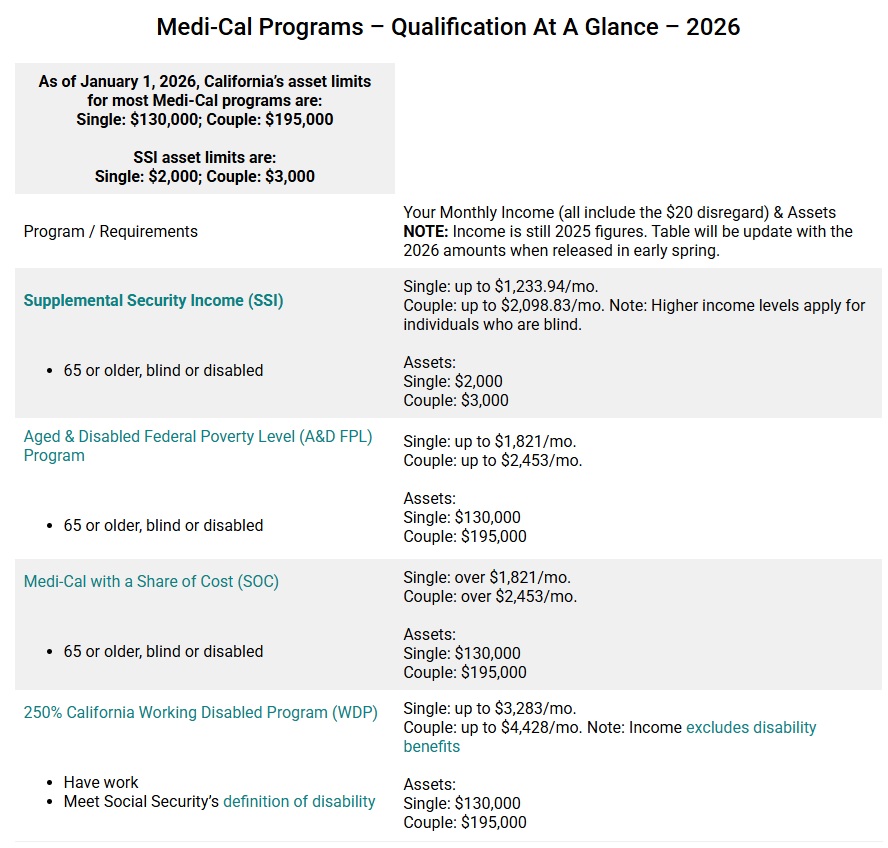
2026 Medi-Cal Qualification at a Glance
The following figures are preliminary screening amounts. They generally refer to countable income after applicable exclusions, not simply the total amount deposited into a bank account.
| Program | 2026 Income Screening Amount | Asset Limit |
|---|---|---|
| Supplemental Security Income—SSI Age 65 or older, blind or disabled |
Individual: up to $1,233.94 per month Couple: up to $2,098.83 per month Higher income rules may apply to an individual who is blind. |
Individual: $2,000 Couple: $3,000 |
|
Aged & Disabled Federal Poverty Level Program Scroll down to next module |
Individual: up to $1,856 per month Couple: up to $2,510 per month |
One person: $130,000 Two-person household: generally $195,000 |
| Medi-Cal With a Share of Cost Age 65 or older, blind or disabled |
Generally above $1,856 for an individual or $2,510 for a couple after applicable deductions | One person: $130,000 Two-person household: generally $195,000 |
| 250% Working Disabled Program Must meet the program’s disability and paid-work requirements |
Individual: up to approximately $3,345 per month Couple: up to approximately $4,530 per month Special income exclusions apply, including exclusions for qualifying disability income. |
One person: $130,000 Two-person household: generally $195,000 |
About these figures:
- The income amounts above include the generally applicable $20 income disregard used in the comparison chart.
- Different rules determine which income and household members count.
- SSI uses different asset and income rules from the other Medi-Cal programs shown.
- SSDI is not the same program as SSI and does not have the same financial eligibility test.
- Some married couples or registered domestic partners may qualify for higher protected asset allowances.
- The county makes the final eligibility determination.
More information on our website:
- Medi-Cal asset rules and 2027 changes
- Estimate a Medi-Cal Share of Cost
- MAGI Medi-Cal income limits for other eligibility groups
View the California Health Advocates 2026 qualification chart and explanation.
Aged & Disabled Federal Poverty Level Program
The Aged & Disabled Federal Poverty Level Program—often abbreviated as A&D FPL—provides full-scope Medi-Cal without a monthly Share of Cost for qualifying older adults and people with disabilities.
A person generally must meet the following requirements:
- Age or disability: Be age 65 or older, blind, or meet the disability standard used by the program.
- Countable income: For 2026, have countable monthly income of approximately $1,856 or less for an individual or $2,510 or less for a couple after applicable exclusions.
- Countable assets: Through June 30, 2027, the general limit is $130,000 for one person, plus $65,000 for each additional qualifying household member. See our Medi-Cal asset-limit page.
- Other eligibility requirements: Meet California residency and any other applicable Medi-Cal requirements.
Countable income is not always the same as gross income. Medi-Cal may exclude or deduct certain amounts before determining eligibility. Health-insurance premiums and other allowable deductions can affect the result.
A person who appears to be slightly over the income limit should not automatically assume that full Medi-Cal is unavailable. The person may instead qualify for:
- Medi-Cal with a Share of Cost;
- The 250% Working Disabled Program;
- SSI-linked Medi-Cal;
- DAC or Pickle Amendment Medi-Cal protection; or
- MAGI Medi-Cal, when the person meets the requirements for that eligibility category.
Ask the county to perform the complete Medi-Cal calculation and issue a written Notice of Action. See our pages on contacting Medi-Cal and appealing a Medi-Cal decision.
250% Working Disabled Program
The California 250% Working Disabled Program may allow a person with a disability who performs paid work to receive full Medi-Cal without a monthly Share of Cost.
- The monthly program premium is currently $0.
- The person must meet the disability standard used by the program.
- The person must perform legitimate work or services for pay.
- There is no minimum number of hours the person must work.
- There is no minimum amount the person must earn.
- Work may include self-employment, work for a friend or relative, pet care, tutoring, childcare, recycling bottles or cans, or another genuine paid task.
- Proof may include a pay stub, employer verification, receipts, invoices, payment records or other credible evidence of paid work.
- Special income rules exclude qualifying disability benefits and apply earned-income deductions before comparing income with the program limit.
- For 2026, the preliminary screening amount is approximately $3,345 per month for an individual or $4,530 for a couple when the $20 disregard is included.
Social Security benefit distinctions can matter:
- SSI is a needs-based program connected with automatic Medi-Cal in many California cases.
- SSDI is based primarily on the person’s work record.
- A person whose SSI stopped after receiving SSDI or DAC benefits should also review the DAC and Pickle Amendment protections.
Approval is not automatic. The person must meet the disability, work, income, asset and other Medi-Cal eligibility requirements. The county must approve the eligibility category.
Recommended next steps:
How Medicare and Medi-Cal Work Together
A person may have Medicare and Medi-Cal at the same time. This is commonly called being dually eligible or having Medi-Medi coverage.
- Medicare generally pays first for Medicare-covered services, while Medi-Cal generally pays second.
- Full Medi-Cal without a Share of Cost may help pay the Medicare Part B premium.
- Full Medi-Cal may also cover Medicare deductibles, coinsurance and copayments, subject to Medi-Cal payment rules.
- A person with Medicare and full Medi-Cal generally has protections against being improperly billed for Medicare cost sharing.
- Medicare Part D generally provides prescription-drug coverage for a person who has Medicare, while Medi-Cal may cover certain drugs or services excluded from Part D.
- Medi-Cal with an unmet Share of Cost does not provide all the same immediate assistance as full Medi-Cal without a Share of Cost.
- Medicare Savings Programs—QMB, SLMB and QI may help with Medicare costs even when a person does not qualify for full Medi-Cal.
Coverage choices may include:
- Original Medicare with Medi-Cal or a Medicare Advantage Dual Special Needs Plan—D-SNP.
- Medi-Cal managed care or fee-for-service Medi-Cal, depending on the person’s eligibility and county.
- Other forms of dual health coverage.
A person receiving SSDI may eventually become eligible for Medicare and may also qualify for Medi-Cal based on income and other program rules.
Always show health-care providers both your Medicare card and Medi-Cal Benefits Identification Card when both coverages are active.
Medi-Cal Asset Limits: Important 2026 and 2027 Changes
Through June 30, 2027:
- The general asset limit is $130,000 for one person.
- Add $65,000 for each additional qualifying household member, up to the program limit.
- A two-person household therefore generally has a $195,000 asset limit.
Beginning July 1, 2027:
- $21,000 for one person;
- $31,000 for two people; and
- An additional $1,550 for each additional qualifying household member, up to 10 people.
Examples of assets that may count include:
- Cash;
- Checking and savings accounts;
- Second homes or other real property;
- Additional vehicles; and
- Other investments or property subject to Medi-Cal’s asset rules.
Examples of property that may be excluded include:
- The primary home in which you live;
- One primary vehicle;
- Ordinary household belongings and clothing; and
- Certain retirement funds when the applicable requirements are met.
Not everyone living in the home necessarily counts as a household member for the asset limit. Some married couples and registered domestic partners may also qualify for higher protected amounts under spousal-impoverishment rules.
The rules may be different when long-term care is involved.
- Review our main Medi-Cal asset-limit and resource page.
- Learn about qualifying for nursing-home Medi-Cal.
- Learn about Medi-Cal long-term care and estate recovery.
- Learn about IHSS and programs that may help a person remain at home.
- dhcs.ca.gov/ medi-cal-changes
Do not transfer or give away property merely to qualify without obtaining qualified legal advice. Long-term-care Medi-Cal can involve separate transfer, estate-recovery and look-back rules.
How to Apply or Ask for a New Medi-Cal Evaluation
You may apply for Medi-Cal or submit documents online through BenefitsCal. A person who already has Medi-Cal may request a redetermination when income, insurance premiums, employment or another relevant circumstance changes.
Suggested steps:
- Gather income records. Include Social Security statements, pension statements, wage information, disability payments and other requested income verification.
- Identify whether the benefit is SSI or SSDI. See our explanations of SSI and SSDI.
- Gather asset records. Include bank statements and information about other property when the asset rules apply. See our asset-limit page.
- Gather insurance-premium records. Include Medicare, Medicare supplement, Medicare Advantage, Part D, dental, vision and other health-insurance premiums.
- Gather proof of paid work. This is especially important when requesting evaluation for the 250% Working Disabled Program.
- Upload the documents through BenefitsCal. Follow our proof and BenefitsCal upload instructions.
- Report the change. See our page on reporting changes that affect Medi-Cal eligibility or Share of Cost.
- Contact the county after uploading. Use our Medi-Cal county contact page and ask the eligibility worker to confirm that the documents were received.
- Name the program you want reviewed. For example, ask specifically for an A&D FPL, Share of Cost or Working Disabled Program evaluation.
- Ask the county to review all potentially applicable Medi-Cal categories.
- Request a written Notice of Action. The notice should show the county’s decision, effective date and hearing rights.
- Appeal when necessary. See our Medi-Cal and Share of Cost appeals page.
Do not rely only on a telephone conversation. Keep a written record of the request, documents, dates, county contacts and responses.
Find the Detailed Medi-Cal Page You Need
Aged, disabled and Social Security eligibility:
- SSI and automatic Medi-Cal eligibility
- SSDI, Medicare, Medi-Cal and SSI differences
- Disabled Adult Child benefits, Pickle Amendment and keeping Medi-Cal
- Disabled adult children remaining on a parent’s insurance after age 26
- 250% Working Disabled Program
Calculate, reduce or correct Share of Cost:
- Medi-Cal Share of Cost and qualifying insurance premiums
- Calculate an estimated Medi-Cal Share of Cost
- Medigap premiums and Share of Cost
- Use medical expenses to lower or meet Share of Cost
- Correct a Medi-Cal Share of Cost retroactively
- Frequently asked Share of Cost questions
Report changes, renew and appeal:
- Report income, household and insurance changes
- Annual renewal and Share of Cost redetermination
- Proof needed and BenefitsCal upload instructions
- Medi-Cal and Share of Cost appeals
- Medi-Cal county contacts and help
Medicare and other insurance:
- Medi-Cal and dual health coverage
- Medicare, Medi-Cal and which coverage pays first
- Medi-Medi and Dual Special Needs Plans
- Medicare Savings Programs and help paying the Part B premium
- Medi-Cal and employer insurance
- Medi-Cal managed care versus fee-for-service
Other Medi-Cal benefits and rules:
- Denti-Cal, Medi-Cal dental and vision benefits
- MAGI Medi-Cal income limits
- Medi-Cal resources and asset limits
- IHSS, home care and other community-based services
- Qualifying for nursing-home Medi-Cal
Important disclosure: Steve Shorr Insurance provides general educational and insurance information. Medi-Cal eligibility and Share of Cost decisions are made by the county. We are not the county Medi-Cal office, an attorney, accountant or government agency. There is generally no insurance-agent compensation for assisting with Medi-Cal eligibility questions.
Child & Sibling Pages

- Share of Cost – Eliminate with Dental Insurance Premiums
- SSI – Supplemental Security Benefits – Automatic Medi Cal
- Aged and Disabled Federal Poverty Level Program
- Share of Cost – Eliminate with Dental Insurance Premiums
- SSI – Supplemental Security Benefits – Automatic Medi Cal
- Denti Cal Medi Cal Dental & Vision
- Dual Coverage? Medi Cal?
- MAGI Medi Cal Income Limits
- Medi Cal Report Changes
- Medi Cal Contact Help
- Medi Cal Resources Asset Limits

Aged, Blind & Disabled Medi-Cal Program
Full-Scope Medi–Cal Health Benefits global
- See the My Medi Cal brochure for details & Benefits
- The Aged and/or Disabled Federal Poverty Level Program (See Income Chart) (A&D FPL) serves individuals aged 65 and older, and persons with disabilities.
- To qualify for this program, individuals Must meet all of the following three criteria:
- Be aged (65+) or
- disabled (meet Social Security’s definition of disability, even if your disability is blindness).
- If you are on SSI you get - Automatic Qualification for Medi Cal
- 2026 Asset Limits are back Learn More our webpage
- Worksheets for Determining Eligibility Under the Aged & Disabled Federal Poverty Level (A&D FPL) Medi-Cal Program Disability Rights *
- Qualifications at a Glance 2026 Cal Health Care Advocates.com
Resources & Links
- CANHR.org - Fact Sheet
- CA Health Care Advocates
- Kaiser Foundation
- Does Integrating Medicare and Medicaid Improve Care for Dual Eligibles?
- DHCS.CA.Gov
- Disability Benefits 101
- BenefitsCal online enrollment
-
Medicare And Disabilities

Links & Resources
- Main Webpage on Medicare & Enrollment
- Publication 524 (2023), Credit for the Elderly or the Disabled IRS.Gov *
- Publication 907 (2024), Tax Highlights for Persons With Disabilities IRS.gov *
- Publication 554 (2024), Tax Guide for Seniors IRS.Gov
- Negative MAGI Income Carry Forward Loss Our website
- The Health Consumer Alliance (HCA) is a statewide partnership that offers Free Over the Phone or In-Person Assistance to help California residents struggling to get or maintain health coverage and resolve problems with their plans.
- Disability Rights California (DRC) defends and improves the rights of Californians who have disabilities.
- Big change in Medi-Cal rules opens the door to more seniors
- CA Health Advocates – Medi-Cal for People who have Medicare
- CANHR.org * Aged & Disabled
- Disability Benefits 101
- Orange County Social Services Agency
- Chart – MAGI and NON-MAGI Qualification for Medi-Cal
- See also our site on Medi-Medi – both Medi-Cal and Medicare
- Insure Me Kevin.com – Friendly Competitor
- How to Report Income Change
- MC 239 Denial of Benefits
- Medi-Cal Eligibilty Procedures Manual Article 22 Disability 179 pages
- Medically Needy Program
- Program for All Inclusive Care For The Elderly
- Welfare & Instituions Code General Provisions [14000 – 14042]